










































Culturally Antagonistic Memes and the Zika Virus: An Experimental Test
Yale University Law School (Kahan); University of Pennsylvania (Jamieson); Annenberg Public Policy Center (Landrum, Winneg)
"[T]he most effective way to protect the science communication environment from culturally antagonistic memes is for government and other professional risk communicators to intervene early on in the career of the public's affective assessment of a putative risk source..."
Experimental results involving perceptions of the risk of the Zika virus among a general sample of 400 United States (US) subjects are used here to present a model that adds the phenomenon of culturally antagonistic memes: "ideas and practices that enjoy wide circulation and arouse self-reinforcing forms of attention as well as spontaneous adaptation and elaboration". The accounts in question feature two dynamics: the affect heuristic, which emphasises the impact of visceral feelings on information processing; and the cultural cognition thesis, which describes the tendency of individuals to form beliefs that reflect and reinforce their group commitments. The defect of which the authors are critical is the failure of these two dynamics, when combined, to explain the peculiar selectivity of public risk controversies: Despite their intensity and disruptiveness, such controversies occur less frequently than the affect heuristic and the cultural cognition thesis seem to predict. To account for this aspect of public risk perceptions, the paper argues that antagonistic memes transform affect and cultural cognition from consensus-generating, truth-convergent influences on information processing into conflictual, identity-protective ones. The paper found that members of the US population who were not polarised when exposed to neutral information formed culturally polarised affective reactions when exposed to information that was pervaded with antagonistic memes linking Zika to global warming; when exposed to comparable information linking Zika to unlawful immigration, the opposed affective stances of the subjects flipped in direction. Normative and prescriptive implications of these results for risk communication efforts going forward are discussed.
As the authors explain, the landscape of public risk perceptions is dominated by two opposing features: pockets of cultural polarisation on a very small number of putative hazards and the absence of conflict over a vast expanse of the same. Variance in cultural conflict across and within societies highlights the dissonance of the juxtaposition. For example, at the very time the US general public was rebelling against universal administration of a vaccine to protect adolescent school girls from the human papilloma virus (HPV), a sexually transmitted infection (STI) that causes cancer, they were placidly assenting to mandatory vaccination of the same girls to protect them from hepatitis-b, another cancer-causing STI. One might assume that how people feel about a potential source of danger (e.g., a gun) reflects their weighing of its perceived costs and benefits. The affect heuristic, however, stands this view on its head. In the main, emotional appraisals aren't a consequence of the significance people give to information about societal risks; rather they are the source of it, shaping the effect they assign to information on its potential consequences. The cultural cognition thesis suggests that group values invest objects (e.g., guns), actions (e.g., the termination of a pregnancy), or states of affairs (e.g., industrialisation) with social meanings the valence of which determines whether group members' affective appraisals are feelings are positive or negative. When groups attach opposing meanings to one and the same risk source, they will form opposingly valenced affective orientations, and thus opposingly valenced information-processing biases, toward it.
The authors call the conception of how the affect heuristic and cultural cognition fit together the AH-CCT Model. In short, "[c]ultural cognition supplies individuals with the psychic incentive necessary to immerse themselves in a rich source of expertise prototypes - the ones latent in the interactions of their cultural groups. The affect heuristic, on this account, is what makes the sort of tacit knowledge acquired in this way capable of suppling [sic] orienting guidance: by summoning it when the occasion is apt, and by motivating action consistent with it." The incompleteness of this conception of AH-CCT is this: what now needs to be explained is why diverse groups don't always converge (as in the vaccination example, above). The missing feature, according to the authors, is memes. A small subset of these sorts self-replicating ideas and practices, the ones they call "culturally antagonistic memes", refer to "highly evocative, highly inflammatory argumentative tropes used by members of one group to stigmatize another". They explain that, "[b]y fusing contending positions on a risk or like facts to opposing group identities, antagonistic memes effectively transform positions on them into badges of membership in, and loyalty to, competing groups. Because this state of affairs pits opposing groups' knowledge-certification systems against one another, the forms of information-processing associated with cultural cognition and the affect heuristic will under these conditions necessarily lose their power to generate truth-convergent forms of consensus across them."
To put these ideas into a concrete context, the authors return to the example of the HPV vaccine, whose path to public awareness was "treacherous. Seeking to establish a dominant position in the market before the approval of a competing shot, the manufacturer of the HPV vaccine orchestrated a nationwide campaign to establish immunization mandates by statutes enacted by state legislatures. What was normally a routine, nonpolitical decision - the administrative updating of states' mandatory-vaccination immunization schedules - thus became a high-profile, highly partisan dispute. People became acquainted with the vaccine not during visits to their pediatricians' office but while viewing Fox News, MSNBC, and other political news outlets....These media stories and resulting social media reaction were replete with what we are referring to as 'culturally antagonistic memes'."
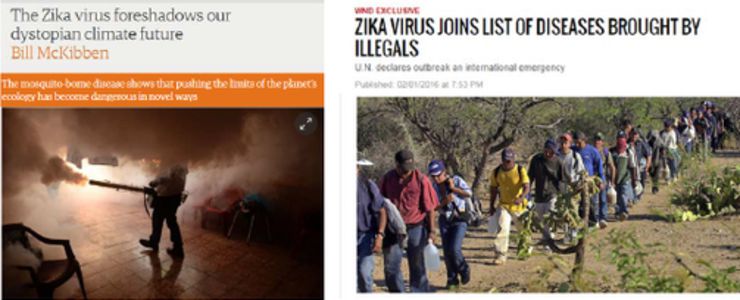
In the case of Zika, there has been "a steady accumulation of communications tying the Zika health threat to already culturally charged issues....The voice of public health officials furnishing the public with precautionary advice is only one in a chorus, whose other members include a collection of advocacy groups all seeking to leverage public anxiety over Zika into greater attention to their special cause. Among these are anti-immigrant groups. These actors suggest that the spread of Zika is likely to be accelerated by undocumented aliens as well as lawful immigrants from Zika-affected regions [see image above]....Climate change advocates have also latched onto Zika....'The Republicans are in denial about climate change, but in the real world, we can feel it....It's also an invitation for breeding mosquitoes and putting Americans at risk all across the United States' (Johnson 2016)."
The subjects in the study were assigned to one of three conditions: "Public Health", "Immigration", and "Global Warming". Subjects in all three read a news story on Zika public health risks. Patterned on a Centers for Disease Control and Prevention (CDC) advisory (2016), the stories presented identical, true information on Zika. The lead and introductory material in the Global Warming and Immigrant condition versions were patterned on real communications linking the spread of Zika to climate change and illegal immigration. Subjects' cultural outlooks were measured with the Cultural Cognition Worldview scales (Decision Making Individual Differences Inventory 2011), which use a 2-dimensional framework to characterise preferences about how society and other groups should be organised. One dimension, "hierarchy-egalitarianism", assesses attitudes toward social stratification in status and roles (e.g., "We need to dramatically reduce inequalities between the rich and the poor, whites and people of color, and men and women"). The other, "individualism-communitarianism", assesses attitudes toward the relative prerogatives and obligations of individuals, on the one hand, and those of collectivities, on the other (e.g., "The government interferes far too much in our everyday lives").
The paper explores in depth the researchers' hypotheses, as well as the results of the study and its implications. The following excerpt offers an idea of the practical ramifications of their findings for communicators:
"The prescriptive implications of our study, we believe, are both patently obvious and painfully obscure. What's obvious, then, is that actors in a position to do so should combat the emergence of antagonistic memes....Government agencies and other risk communicators are not in a position to prohibit behavior generative of antagonistic memes, certainly. But they are in a position to boost the immunity of the body politic to the impact of them.
As we have emphasized, the AH-CCT Model does not naturally lead to polarization. On the contrary, under the Model diverse citizens ordinarily converge on the best available evidence as a result of their immersion in group interactions that feature the opinions and behavior of group members situated to recognize valid scientific information. The AH-CCT Model predicts cultural division only if antagonistic memes take root, fusing positions on risk to opposing group identities.
....The affect heuristic counsels that individuals will conform information to their affective appraisals. Thus, where culturally uniform affective appraisals are already deep and settled, one can expect the public to be relatively unaffected by communications that contain the sorts of argumentative tropes that can evolve into antagonistic memes. Such appraisals, the AH-CCT Model implies, are formed in the context of relatively insular interactions among individuals who share basic cultural outlooks. Accordingly, professional risk communicators stand a reasonable chance in beating antagonistic-meme-generating communications to the punch - or in turning such punches into at best glancing blows - if they seed these affect-shaping affinity groups with the sorts of information likely to align their members' sensibilities with the best available scientific evidence.
This is a recommendation that is admittedly general. But it can still furnish guidance, in the form of an injunction to act decisively and quickly in a case like that of the Zika virus, where evidence shows that the public's sensibilities remain largely unformed. It can also furnish the basis for a research program that focuses on formulating and testing hypotheses that can help validate such a prescription and sharpen it into progressively more determinate directives....
In the course of exploring a more general theory, we presented evidence that the public's comprehension of the best available evidence on a particular public health threat - the spread of the Zika virus - is at risk of being compromised by a distinctive science communication pathology. The infectious agent of this pathology consists in culturally antagonistic memes fabricated and propagated by advocates seeking to cash in on the public fear of Zika by bundling it with rhetoric calculated to excite contempt for those who oppose them on culturally charged issues like illegal immigration and climate change. When exposed to communications incorporating such rhetoric, culturally diverse study subjects formed polarizing affective reactions that in turn degraded their capacity to make sense of valid public health information.
Obviously, we don't know whether what we observed in the lab will occur outside of it. But we believe that the best way to reduce the risk of this outcome is to recognize that the proliferation of the sorts of rhetorical opportunism featured in this study is a public health threat in its own rights [sic]. Public health agencies and individual public health professionals; professional health communicators and science journalists; responsible advocacy groups and ordinary citizens who support the causes being irresponsibly advanced by these means - all should oppose such forms of discourse..."
Kahan, Dan M., Jamieson, Kathleen Hall, Landrum, Asheley R., and Winneg, Kenneth, "Culturally Antagonistic Memes and the Zika Virus: An Experimental Test" (July 18, 2016). Annenberg Public Policy Center Working Paper No. 3; Yale Law & Economics Research Paper No. 554. (As of November 2016, this paper is in press at the Journal of Risk Research.) Available at SSRN: http://ssrn.com/abstract=2811294 - sourced from Cultural Cognition Project at Yale Law School website, August 5 2016.
- Log in to post comments