










































Dabanga
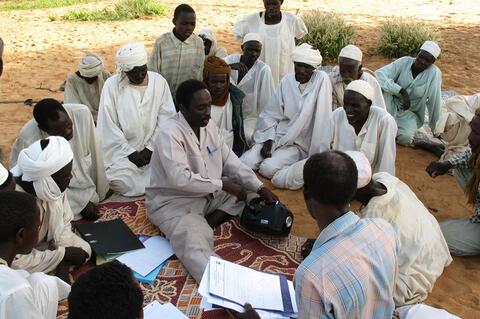
Dabanga is an independent Sudanese news and information broadcaster. Founded in 2008 to report on the Darfur crisis, Dabanga has expanded to provide coverage of the country's issues more broadly. Via shortwave radio, satellite television, and online platforms, Dabanga reaches a wide and diverse audience. The station has a particular strength in serving marginalised and hard-to-reach communities through its reporting on civil war, health epidemics, and human rights abuses. It is the belief of Dabanga that representation of issues concerning minorities in the media can help to foster information exchange, understanding, and - eventually - peace in Sudan.
Dabanga broadcasts 90 minutes every day in Arabic through shortwave radio (for listening details, click here). In addition to reporting on the latest news, the station offers feature programmes on democracy, health issues including COVID-19, transitional justice, and programming designed for specific audiences, such as refugees and internally displaced persons (From the Camps), youth (Youth Issues) and women (Kandaka), which gives different groups throughout the country the space to express themselves and be heard in the media. Radio programmes are also broadcast via TV satellite and published on Soundcloud in order to reach a diverse audience, including diaspora. Written in Arabic and English, articles are published daily on Radio Dabanga's website, Facebook page, Twitter feed, and via WhatsApp groups. Dabanga's cartoons are an additional way in which the station portrays daily news and engages with its audience.
In 2019, the "people's revolution" brought about the end to the repressive 30-year al-Bashir-led regime. Since then, with Sudan on a (fragile) path to democracy, Dabanga is committed to serving as a vital information and communication loop between citizens and those in power. Dabanga's programming is focused on educating and informing people about democracy, providing a space for informed debate, and holding those in power to account.
Exiled by Sudan's former regime, Dabanga was set up in Amsterdam, the Netherlands, with operational support from Free Press Unlimited. Dabanga has survived a number of government efforts to take its shortwave radio and TV satellite broadcasts off-air, including attempts at jamming and prosecution of reporters. Because it was too dangerous to work from Sudan, the founders of Dabanga left their homes to settle in the Netherlands. Operating the newsroom remotely has afforded Dabanga freedom, allowing editors to communicate with a vast network of Sudanese sources, stringers, and WhatsApp tipoffs to collect, verify, and report the news. Via shortwave radio, Dabanga is able to broadcast back into Sudan without risk of being shut down.
Post-revolution, Dabanga is transitioning back to Sudan - growing its team of Sudan-based reporters and stringers to offer grassroots media coverage of social, economic, and political issues. Formerly exiled Dabanga staff have also been able to return to Sudan - many for the first time in more than a decade. However, repressive elements of the former regime have not disappeared, and security risks remain. Dabanga will continue to adapt to the unfolding situation, while maintaining its commitment to broadcasting independent and accurate news.
Independent Media, Conflict, Health, Gender, Rights
Dabanga was founded 2008 by a coalition of Sudanese journalists, a number of international non-governmental organisations (NGOs), and the movers behind the Dutch campaign 'Tot Zover Darfur', including Stichting Vluchteling, Pax for Peace, and Stichting Doen. Since its naissance, Dabanga has functioned under the operational and financial support of Free Press Unlimited (formerly Press Now), a Dutch NGO promoting press freedom in countries where freedom of expression in the media is limited.
Sometimes written "damanga" or "dabunga", a dabanga is a large storage vessel made of a mixture of clay, water, and dried grass that is used by Sudanese farmers to preserve crops, such as corn and grain, to keep them from spoiling. These provisions can be lifesaving rations in the event of a famine. In addition, farmers sometimes hide their money or other valuables in the bottom.
United Nations Educational, Scientific and Cultural Organization (UNESCO) data indicate that the illiteracy rate for people above 15 years in Sudan is approximately 60%. Only around 14 million of the 42 million inhabitants of Sudan have access to the internet, and both the Sudanese government and the militia that overthrew the government shut down the internet multiple times when clashes with protesters turned bloody.
Thus, radio is in many cases the only type of media that can overcome the obstacles people in Sudan face to accessing information. The broadcasts from Dabanga reach the whole country via shortwave radio frequencies from undisclosed locations. This allows the radio station to avoid government censorship and provide independent news to people in even the most remote areas of Sudan without disruptions.
On a daily basis, Dabanga reaches roughly: 2.3 million people through shortwave radio; 1 million through satellite television; 460,000 followers on Facebook; 30,000 followers on Twitter; and audiences via WhatsApp and the bilingual Dabanga website.
Dabanga description on the Free Press Unlimited website, Wikipedia, Radio Dabanga website, and Centre for Innovation website - all accessed on December 5 2019 and September 21 2021; and emails from Julia Herzog and Laura McDowell to The Communication Initiative on December 9 2019 and September 21 2021, respectively. Image credit: Dabanga
- Log in to post comments