










































Dimensions of Misinformation About the HPV Vaccine on Instagram: Content and Network Analysis of Social Media Characteristics
Drexel University (Massey, Kearney, Hauer, Koku); Thomas Jefferson University (Selvan, Leader)
"Communication strategies that only leverage conventional health experts and authorities are ill-equipped to address misinformation on social media."
In recent years, the safety and efficacy of vaccines in general and the human papillomavirus (HPV) vaccine specifically have come under attack, particularly through the spread of misinformation on social media. In 2016, the National HPV Vaccination Roundtable identified social media as a priority tool for strengthening vaccine confidence and increasing HPV vaccination rates in the United States (US), and the National Institutes of Health (NIH) has underscored its support for digital health behaviour research. Grounded in the conviction that addressing misinformation on social media requires a proactive approach, this analysis sought to characterise pro- and anti-HPV vaccine networks on Instagram and to describe misinformation within the anti-HPV vaccine network.
From April 2018 to December 2018, the researchers collected publicly available English-language Instagram posts containing the hashtags #HPV, #HPVVaccine, or #Gardasil using Netlytic software (n=16,607). They randomly selected 10% of the sample and analysed the content relevant posts (n=580) for text, image, and social media features, as well as holistic attributes (e.g., sentiments, personal stories). Among antivaccine posts, they organised elements of misinformation within 4 broad dimensions:
- Misinformation theoretical domains: concealment (i.e., purporting to reveal a lie), ambivalence (i.e., raising questions), distortion (i.e., misrepresenting original information), and falsification (i.e., fabricating information);
- Vaccine debate topics (e.g., vaccine inefficacy, civil liberties, alternative medicine, ideology, conspiracy theories);
- Evidence base: type of information cited as the basis for assertions about the HPV vaccine, including nanopublications (e.g., academic manuscripts), vaccine injury stories, and unsubstantiated claims (i.e., no scientific evidence provided); and
- Health beliefs: constructs from the Health Belief Model (HBM) that capture risk (i.e., severity and susceptibility) of vaccine-related injury and vaccine-preventable diseases (VPDs), barriers and benefits of not vaccinating, and self-efficacy to not vaccinate (i.e., cues to action, perceived behavioural control).
All misinformation elements were coded independently and were not mutually exclusive. The researchers then conducted univariate, bivariate, and network analyses on the subsample of posts to quantify the role and position of individual posts in the network.
Results in brief:
- The majority of posts were provaccine (324/580, 55.9%) and used hashtags #HPV and #HPVvaccine, and posts containing personal narratives received significantly more likes compared to posts containing information/resources (217.5 mean likes vs 114.0 mean likes, respectively; P=.033). For more details, see Table 1 in the paper, which summarises coded post characteristics and social media features, stratified by vaccine sentiment.
- Significant differences were found between characteristics of pro- and antivaccine posts (see Table 1). For example, compared to provaccine posts, antivaccine posts (256/580, 44.1%) were more likely to originate from non-health individuals (164/256, 64.1% antivaccine vs 81/324, 25.0% provaccine; P<.001), include personal narrative (95/256, 37.1% vs 83/324, 25.6%; P=.003), or show (in an image) a parent/caregiver (21/256, 8.2% vs 9/324, 2.8%; P=.003). Such findings "may inform public health messaging to better pair with existing content. For instance, personal narrative posts may be better suited to address conspiracy than information/resource posts."
- As Table 2 in the paper depicts (for antivaccine posts only: n=256), concealment and distortion were the most frequent misinformation theoretical domains (135/256, 52.7% and 84/256, 32.8%, respectively). The most common vaccine debate topics were conspiracy theories (144/256, 56.3%) and vaccine inefficacy (72/256, 28.1%). Nearly three-quarters of antivaccine posts offered unsubstantiated claims (185/256, 72.3%). The majority of posts highlighted the risk of vaccine-related injury: 80.1% discussed severity, 63.7% discussed susceptibility, and 16.0% discussed the risks of VPDs, primarily by downplaying susceptibility of VPDs. Building self-efficacy to not vaccinate was another key component of posts: 40.2% (103/256) of posts promoted one's behavioural control over not vaccinating, and 39.8% (102/256) mentioned tangible cues to action such as links to vaccine exemption forms.
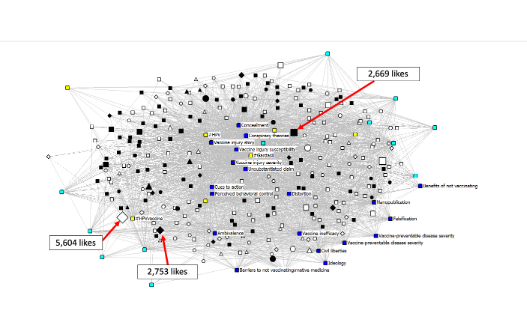
- The most liked post (6,634 likes) in the full subsample was a positive personal narrative post, created by a non-health individual; the most liked post (5,604 likes) in the antivaccine subsample was an informational post created by a health individual.
Based on these findings, the researchers suggest that identifying characteristics of health misinformation on social media can help inform targeted interventions and tailored messages to sow corrective information and stories. For example, misinformation characteristics can be identified and segmented for focused interventions through opinion leader or peer outreach education programmes. "Addressing misinformation on social media will require resource development and enthusiasm across multiple industries and health consumer types, including tech and health insurance companies, hospital and physician groups, and parent and cancer survivor advocates."
Journal of Medical Internet Research (JMIR) 2020 (Dec 03); 22(12):e21451. Image caption (Figure 2): Antivaccine network visualisation (n=256 posts). Variables coloured by type of characteristic. Sized by likes (mean=220.9; median=27; maximum=5,604). Top 3 posts with the most likes are indicated. Symbol shapes represent post source (circle = general group; square = general individual; triangle = health group; diamond = health individual) and colour represents node type (yellow = social media features; light blue = image characteristics; dark blue = type of misinformation; black = personal narrative; white = information/resource).
- Log in to post comments