










































Effect of a Behaviour-Change Intervention on Handwashing with Soap in India (SuperAmma): A Cluster-Randomised Trial
London School of Hygiene & Tropical Medicine (Biran, Schmidt, Greenland, Aunger, Curtis), St John's Research Institute (Varadharajan, Rajaraman, Kumar), Centre of Gravity (Gopalan)
"Thus far, efforts to change handwashing behaviour on a large scale have had little success, possibly because they have focused on beliefs about the health benefits of handwashing with soap and given relatively little attention to the effect of emotional drivers."
This study aimed to test the effect of an intervention that used an emotional driver, in this case, the emotion of disgust, to promote handwashing with soap in behaviour change campaigns. The study on the SuperAmma campaign in India was done in Chittoor district in southern Andhra Pradesh between May 2011 and September 10 2012. "The intervention was designed on the basis of formative research, done at the study site and at sites in other countries, to understand the influences and constraints on handwashing practice and the opportunities for intervention." [Footnotes have been removed throughout by the editor.]
The researchers used the Evo-Eco model as a framework to help guide the interpretation and analysis of formative research data. "The model draws on evolutionary theory, psychology, and neuroscience to propose a systematic means of classifying the influences and drivers of human behaviour." The research team created a theory-based checklist of factors that the intervention sought to alter to achieve behaviour change, considering "the physical and social environments, existing behavioural routines, and fundamental human motivations, associated with handwashing practice....A Bangalore-based creative agency designed communication concepts based on nurture, disgust, affiliation, and status as motivational drivers of handwashing. The concepts were refined through pilot testing with groups of mothers from non-study villages."
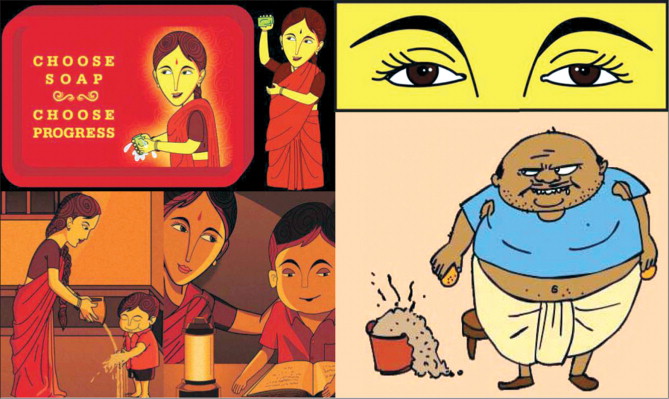
The campaign centred on a progressive mother figure (SuperAmma) who had "a loving, nurturing relationship with her son, teaching him good manners and ensuring that they both used soap for handwashing. It also featured a comical, male character whose disgusting habits were humorously contrasted with those of SuperAmma." An agency took on managing community events using a team of two facilitators (members of a street theatre troupe with experience of creation and delivery of performances relating to social issues), an audio-visual technician, and a driver. They delivered the intervention on 4 days in each of seven villages. "The first 2 days of delivery were consecutive, the third day of delivery occurred 14 days later, and the fourth day of delivery after a further 8 days....[The intervention] included community and school-based events incorporating a SuperAmma animated film, skits contrasting the clean habits of SuperAmma with her dirty comic counterpart, and public pledging ceremonies during which groups of women promised to wash their hands with soap at key event times and to help ensure their children did likewise. The pledge followed a specific script intended to link handwashing to social identity and included an element of theatre (the women stood together with one hand raised), intended to add some solemnity to the activity. The names of those who had pledged were placed on a public display board and posters featuring images of local opinion leaders washing hands were prominently displayed around the villages. Provision of soap was not part of the intervention. Interim activities took place in villages between the visits of the implementation agency. These components were intended to maintain the visibility of the campaign and to encourage repeated practice of the target behaviours." A shorter version of the intervention was also tested in control villages after the second follow-up survey to determine whether a more scalable intervention could achieve the same outcomes.
Female observers, thought to be less intimidating, were stationed with checklists in households for two rounds of observation in a random sample of 25 households per village. An observation was also done at a 6-month interval. "The primary outcome measure was the proportion of key events (after defecation, after cleaning a child's bottom, before food preparation, and before eating) on which hands were observed to be washed with soap at all follow-up visits. Secondary outcome measures were the proportion of all observed handwashes that used soap and the total number of handwashes observed at all follow-up visits."
At baseline, handwashing with soap associated with key events was rare. There was "strong evidence that, at 6 weeks' follow-up, handwashing with soap at key events was more common in the intervention group than in the control group....At 6 weeks, there were substantial differences between intervention villages in handwashing with soap, suggesting a substantial initial heterogeneity in intervention effect. The last three villages to receive the intervention had much higher prevalence of handwashing with soap after intervention than did the earlier villages....At 6 months' follow-up, handwashing with soap at any key events had increased further in the intervention group....The short intervention implemented in the control group achieved much the same increase in handwashing with soap..."
The research concludes that the intervention seemed to be successful in changing handwashing practices and that implementers became more skillful as they delivered the intervention, including being better at eliciting support from key village figures. Researchers note that they were not "able to distinguish the effects of the different components of the intervention, for example, whether disgust, nurture, status, or affiliation was the most important driver of behaviour change."
The Soapbox e-newsletter from Global Public-Private Partnership for Handwashing to The Communication Initiative on April 9 2014 and The Lancet Global Health, Volume 2, Issue 3, Pages e145 - e154, March 2014, accessed on April 9 2014.
- Log in to post comments