










































Engaging Communities during a Pandemic: Experiences of Community Engagement during the COVID-19 Response in Camps and Out-of-Camp Settings
Norwegian Refugee Council (NRC)
"The need among vulnerable community groups and individuals for information, assistance and protection has increased greatly during the pandemic, and due to the nature of the response with its restrictive measures, the need to involve them in the design and decisions about the response as well as the implementation and monitoring, has been critical."
Community engagement, deemed essential for any disease outbreak response, has been particularly critical during the outbreak of the novel Coronavirus (COVID-19), which in many cases created confusion, misunderstanding, and fear. However, community engagement, which usually necessitates face-to-face time spent with communities to build trust and ensure the community representation structures are inclusive and accountable, can be a challenge in light of pandemic-related safety measures. Geared toward camp management and camp coordination (CCCM) practitioners and humanitarian agencies, this research presents examples from different agencies on how they have approached community engagement in their COVID-19 responses in camps and out-of-camp settings - looking at the tools and methodologies used, the challenges encountered, best practices and lessons learned, and recommended steps to ensure community participation in this and future pandemic responses. It was prepared by the Norwegian Refugee Council (NRC) as part a larger partnership between the NRC and the International Organization for Migration (IOM) that explores how increasing women's participation in displacement sites can reduce gender-based violence (GBV) risks.
Between June and August 2020, the research team interviewed 20 key informants from 10 humanitarian agencies (national and international non-governmental organisations (NGOs), United Nations (UN) agencies and the International Federation of the Red Cross and Red Crescent Societies, or IFRC) across Latin America, Europe, West, Central and East Africa, the Middle East, and South East Asia. The researchers also conducted a desk review of literature on engaging the community in the COVID-19 response and in previous pandemic responses. The research methodology did not include consultations with the communities receiving assistance due to the access issues created by the pandemic. The research team used the Active Learning Network for Accountability and Performance (ALNAP)'s participation framework to select the best practices for this review, based on their demonstrated or aimed-for levels of participation.
Here is a brief summary of research findings:
- During the first phase of key informant interviews, it became evident that the agencies interpret the concept of community engagement very differently. Half of the agencies approached identified their community engagement programming as information activities; this only sometimes included communication from the communities, and rarely identified how information from communities was used to inform decisions on response design. Examples often included bulk risk communication and community engagement (RCCE) text messaging or hotline initiatives, or the use of megaphones and posters to provide critical information. Often, there was no clear strategy or steps outlined for how to translate RCCE) guidance into practical steps for ensuring participation in programme activities.
- There were different understandings of who is a community representative and what makes a community focal point truly representative. Some key informants highlighted engagement that excluded informal leaders and marginalised groups from the discussions. However, a true community representative is a community member who has been selected, elected, appointed, or identified - formally or informally - as inclusive and accountable by several of the community members to represent them when interacting with aid agencies.
- Agencies reported better access to and involvement by community members where community representation structures were already established pre-COVID-19, using community representatives who already had a deep connection with the organisation and within the community. Where this was the case, the agencies could use the representatives' capacities to collect information on needs, priorities, concerns, and feedback on agencies' response activities.
- Several agencies created rumour task forces; the key informants mentioned they had engaged women and youth specifically to help with rumour tracking. This tracking was especially critical in areas with functioning internet where "fake news" could flourish. Organisations reported that their engagement with respected community leaders, such as healthcare providers, teachers, and religious leaders, helped provide accurate information about COVID-19 and correct misinformation.
- The agencies used a range of tools to connect remotely with the communities, including telephone calls, hotlines, text messages, WhatsApp groups, Zoom, chat bots, and interactive radio programmes. Such solutions were not without challenges; one international NGO (INGO) working across several West and Central African countries highlights that the rise of digitalisation simply does not work in several of their field locations due to unstable network connections, the relatively high cost of connecting to a network, and the assets and facilities that need to be in place. Furthermore, except for some reports of using phone calls and hotlines, most of the informants mentioned concerns related to the uneven reach and participation of women and marginalised groups such as elderly and illiterate when using digital tools.
- Challenges were often exacerbated in outside-of-camp settings, where women and marginalised community groups were harder to identify, reach, and engage than in camp settings.
- When agencies managed to engage women and marginalised groups in the design and feedback on the response, critical input on messaging and assistance was received - e.g., on specific needs for pregnant and breastfeeding women during isolation and quarantine, as well as regarding safety concerns and income generation issues during lockdown.
Among the many examples provided: In Cox's Bazar, Bangladesh, Rohingya women leaders self-mobilised to raise awareness about COVID-19 in the camps. The women collaborated with UN Women to form networks and recruit volunteers to be trained on COVID-19 prevention and response. The volunteers conducted door-to-door visits, giving information to women and girls about how to protect themselves and what to do in case of infection, in addition to connecting them with women-friendly spaces. Volunteers have reported feeling respect from their families and communities, as their role provides them with an official identity and dignity.
Though primarily intended for CCCM practitioners in their work, the recommendations offered may be relevant for other sectors in their efforts to ensure community participation.
- Work with accountable and inclusive community representatives - Ensuring the voice of all groups within the community is heard, and that the representatives are selected by and advocate for the community as a whole, can ensure a relevant, context-appropriate, and impactful response.
- Build emergency preparedness within displaced communities on community engagement principles that include the participation of women and marginalised groups - Suggestions:
- Build community-centred mechanisms through support and capacity building to community representatives in a structured manner by utilising participatory methodologies such as NRC's Community Coordination tools.
- Include representatives from all groups within the community to ensure their capacities and needs are fully integrated and addressed.
- Complement digital feedback and engagement mechanisms with alternative, non-digital methods to ensure inclusiveness, further exploring user-centred design approaches to ensure appropriate digital methodologies for community participation.
- Systematically build community engagement into a programme's strategy and activities to make sure it identifies and addresses the skills, capacities, and training and support needs of all community groups to facilitate their meaningful participation in response - Donors need to require a community engagement strategy from their implementing partners for this to be systemically included in responses.
The research team hopes this report will contribute to more discussions on evaluating community engagement overall, and to more thorough evaluations, specifically involving the community members directly, of communities' participation in the response to the COVID-19 pandemic.
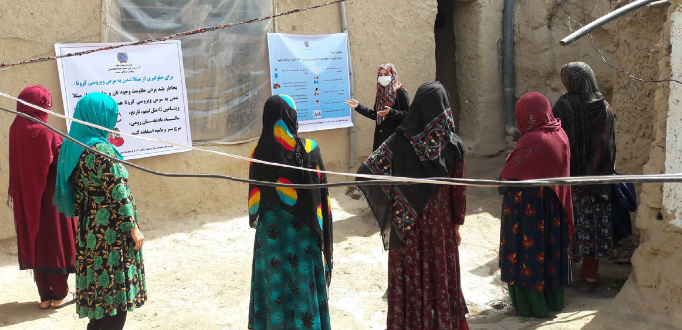
NRC website, February 22 2021. Image credit: NRC Afghanistan
- Log in to post comments