










































Ensuring the Integration of Refugees and Migrants in Immunization Policies, Planning and Service Delivery Globally
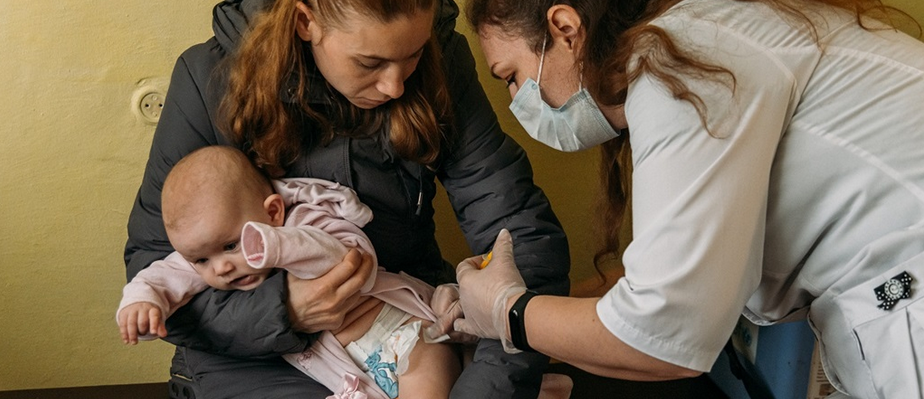
"A shift towards migrant-sensitive and adaptable vaccination services, systems, and policies, with coproduction of tailored interventions and clear, consistent public health messaging, is key..." - H.E. Paulette Lenert, Minister of Health, Luxembourg - speaking at the May 24 2022 report launch
Data suggest that adult, adolescent, and child refugees and migrants as a group are underimmunised for routine vaccines in several contexts and may have a higher burden of vaccine-preventable diseases (VPDs) compared with host populations. The COVID-19 pandemic highlighted weaknesses in immunisation programmes globally and specifically underlined the extent to which refugees and migrants may be excluded from and/or face unique barriers to accessing vaccination and health systems. In that context, this third report of the World Health Organization (WHO) Global Evidence Review on Health and Migration (GEHM) series focuses on policy and practice regarding the inclusion of refugees and migrants in immunisation systems globally.
Searches of academic and grey literature published between January 1 2010 and October 31 2021, with no restrictions on language or geographical scope, identified 210 relevant articles for inclusion in the scoping review. As outlined in this report, the review synthesised evidence on: the integration of refugees and migrants into national immunisation policies and implementation of these policies; the barriers faced in accessing vaccines; facilitators and good practices for strengthening the delivery of immunisation services and improving global vaccine coverage; and the specific impact of the COVID-19 pandemic on immunisation services for mobile populations globally.
Among the communication-related elements of the review are is a discussion of the unique barriers refugees and migrants may face in accessing vaccines. In addition to administrative, policy, and financial barriers, the availability of vaccines and logistics of bringing them to refugee, migrant, and mobile populations can be problematic in some settings, particularly in low- and middle-income countries (LMICs) and humanitarian contexts. For example, greater access to polio immunisation services for migrants in the World Health Organization (WHO) African Region, particularly those in hard-to-access border areas and seasonal migration routes, is needed. This could be achieved by combining polio vaccination with other health interventions (for example, cross-border vaccination, including permanent vaccination at transit points and market days), alongside increased surveillance of migrant and nomadic populations. Also:
- Individual-level barriers include trust, cultural, religious, social norms, and beliefs. For instance, low knowledge in healthcare professionals of migrant health needs and healthcare eligibility may prevent migrants from being offered or given vaccinations, regardless of their entitlement in policy, and language barriers or lack of empathy or cultural competency in healthcare workers may lead to distrust, confusion, or low motivation to present for vaccination in migrants. Religious or cultural norms or expectations in migrant groups, particularly when these differ from the norms in the host country, may affect the perceived acceptability of vaccines and, subsequently, vaccination uptake.
- Logistical barriers such as availability and accessibility of vaccinations may restrict vaccination uptake by refugees and migrants. For example, a mass polio vaccine campaign in Kenyan refugee camps reported that 52% pf unvaccinated people lacked vaccination because they did not know where to get vaccinated or were unaware of the campaign. Trust in the available access points may also be an important barrier to vaccine uptake, particularly for irregular migrants, who may fear immigration checks. To overcome this barrier, access points in safe and trusted locations, such as local community centres, places of worship, pharmacies, or non-governmental organisation (NGO)-run clinics, should be provided.
- Information and communication barriers present barriers to vaccination among these populations. Refugee and migrant populations have been found to be excluded from accessing information because of poor digital literacy or lack of technology, language barriers, low reading/written literacy, poor doctor-patient communication, lack of interpreting services, or information not being provided in an accessible and acceptable format. WHO has also suggested that in settings where there is a gender gap in education (for example, some refugee and migrant communities), women may have limited access to accurate vaccine information, resulting in lower vaccine confidence. In the context of the COVID-19 pandemic, humanitarian organisations have highlighted concerns about high levels of misinformation about COVID-19 vaccines among migrants, including via social media. Such findings highlight the importance of tailored information campaigns based on local evidence and informed by or co-designed with local actors.
The review identified a wide range of facilitators of vaccine uptake in refugee and migrant populations. For example, in the area of trust and social processes, the literature recommends:
- Culturally competent and migrant-sensitive care - e.g, inclusive services and policies, training for healthcare workers on migrant health and vaccination needs;
- Reinforcement of positive social norms and normalisation of vaccinations, e.g. encouraging those recently vaccinated to share on social media;
- Culturally tailored and community-based interventions, e.g. face-to-face communication, community advocates; and
- Increased funding for and collaboration with NGOs or other groups already providing health and social care to migrants locally.
Another set of facilitators is connected to the themes of information, misinformation, and hesitancy, including:
- Tailored health promotion and education programmes in relevant languages to increase awareness of vaccination benefits;
- Information campaigns that are tailored to different cultural and religious values - "one size doesn't fit all";
- Extensive research into information channels used by specific communities, which should be harnessed to increase information reach; and
- Efforts to directly counter misinformation known to be circulating.
At the macro level, cooperation within and across borders is needed to facilitate the generation and sharing of health information, such as vaccination records and coverage data, and to align national immunisation guidelines and programmes to control VPDs in mobile populations. For example, a study on Syrian refugees in Jordan described the development of the CImA children's immunisation app as a low-cost digital solution to provide evidence-based vaccine information to parents and record vaccination history, with promising results achieved following initial implementation in the Zaatari refugee camp.
Beginning on page 37 of the report, case studies 1-5 describe good practices of implementing immunisation initiatives in refugee and migrant populations in camp settings) and case studies 6-12 outline good practices of implementing immunisation initiatives in refugee and migrant populations in community settings. Box 7 on pages 43-44 lists good practices in implementing immunisation in refugees and migrants. Examples include: Establish ongoing community engagement platforms, rather than one-time social mobilisation activities, in refugee camps and other humanitarian settings to increase trust in vaccination services at local level; and build confidence in vaccination and vaccine development through use of transparent processes and including refugees and migrants in vaccine trials, recognising their research contributions and equipping them with knowledge of their entitlements.
WHO acknowledges that addressing underimmunisation requires understanding its determinants and developing tailored, evidence-based strategies to improve uptake, as well as monitoring their impact and sustainability. The report discusses WHO's expert working group, called Measuring Behavioural and Social Drivers of Vaccination, which has developed standardised tools and implementational guidance on the systematic assessment of behavioural and social factors affecting vaccination uptake, including among refugees and migrants.
To support countries fully integrating refugees and migrants into national immunisation plans, and to increase access to routine vaccines, the report outlines three areas for policy consideration:
- Ensure universal and equitable access to vaccines for all refugees and migrants regardless of migrant status, age and gender - by, for example:
- addressing the physical, social, and personal barriers to immunisation services and factors influencing motivation to vaccinate, including among primary caregivers of migrant children;
- developing participatory approaches and communication and engagement strategies to strengthen vaccine uptake, build trust, and tackle vaccine hesitancy, and to develop innovative migrant-friendly delivery mechanisms, tailored approaches, and local solutions;
- engaging with communities in vaccination planning and implementation and through educational outreach on the benefits of vaccination and when/where to get vaccinated;
- developing communication strategies that reduce vaccine information inequities (including using translating resources into relevant languages), ensure the availability of qualified interpreters and health navigators, and counter misinformation and disinformation; and
- improving integration between immunisation and other health programmes in order to strengthen primary health care and attain equity goals.
- Strengthen health systems to provide catch-up vaccination in mobile populations across the life course to close existing immunisation gaps by, for example, bolstering patient-provider interactions through training health workers on competencies to provide people-centred and culturally sensitive services to refugee and migrants and educating primary healthcare providers and vaccinators about the general and specific barriers to immunisation services and the sociocultural perspectives of refugees and migrants.
- Strengthen data collection to monitor immunisation coverage and service delivery gaps in refugee and migrant populations by, for example:
- renewing efforts to collect and analyse national data (disaggregated by migrant status and gender) on vaccination barriers and vaccine hesitancy and their impact on vaccination uptake and coverage in refugee and migrant populations;
- establishing or upgrading immunisation information systems to capture vaccination coverage data for refugees and migrants;
- ensuring that processes are in place for continuous data assessment, drawing lessons from experiences, documenting processes and outcomes, and improving information sharing;
- performing robust, large-scale studies to understand the drivers of underimmunisation and vaccine hesitancy in diverse refugee and migrant populations and identify workable solutions (specifically for use in LMICs and humanitarian contexts);
- generating evidence on the drivers of underimmunisation and vaccine hesitancy in diverse refugee and migrant populations, especially in LMICs and in humanitarian contexts globally; and
- assessing the influence of social media as a major new source of vaccine misinformation for marginalised populations with less access to public health messaging and exploring opportunities to share accurate and reliable information with highly mobile populations through social media.
In conclusion: "WHO, international organizations, national authorities and key partner agencies urgently need to work together to embed these policy considerations into future planning, in order to uphold the human right to immunization for all refugees and migrants and...[ensure] that immunization services are people centred, data guided, country owned and partnership based....This GEHM highlights the wide variation in approaches of different countries and different regions with respect to addressing the health and immunization needs of refugees and migrants, and the need for a more integrated approach to specific public health approaches for refugees and migrants."
Editor's note: Click on the video below for a message by WHO Director-General Dr Tedros Adhanom Ghebreyesus during a launch event of this report, May 24 2022, and click here for the meeting report [3 pages, PDF] from that event.
WHO website, July 21 2022. Image credit: WHO
- Log in to post comments