










































Evaluation of the SOPO School Handwashing Promotion Programme: Nyanza and Rift Valley Provinces, Kenya
University at Buffalo (Kamm, Crabtree-Ide, Ram); UNICEF-Eastern and Southern Africa Regional Office (Thomas)
"Soap was available to children in a minority of schools, limiting the students' ability to wash their hands, regardless of their knowledge and desire to do so. At home, nearly half the school children reported that soap was unavailable to them when they wanted to wash their hands. Without access to soap and water, handwashing with soap is not possible."
This was a key finding of an evaluation conducted to assess the extent of sustained behaviour change resulting from the SOPO schools campaign in Kenya, which sought to increase handwashing behaviours among schoolchildren as a way to improve health and sanitation among children and their caregivers. This 8-page field note discusses the implementation, as well as the results of an assessment conducted two years after the close of the campaign. The findings show that increasing knowledge does not necessarily improve behaviour, especially if the needed resources - in this case, soap – are not readily available.
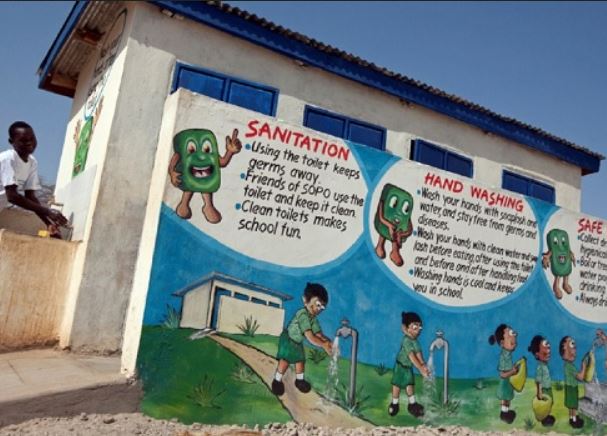
Implemented in 2010 by the United Nations Children's Fund (UNICEF) Kenya Country Office, the Kenya Ministry of Public Health and Sanitation, and the Kenya Ministry of Education, the campaign chose children as a key audience, as it was believed they may be more amenable to behaviour change than adults and could be advocates for behaviour change in their families and communities. "The campaign recommended washing with soap at four critical times (after toileting, before eating or feeding a child, after changing a baby's nappy, and before cooking or preparing food) using a five step method (wet hands, apply soap, scrub all surfaces of hands, rinse, and air dry)." The school programme consisted of a single three-hour assembly where activation teams promoted the SOPO messages through the SOPO mascot (a caricature of a green bar of soap), demonstrations of proper handwashing technique, teaching the SOPO song and dance, and distribution of SOPO activity booklets and promotional materials. The community programme included posters, murals, billboards, fliers, wall stickers, and community theatre, complemented by radio and television advertisements.
In 2012, the programme was evaluated by comparing observed behaviours among children in 30 schools that received a SOPO activation assembly to 28 schools that did not receive a SOPO assembly but were located in the same district as a SOPO school. The evaluation found that "children and mothers in SOPO households were more likely to recognize the SOPO brand and be able to report the four critical times for handwashing with soap promoted by the programme, compared to those in non-SOPO households." In addition, "31% of mothers with a child attending a SOPO school reported they heard of the programme from their child, "suggesting a minority of the children were able to successfully share the message with their mothers."
However, despite recognition of the SOPO programme, children demonstrated poor handwashing behaviour both at school and at home. "Among all toileting and eating events observed at the schools, only 3% of events in SOPO schools and 2% in non-SOPO schools were accompanied by handwashing with soap." Similarly children in both evaluation groups children rarely washed their hands with soap at home. According to the report, the poor handwashing behaviour among schoolchildren may be explained by lack of access to soap. "Although 70% of SOPO schools and 86% of non-SOPO schools had a handwashing station on school grounds, only four (13%) SOPO schools and three (11%) non-SOPO schools had soap and water at a handwashing station." School children also reported limited access to soap at home and, overall, the most commonly reported barrier was lack of soap in the home and inability to find the soap (18%).
The field note discusses a number of lessons learned. These include the importance of addressing access to soap at the same time as promoting the related behaviour change, as addressing knowledge alone will not improve handwashing behaviour. Another key lesson discussed is the need to improve communication and coordination between programme activities, as well as with other ongoing or planned WASH programmes, to reinforce the programme message within the implementation area. Such coordination with other activities may also be able to help address the resources (lack of soap) issue, as well as prevent conflicting messages.
In terms of next steps, among the recommendations included in the brief is that "handwashing promotion programmes should address multiple factors that impact behaviour change in their design. The practical but essential concern of maintaining availability and access to soap and water must be addressed." Schools and household environments may, however, have different motivating factors and different barriers to maintaining soap and water accessible to children, which should be considered. Furthermore, there is a need "to understand effective methods for teaching children to disseminate programme messages."
UNICEF website on September 27 2015.
- Log in to post comments