










































Exploring the Factors Contributing to Low Vaccination Uptake for Nationally Recommended Routine Childhood and Adolescent Vaccines in Kenya
Affiliation
Agence de Médecine Préventive (AMP) Afrique (Essoh, Tall, Aplogan); University of Erfurt (Adeyanju); Bernhard Nocht Institute of Tropical Medicine, or BNITM (Adeyanju); Cochrane South Africa (Adamu); Stellenbosch University (Adamu); Wellcome Trust (Tabu); Ministry of Health, Nairobi, Kenya (Tabu)
Date
Summary
"Low vaccination demand or vaccine hesitancy must be tackled through collective activities that increase awareness about importance of vaccination and must carry along all stakeholders."
In Kenya, basic childhood vaccination coverage was lower (82%) than the global average (86%) in 2020. A similar trend can also be noted for human papillomavirus (HPV) vaccination, as well. Studies have associated vaccination stagnation, retrogression, or inconsistencies with the complex and context-specific phenomenon of vaccine hesitancy. This study aimed to identify the context-specific factors that influence vaccine hesitancy in Kenya from the point of view of both the immunisation programme stakeholders/community members (supply side) and caregivers (demand side).
The selection of study sites was based on vaccination coverage such as high (Kilifi) and low (Turkana) counties, an urban county where the HPV vaccine was piloted (Nairobi), and a rural or sub-urban county where the same was done (Kitui). The researchers purposively selected 41 key immunisation stakeholders and caregivers for interviews, conducted between August 6 and September 6 2020.
Vaccine and vaccination factors driving vaccine hesitancy for routine childhood immunisation included:
In Kenya, basic childhood vaccination coverage was lower (82%) than the global average (86%) in 2020. A similar trend can also be noted for human papillomavirus (HPV) vaccination, as well. Studies have associated vaccination stagnation, retrogression, or inconsistencies with the complex and context-specific phenomenon of vaccine hesitancy. This study aimed to identify the context-specific factors that influence vaccine hesitancy in Kenya from the point of view of both the immunisation programme stakeholders/community members (supply side) and caregivers (demand side).
The selection of study sites was based on vaccination coverage such as high (Kilifi) and low (Turkana) counties, an urban county where the HPV vaccine was piloted (Nairobi), and a rural or sub-urban county where the same was done (Kitui). The researchers purposively selected 41 key immunisation stakeholders and caregivers for interviews, conducted between August 6 and September 6 2020.
Vaccine and vaccination factors driving vaccine hesitancy for routine childhood immunisation included:
- Fear of adverse events following immunisation (AEFIs)
- Vaccine shortages and stockouts
- Cost of commuting from communities to healthcare facilities
- Constraints or competing priorities and long waiting hours
- Inadequate knowledge of vaccine-preventable diseases on the part of caregivers
- Lack of incentives
- Fear of COVID-19 infection and/or unclear communications about pandemic response strategies (e.g., restriction on movement of people)
- Religious influence
- Inadequate knowledge of HPV vaccine
- Low literacy among caregivers
- Rumours and conspiracy theories associated with vaccination of girls (e.g., that it could lead to infertility)
- The role of social media and caregivers in urban centres in spreading misinformation
- The COVID-19 pandemic and the response strategies adopted
- Disrespectful attitudes of healthcare workers (HCWs)
- Communication from HCWs is crucial to educate and remind caregivers about what vaccines are available and what they do, particularly for new vaccines such as the HPV. This communication should be continuous, even when the vaccines are out of stock. When the problems are resolved (e.g., the vaccines are in stock), communication should be maintained to inform the caregivers and remind them of the importance of resuming the vaccination schedules.
- HCWs should be involved in awareness campaigns for HPV vaccination, as they are trusted by the communities. Involvement of other actors from the communities, such as religious and community leaders and school teachers, could improve awareness and strengthen acceptance on the part of hesitant caregivers.
- Politicians such as governors should continue to provide political support and to champion immunisation programmes, as well as to increase confidence in immunisation and reduce vaccine hesitancy.
- Both national and sub-national governments should increase public expenditure for immunisation-programme-related communication activities, such as outreach, educational programmes, and social media campaigns, which are important for increasing vaccination awareness and demand in urban centres. In particular, social media must be a significant component of any vaccination uptake intervention strategy because it has the capacity to counter misinformation and to be an effective communication tool for behaviour change.
- Extensive social mobilisation and raising awareness are needed to demystify the myths and misconceptions that still exist about HPV vaccine. The same should also address concerns raised by various religious organisations.
- In addition, in rural communities of large counties with distance between the communities and healthcare facilities, regular outreach immunisation campaigns should be sustained to help improve vaccination uptake.
Source
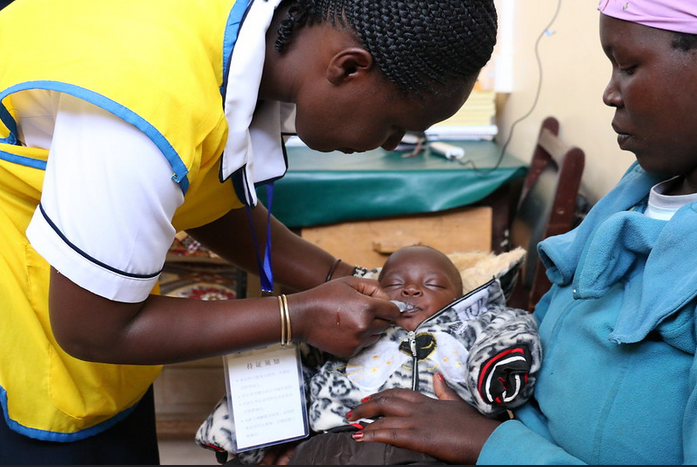
BMC Public Health (2023) 23:912. https://doi.org/10.1186/s12889-023-15855-w. Image credit: Irene Angwenyi, USAID/Kenya via Flickr (CC BY-NC 2.0)
- Log in to post comments