










































Family Planning Through the Mobile Phone, No Doctor Necessary!
This MobileActive.org article reports on an SMS (text message)-based delivery project of the Standard Days Method® (SDM) of family planning developed by the Institute for Reproductive Health (IRH) at Georgetown University, Washington, DC, United States. SDM is described as an information-based, low-cost, and non-hormonal method of family planning. Because of the high use of traditional methods for family planning, and the ubiquity of mobile phones reported in research in India, IRH developed a mobile platform for delivery of SDM called CycleTel™.
CycleTel™ is designed to inform women of their fertility status using mobile phones. A woman can subscribe to the service via SMS on the first day of her menses, after which a text message is sent to her mobile indicating her fertility status during each day of the 8-19 day fertile window of her monthly cycle.
"Previous field research in Lucknow, in the state of Uttar Pradesh, [India] found that many women preferred a non-hormonal method or fertility awareness method for family planning. In the health survey in Uttar Pradesh, researchers found that approximately 14% of women were using a traditional method of family planning and many wanted to explore other options than the pill, IUD, condom or the rhythm method."
As reported here, the SDM is increasingly being adopted as a contraceptive method in developing countries, facilitated by CycleBeads®, a product, obtainable in clinics and pharmacies, as well as through community health workers, to indicate the calendar-based fertile window. CycleTel™, the mobile phone-based version of this fertility awareness product, requires only a mobile phone. "The CycleTel system is designed to send users a message to let her know which days she can get pregnant. There may also be menu-based service built into the program, where women can choose from a set of options to receive more information via SMS about alternative family planning methods, STI [sexually transmitted infection]/HIV prevention, counseling and testing information, condom use and connect to local health clinics. Additionally, a helpline number is available for one-on-one consultation over the phone."
The IRH’s proof-of-concept and pilot testing in Lucknow and Delhi analysed the appropriateness of the technology, given the users and context, and included the input of users to guide the development of the SMS service. "The three phases included:
- Focus group discussions: to understand patterns of phone usage, determine potential interest among the target audience, and explore appropriate messaging and preferences for the service.
- Cognitive interviews: to verify the comprehension of messages and adapt messages as per input from users
- Manual testing: in which, married couples were enrolled for 2 cycles to assess CycleTel's feasibility, user satisfaction and correct use."
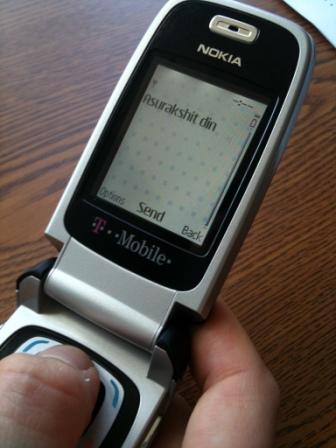
Researchers found that non-technical, culturally appropriate, simple messages, such as "safe" or "unsafe day", were women's preference. In addition, women preferred only receiving messages on their fertile days, not every day. Researchers wanted to send messages in Hindi, rather than English, but found that not all phones supported messages in Hindi script. "Interestingly, women better understood messages written in 'Hinglish', which is the Hindi script written out in the Roman alphabet. The focus groups and cognitive interviews confirmed that 'Hinglish' is the best way to ensure comprehension among users."
Other findings from the research indicated that: SMS was preferred to voice messages; male partners wished to received the SMS also "since they bring the condoms home"; a helpline number was requested at the beginning of service rather than later in the programme; women preferred responding to yes or no questions and wished for no greetings or acknowledgements of their responses; and women preferred one message rather than two simultaneous messages. In addition, it was found that not all women had literacy levels adequate to send and read texts, and some could read and forward messages but not write responses. As a result, researchers are considering focusing the application on middle- and higher-income women. Also, some incompatibilities among mobile service providers hindered use of the CycleTel™ service.
The sustainability of the service was addressed with a question about fees for the service. "Men and women, who participated in CycleTel pilot test, were willing to pay for the service. In the focus group discussions, women suggested 20-25 rupees, men suggested 15 rupees and couples suggested 30-35 rupees as reasonable monthly price for CycleTel.
....For the next phase of CycleTel, an automated messaging system is in development and will be ready to begin rolling out in early 2011. While India will be the first CycleTel country, plans are underway to conduct formative research elsewhere so that it can be adapted to other countries. The CycleTel project is being carried out as part of the Fertility Awareness-based Methods (FAM) Project. This 5 year global project intends to scale modern natural family planning methods (like SDM, and Lactational Amenorrhoea Method or LAM) in national level public and private programs in select countries. The FAM Project is funded by USAID [United States Agency for International Development]."
Mobile Active.org website, November 10 2010, and email from Meredith Puleio to The Communication Initiative on November 12 2010.
- Log in to post comments