










































FIGO Guidance for Sustainable Implementation of Vaccination Programs for Women: Pregnancy and HPV
International Federation of Gynecology and Obstetrics - FIGO (Amaral, Cain, Hearing, Lumsden); University of Campinas (Amaral); University of Massachusetts - retired (Cain)
"The biggest challenge to vaccine implementation for women comes from gender inequality."
Although vaccinations are an essential part of women's and girls' health care, barriers affecting implementation of vaccination are numerous and complex and include knowledge gaps, misinformation among women and communities, and research gaps, as observed for vaccination in pregnancy. An implementation strategy that addresses such barriers is necessarily unique for each setting, as it must be based on cultural, economic, and personnel realities. That said, the International Federation of Gynecology and Obstetrics (FIGO) assembled an international group in July 2022 to examine the background and implementation strategies for vaccination for girls and women, with the aim of facilitating introduction and scaling up initiatives supported by FIGO member organisations. This document sets out the key findings from the workshop and, in particular, explores current knowledge in implementation and communication strategies to enhance the success of vaccination programmes for women globally. It aims to help support action at a local level.
First, the important roles of vaccination throughout a woman's life are reviewed in brief scientific and ethical overviews. For instance, human papillomavirus (HPV) vaccination in childhood has proved to be critical, as part of an overall global strategy, to accelerate the elimination of cervical cancer. In addition, pregnancy has been shown to be an opportune occasion to prevent disease in women and their offspring, reducing morbidity and mortality related to a number of conditions (such as tetanus, influenza, COVID-19, pertussis, and hepatitis B). While vaccines should be affordable to all and accessible without any discrimination, access is disturbingly uneven, with consequent poorer health outcomes and deaths for women and girls, as well as marginalised populations. In this context, FIGO member societies can play a significant role in assuring lifelong vaccination success for women's health through research, advocacy, training, and interprofessional collaboration
Next, the important steps to follow when preparing for the implementation of vaccines are outlined. Some key points to emerge include:
- Implementation strategies for vaccine introduction or expansion for women and girls require careful pre-implementation efforts.
- The provision of well-funded and evidence-based training for a wide range of healthcare professionals (HCP) and allied professionals is essential to the successful implementation of HPV and maternal immunisation programmes, where unique age groups and underserved and vulnerable populations are at risk.
- The entire cycle of vaccine delivery (availability/supply, cost/procurement, policy/advocacy, supply chain, delivery infrastructure, and acceptability) needs scrutiny and planning before, during, and iteratively after implementation. For example, it is critical to women's health to continually strengthen public trust in vaccination.
- The engagement of stakeholders with tailoring to local conditions is essential to success. This process includes the active participation engagement and collaboration of various groups, from business to religious organisations, women's organisations, and local and national governmental and non-governmental organisations.
- A communication strategy for vaccine acceptability should be considered during the planning process, as vaccine hesitancy has become a global challenge, often resulting from a lack of trust in vaccine efficacy, safety, and health systems. Increasing public confidence may include tailored messaging to individual groups and community preparation before implementation via positive messaging regarding the vaccine. For some vaccines, such as HPV, considerable education and messaging may be needed to avoid stigma around sexual transmission. In particular, the engagement and education of men and boys regarding the HPV vaccine has been an effective strategy.
The Integrative Systems Praxis for Implementation Research (INSPIRE), while developed for participatory action research, offers an example with four phases to implementation that could be applied to all initiatives and revisions of vaccine delivery systems:
- Develop models of the system based on the narrative (what is) from multiple stakeholder viewpoints and make the system and the perspectives visible to all.
- Leverage for system success through engaging stakeholders in collaborative model building, then sharing, testing, and revising the proposed system map. This approach allows the group to define and localise potential problem areas and solutions as well as a platform for change.
- Act strategically to identify any infrastructure modification, training, or dissemination plan needed, and implement changes.
- Learn and adapt as the system is implemented. Reassess with agreed outcome metrics, and have the stakeholders review the results. Start at phase 1 to re-initiate a cycle for improvement as needed.
This section is followed by evidence-based guidance for the effective design and sharing of vaccination communication, including how to plan for and manage misinformation via multiple routes, including social media. Highlights include:
- As noted above, planning communications ahead of roll-out is key. Research in advance allows providers to prepare effective content, design, and channels of communication, to develop responses to possible emergencies or misinformation campaigns, and to construct effective professional training and counseling.
- Finding and building alliances with various trusted sources of health-based information relevant to the priority population will help to alleviate any possible concerns relating to vaccine mistrust and hesitancy.
- Vaccine providers can harness new and innovative methods of communication, from podcasts to social media trends, and strengthen these alliances through further research and partnerships with trusted stakeholders.
- Channels of communication should be tailored to the priority population demographics and should include: physical messaging, such as posters and pamphlets; digital messaging, such as social media adverts and television campaigns; and both formal and informal messaging across education, cultural, and religious settings.
- To be effective, vaccine information must be culturally appropriate and edited to the correct educational level and training of recipients, which will facilitate uptake. For instance, younger generations may prefer online resources, such as videos, websites, and QR codes, to receive accurate information. Older adults might be more interested in hard-copy brochures.
- By demonstrating a commitment to engaging with the public through listening and collaboration, a vaccine provider or health official must proactively recognise the way in which authorities have previously imposed and controlled the knowledge that lead to distrust, to become a trusted source of information.
- HCPs and professional bodies can leverage their knowledge and experience to combat online misinformation/disinformation and to strengthen vaccine confidence and acceptance. Well-informed HCPs must effectively engage with members of the public via online forums, including social media.
- Providers should allocate a planning stage in the implementation process in order to develop and strengthen public engagement in campaigns before vaccination, by building alliances with similar and/or high-profile accounts to gain a trusted presence online.
- National registries and government surveillance must be available and ready to assist in tracking adverse effects and allergies and responding to public concerns. When databases are lacking, HCPs should prepare, or work with the authorities to prepare, official information materials on vaccine adverse effects as part of the preparatory efforts. The list of evidence-based international and national resources, such as websites and databases, on vaccine adverse effects should be shared openly.
- Before counseling sessions, HCPs should conduct research on any recent media-covered news on vaccination adverse effects to be able to address potential questions. This level of preparation provides a basis for a respectful and knowledgeable exchange of information. A considerate and proactive discussion regarding the frequency of allergic reactions, of common and expected adverse effects, and the treatment of each can reduce vaccine hesitancy.
- Table 1 in the paper outlines the key elements to consider when preparing pro-vaccination messaging. These elements have been adapted from toolkits developed in a range of settings and are relevant to both text-based media and in-person dialogue.
Various country-based case studies are provided throughout - from Rwanda, Japan, Australia, and the United States - to elucidate how local settings shape different experiences of implementation. For example, the Japan case study explores the role and effects of anti-vaccination information on implementation.
Areas that need further research - in terms of HPV vaccination and maternal vaccination in particular - are identified. For example, further evaluation of feasibility, reach, effectiveness, adoption, acceptability and sustainability of different delivery methods (school-based, clinic-based, or mixed), communication and social mobilisation approaches, surveillance mechanisms, and so on through implementation research may be valuable to inform the strategy and success of HPV vaccine programmes. Another key area for research and development is management of misinformation and disinformation to ensure that populations receive credible knowledge and that this key part of healthcare prevention is supported by the population.
In conclusion: "The development and sharing of curricula, to advance the knowledge of vaccines as critical to the lifelong health needs of women and girls, and to develop successful communication strategies, is an area that deserves continuing effort and sharing of successful curricula and messages."
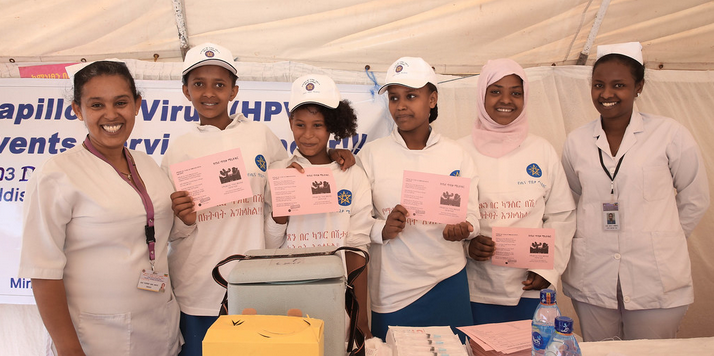
International Journal of Gynecology and Obstetrics 2023;162(Suppl. 1):3-23. DOI: 10.1002/ijgo.14894. Image credit: © UNICEF Ethiopia /2018/Nahom Tesfaye via Flickr (CC BY-NC-ND 2.0)
- Log in to post comments