










































Food, Frustrations, and Family Dynamics: Assessing the Use of Film to Promote Joint Household Decision-making
"Shifting awareness of gender dynamics in households and improving couple communication and joint decision-making can empower both men and women to contribute to improvements within the household."
Shifting awareness of gender dynamics in households and improving couple communication and joint decision-making can empower both men and women to contribute to improvements across the household. An existing body of research shows links between mothers' participation in household decision-making (HHDM) and associated reductions in child stunting. In a country like Timor-Leste, where almost 50% of children under 5 are stunted, and where fathers and grandmothers have a strong influence over family decisions, nutrition interventions should arguably support joint HHDM to reach Sustainable Development Goals 2 and 5, Zero Hunger and Gender Equality.
In 2019, TOMAK (a 10-year agricultural livelihoods programme funded by the Australian government in Timor-Leste) developed a low-budget film in collaboration with a local organisation, Ba Futuru, which focuses on HHDM, the allocation of household resources for nutritious foods, and the important role of fathers and grandmothers in family nutrition. Many projects and government departments do not have extensive budget for the development of a wide range of social and behaviour change (SBC) products or funding for large-scale evaluations. For this reason, TOMAK argues, there is a need to develop cost-effective evaluation strategies that can be applied to individual SBC products to assess their effectiveness in promoting key behaviours to intended audiences. This report describes the use of this film to promote key HHDM behaviours and demonstrates a low-cost approach for evaluating its impact.
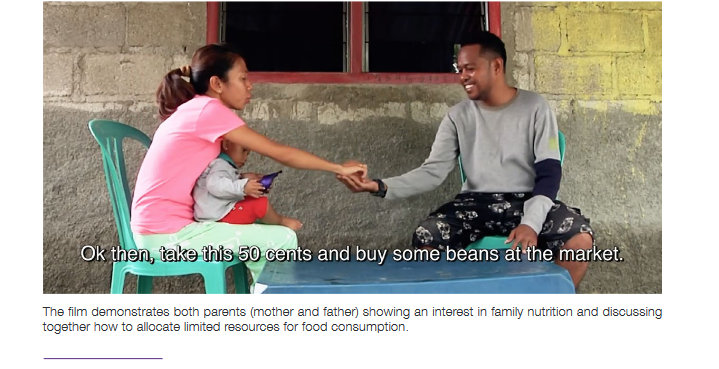
During the development of the film, TOMAK engaged the Ministry of Health (MoH) throughout the process - from initial concept and identification of intended audience and key practices to script development, rehearsals, and the design of the assessment to evaluate the impact of the film. The story (click on the video below to watch) centres around a woman who wants to kill a household chicken to make soup for her and her 8-month-old daughter who is recovering from illness. Her mother-in-law disagrees, preferring to eat rice and greens and save the chicken for potential guests and income. Unbeknownst to the mother-in-law, the daughter convinces her husband that he looks tired and should eat chicken soup. The mother-in-law's anger subsides when she overhears the couple discussing how to allocate their limited funds to purchase nutritious foods so that their child can do well in school in the future. Among the behaviours promoted in the film is that husbands initiate conversation with wives on a weekly basis at minimum on allocation of resources for weekly protein purchase. The cost of a nutritious diet is expensive, and there is a need to promote small feasible practices such as purchasing alternative options to meat (e.g., eggs and beans).
The short film's reality-style approach involves characters talking to the audience, with built-in provocative discussion questions. The film is intended as a facilitated discussion tool for use within established community groups (e.g., savings and lending (S&L) agriculture, nutrition) where members know and feel comfortable with each other. For the evaluation, TOMAK partners carried out 60 such film screenings with 30 existing community groups across 3 TOMAK municipalities from October to December 2019.
The evaluation approach involved a questionnaire that was administered to 195 community group members prior to watching the film and then re-administered three months later, following two film screenings and discussions in each group. Sample findings include:
- Knowledge: There were large increases in the proportion of respondents able to name examples of protein-rich foods and who said that eating these foods "makes a child smart at school". Respondents were also asked if they learned something new from watching the film, to which 92% responded that they did. The most frequently cited learning was: to cook and eat nutritious meals that include foods across different food groups (34%).
- Attitudes: The results show increased acceptance among respondents that fathers have a responsibility to support family nutrition, as well as stronger acceptance that mothers can (and should) take responsibility for purchasing protein-rich foods (previous TOMAK research showed that women need to ask permission to make purchases over US$1). Also, there was a significant increase in the proportion of respondents who reported a role for grandmothers in encouraging communication between couples (from 11% to 39%).
- Behaviour: There were increases in the frequency of protein consumption and improved practices around what households can do when there are limited resources for protein-rich foods (e.g., purchase small quantities at a time). Also, 87% of respondents reported doing something differently since watching the film. The most frequently cited response was: cooking nutritious foods across different food groups (27%).
- Other impacts: 68% of respondents said they discussed the film with others - most frequently, with a neighbour or friend (66%).
Despite some outliers, there were no major differences observed in the effects seen amongst the different group types (S&L, agriculture, nutrition) that viewed the film. This finding indicates that the intervention is appropriate for various groups. Furthermore, TOMAK and implementing partner staff that carried out the film assessment within their existing community groups said that the film resonated with community members and generated lively discussions. The built-in questions made it easy for the facilitator to lead the discussion, although participants had much to say about the film even without the prompts.
Based on these results, TOMAK and partners expanded the film screening and discussions across existing community platforms. In addition, the results from this film assessment were used as a basis for discussions with the MoH and partners on how to facilitate cost-effective evaluation strategies for SBC materials going forward.
TOMAK website, September 29 2022; and email from Sarah Meyanathan to The Communication Initiative on October 4 2022. Image credit: TOMAK
- Log in to post comments