










































HIV Communication Capacity Strengthening: A Critical Review
The Johns Hopkins Bloomberg School of Public Health, Department of Health, Behavior and Society, Center for Communication Programs
This review examines HIV communication capacity strengthening at national, subnational, and community levels: definitions, measurements, implementation, and effects. It also proposes a model to guide HIV communication capacity strengthening. The article is from the JAIDS: Journal of Acquired Immune Deficiency Syndromes supplement addressing clinicians and public health scientists in the field of HIV prevention and treatment who might value information on health communication. (Footnotes removed by the editor.)
The authors propose a new definition of capacity strengthening: "(1) building individual competencies (knowledge, attitudes, and skills) and (2) strengthening systems at organizational and societal levels to support effective HIV communication programs." They "propose a holistic model for HIV communication capacity strengthening and call for rigorous documentation and evaluation to determine and scale-up optimal capacity building interventions for strengthening social and behavior change communication for HIV prevention, care, and treatment in developing countries."
The demand for capacity in HIV communication at country, subnational, and community levels is based in the evidence that social and behaviour change communication (SBCC) "is most effective at shaping social norms and encouraging individual and community practices to prevent and mitigate HIV/AIDS when the process is locally owned and driven, when it adheres to well-accepted principals of design and implementation, and when tailored to local realities." This study reviewed "grey literature" but found little through keyword searches. Thus, the authors "drew on coauthors' experience working on the JHU-CCP [Johns Hopkins Bloomberg School of Public Health Center for Communication Programs] HIV communication capacity building efforts, added a 'snowball' approach to the 'grey' literature, and contacted colleagues working in the field to identify additional reports."
The review of indicators in evaluation of capacity strengthening in HIV communication led to the following measuring systems:
- Individuals: the Galway Consensus core competencies for health promotion - catalysing change, leadership, assessment, planning, implementation, evaluation, advocacy, and partnerships; competency maps for health communication training; and Communication for Change (C-Change) Social and Behavior Change Communication Capacity Assessment Tool (SBCC-CAT) for Use with Individuals.
- HIV Organisations: an AIDStar Two and the United States Agency for International Development (USAID) framework structured around standards, indicators, organisational functions, and practices; JHU-CCP BCC Capacity Assessment; and the SBCC-CAT.
- Qualitative measures: methodologies such as Outcome Mapping (OM) and most significant change, which can be combined with individual and organisational capacity assessments.
Gaps were identified in a number of studies, including:
- the need for inclusion of in-service training, funding, and technical assistance (TA).
- training in social marketing, use of folk media, and working with high-risk youth.
- the need for a broader understanding of medical topics and epidemiology, how to apply SBCC theories, and how to implement, monitor, and evaluate SBCC.
Some solutions found include:
- Trainings combined with networking among participants and alumni
- Internships
- Collaborative learning approaches, where developing country organisations receive grants and TA to design, implement, and evaluate health and HIV communication
- Members of regional communication networks "cascading" their expertise through training, peer-to-peer support, mentoring organisations
- Short courses tailored for new and mid-career professionals
- Integration of face-to-face TA with virtual technologies
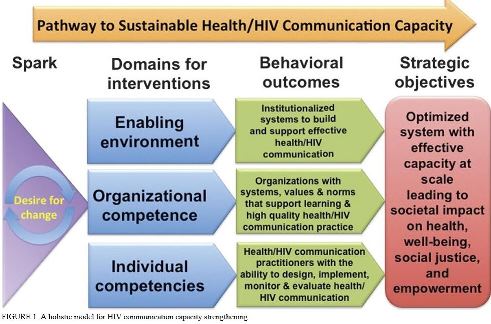
Evaluations showed some improvements associated with certain capacity building formats, as detailed in the review. Based upon findings, the authors conclude with a proposal for "using and evaluating a holistic model for HIV communication capacity strengthening - a pathway that addresses core competencies, systems strengthening, and supportive policies, structures, norms, and values (Fig. 1)." The pathway includes the desire for a change followed by strategically designed capacity strengthening interventions, based on "assessments of individual competencies, the organizational or institutional milieu, and the sociopolitical environment." To build capacity, there must be sufficient resources allocated (human, financial, and material) and supportive policies and strategies implemented. "Indicators of such an enabling sociopolitical environment include effective coordination and collaboration, HIV communication guidelines and standards, and effective resource allocation. For institutions to effectively design and implement HIV communication, they need managerial systems, leadership, and values that include a shared vision, openness to partnerships, fostering a learning environment, commitment to quality, and generating or allocating adequate resources." Internally driven changes can be supported externally with coaching, mentoring, and linking with other institutions and resources. Evaluations of these efforts can draw from existing indicators and are needed "to better understand the conditions under which such efforts build capacity and lead to more effective and sustained programs."
JAIDS: Journal of Acquired Immune Deficiency Syndromes, August 15 2014 - Volume 66 - p. S237-S240, accessed July 22 2014 and email from Cheryl Lettenmaier to The Communication Initiative on July 29 2014. Image credit: Cheryl Lettenmaier
- Log in to post comments