










































Human-Centered Design Process and Solutions to Promote Malaria Testing and Treatment Seeking Behavior in Guyana Hinterlands
Johns Hopkins Center for Communication Programs (Yan, Mitchum, Orkis, Davis, Olapeju, Storey); Noora Health (Yan); Breakthrough ACTION Guyana (Simpson, Wilson, Hunter, Adams); Ministry of Health, Guyana (Trotman, Imhoff, Cox)
"Using HCD [human-centred design] within public health...allows for more meaningful work with beneficiaries and key stakeholders to reveal and understand the public health problem and identify solutions that may work."
Despite an overall decrease in malaria prevalence in Guyana, the disease remains common among gold miners in the country's hinterland. Their work conditions contribute to malaria transmission and make it difficult to seek timely, Ministry of Health (MoH)-approved malaria testing and treatment services. The United States Agency for International Development (USAID)-funded Breakthrough ACTION Guyana collaborates with the MoH and other partners to increase capacity of Guyanese institutions to coordinate, design, implement, and evaluate social behaviour change (SBC) programmes that address challenges such as miners' malaria rates. As part of that work, an interdisciplinary team used a human-centred design (HCD) process to put the audience at the centre throughout, generate a wide range of ideas, and co-create and rapidly iterate low-fidelity prototypes for an SBC campaign. This paper focuses on the first two phases of the effort: (i) Define: gain a deep understanding of the full scope of the problem, and (ii) Design & Test: translate problems into solutions through iterative cycles of design.
Table 1 in the paper outlines stages, descriptions, project components, and outputs for the phases, whose methods have been documented in a previous report. For instance, in both the Define and Design & Test phases, two teams of seven people - each consisting of experienced social scientists from Breakthrough ACTION, the MoH, and design specialists (e.g., visual designers, design strategists) - conducted interviews and focus group discussions (FGDs). The objective of the deepening understanding interviews and FGDs was to understand the experiences of each stakeholder group around malaria-related behaviours. Separate "lines of inquiry" (or interview guides) were developed for each stakeholder group so that conversations would be relevant to each context. Later in the Define stage, the team created design artifacts such as personas and journey maps for miners, camp managers, volunteer testers, and community health workers.
Following in-depth interviews and FGDs with more than 100 miners, camp owners, testers, MoH officials, and other stakeholders, the data gathered in the field were synthesised into 11 insights or key findings that helped the team better understand attitudes, beliefs, and behaviours related to malaria testing and treatment. Figure 3 in the paper demonstrates the insights harvesting process. These insights, outlined in Table 2, were later used to inform the Design & Test phase of the HCD process and served as a framework for identifying solutions for barriers to the intended behaviour.
Stage I of the Design & Test phase included an Imagine Workshop, which used "How might we" (HWM) questions in the development of prototypes based on the insights that emerged from field research during the Define Phase. Participants produced a total of 792 ideas that were grouped into eight major themes, refined into workable concepts, then prototyped. Stage II of the Design & Test phase included the testing of those prototypes and the prioritisation of solutions. As part of this process, in March 2019, the interventions were tested with a total of 145 persons, who were given the opportunity to interact with the prototypes and provide feedback on the ideas. Throughout the process, researchers followed two prototyping principles: (i) the greatest value should be created for the user with the smallest input of resources, and (ii) prototypes should be put in the hands of the user (for testing) as quickly as possible.
Rapidly building and testing tangible, low-fidelity versions of each concept provided early user feedback that helped to refine or abandon design ideas. Field testing of eight prototypes yielded five design prototypes that emerged as the most desirable. The five prototypes were further reviewed and refined into the following solutions (see the full paper for images of each solution):
- The "Little Mosquito, Big Problem" (LMBP) creative concept was most preferred by miners for the SBC campaign since it was easily understood, humorous, and captured their attention. LMBP aims to increase malaria risk perception by appealing to both the head and heart through statistics and testimonials. Addressing four major topics, the campaign will include a soca song (style of Caribbean dance music) and animated music video, radio spots, an animated video mini-series, a social media personality, and posters.
- Testers preferred the Rapid Counseling Cards (RCC): a stack of colour-coded counseling cards with a checklist that would allow them to counsel clients only on topics relevant for their needs. The cards have an image on the front and pertinent information about malaria prevention, transmission, and treatment on the back.
- The branding of malaria testing and treatment services with the use of a flag intended to raise the visibility of free, MoH-approved malaria testing and treatment services was widely appreciated by testers. The branding package also includes a tester's toolkit and certificate of completion of the rapid diagnostic test (RDT) training. Miners thought that branding malaria testing and treatment services would be useful for them.
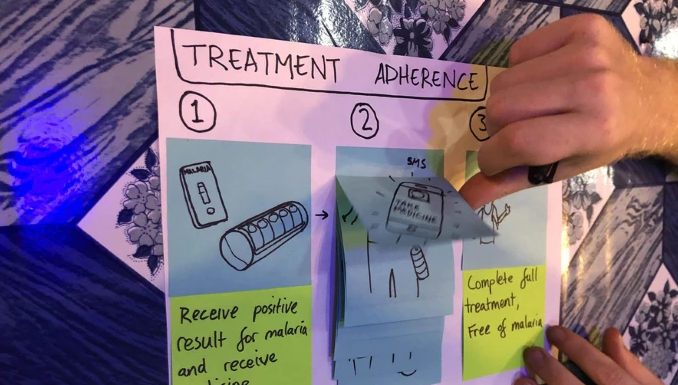
- Two products, collectively known as innovations in treatment adherence, work together to simplify treatment, provide treatment reminders, and encourage treatment completion. Miners preferred a light, compact tablet strip that separates daily prescribed dosages in individual packets. Each packet would also include a visual representation of how parasites in the body are decreased each day the treatment is taken. A second product - a wristband that uses an audible reminder to indicate when the user should take their treatment - would accompany the tablet strip.
- Participants favoured improvements to the current RDT programme - the Participants, Content, and Logistics (PCL) approach - to other prototypes (e.g., the MalaApp). The PCL approach would address the scaling up of testers, antimalarials, and other malarial commodities in difficult-to-access mining areas. Experiences shared by testers that inspired this solution were, e.g.,: "I went to the hospital for supplies and they didn't have any. I never came back".
Breakthrough ACTION Guyana piloted the RCCs and counseling checklist, branding for malaria testing and treatment services and treatment adherence handouts, and PCL approach (referral forms) from June to August 2019. In each pilot area, volunteers were trained to become new RDT testers, while active testers received a refresher training. Immediately after the orientation, FGDs were conducted to elicit feedback from trainers on the materials. Breakthrough ACTION and MoH conducted intermittent supervisory visits during the pilot period to monitor the use of the materials, collect completed forms and checklists, and coach testers on the use of the new products and practices. The project team plans to implement the finalised solutions at scale, with accompanying population-based baseline and endline evaluations.
The researchers stress that, when HCD is used for intervention design, "it should try to adhere to appropriate standards for scientific rigor like any robust qualitative research approach, while also trying to avoid biases about stakeholder experience and maintaining an open-minded agnosticism about the potential solutions to a design challenge. Some of the most essential principles of the scientific method are falsifiability, replicability, and generalizability." The paper explores each of these principles to guide others.
Although there are implementation concerns and limitations of the HCD approach (outlined here), the HCD process of rapid iteration of low-fidelity prototypes and co-creation with the planned SBC campaign's intended audience "allowed the project team to quickly apply learnings to improve, discontinue, or generate new prototypes....For example, miners...did not understand text-based materials due to literacy challenges; therefore, solutions had to be highly visual and direct." The researchers note that the benefit of using HCD to improve malaria outcomes can be seen in the numerous ideas generated, with perspectives across the public health and gold mining communities and with prototypes spanning product-, service-, and systems-level approaches, which demonstrates the multi-faceted nature of the challenge.
In conclusion: "Prior to this project, relatively little contextual knowledge was available about the populations at risk in the remote mining regions of Guyana, even among local health experts. HCD helped to draw back the curtain and dramatically expand understanding of the complex situational dynamics of malaria transmission and prevention through the elicitation and analysis of stakeholder experiential narratives."
BMC Public Health 21: 2287 (2021). https://doi.org/10.1186/s12889-021-12297-0.
- Log in to post comments