










































Inclusion Strategies in Multi-stakeholder Dialogues: The Case of a Community-Based Participatory Research on Immunization in Nigeria
Royal Tropical Institute (Akwataghibe, Dieleman); Vrije Universiteit Amsterdam (Akwataghibe, Broerse, Dieleman); Ogun State Primary Health Care Development Board (Ogunsola); Amsterdam Public Health Research Institute (Broerse); Morgan State University (Agbo)
"This article offers insights into if and how inclusion strategies worked in community dialogues within the framework of participatory research. It...is obvious that a power-free space within the societal context is not possible - exclusion still occurred within the socio-cultural environment..."
Community-based participatory research (CBPR) has been used to address health disparities within several contexts by actively engaging communities. Though dialogues are recognised as a medium by which community members and other actors can make their voices heard, power asymmetries can lead to the exclusion of communities from decision making in participatory practices and dialogues. This study aimed to explore the experiences in the dialogues between communities, health workers, and local government representatives in a CBPR project on immunisation in Nigeria. The researchers explore the possible exclusion mechanisms that could exist in dialogues and propose inclusion strategies to diminish the inequalities as much as possible.
CBPR - frequently used synonymously with "participatory action research" - emphasises collective inquiry and research based on experience and societal history. It comprises a cyclical process of fact-finding, planning, action, reflection, and re-planning. A core principle is the development of meaningful partnerships with communities to ensure marginalised populations have a genuine voice in the research. CBPR works to foster equitable partnerships and shared decision making between communities, professionals (experts), and researchers. These interactions often involve dialogues that are ideally a two-way flow of information that involves mutual listening, sharing, and questioning and that enables communities' views to be integrated as part of an iterative research process.
A research consortium was established to develop and implement a CBPR project to address the problem of poor immunisation utilisation and coverage in parts of Ilara and Ipara, two wards in the Remo-North local government area (LGA) of Ogun State, Nigeria. In 2015, Ilara's immunisation coverage was 26%, and Ipara's was 75%, so these particular areas were selected to shed light on the differences. Traditional and political dynamics in the state reflect the patriarchal nature of the society, with the community leaders (all or most of whom are male) and the male elders in the society having powerful roles in community decision making. In the households, men are also the primary decision makers on immunisation issues.
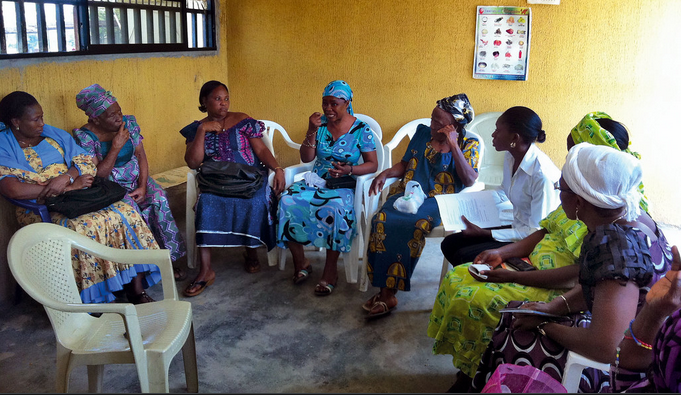
The research team developed a guiding checklist to ensure that relevant vulnerable and other groups were all represented in the dialogues. They presented the nomination checklist to traditional rulers and community leaders, who nominated community members in their respective wards. First, single stakeholder dialogues took place for the three groups: (i) community members per ward (who met separately by sex), (ii) health workers in their respective wards, and (iii) Remo-North LG officials. For the multi-stakeholder dialogues, a structured process was followed. To lessen feelings of intimidation and give community members some leverage in terms of issues that required voting, the number of community members was higher than those of professionals (6-7 versus 4-5, respectively). In each ward, the actions and plans formulated per group were compared and discussed within the joint dialogue groups to develop Joint Action Plans (JAPs) for change. After the multi-stakeholder dialogues, the participants, who now referred to themselves as the Joint Action Committees (JAC), implemented the JAPs in both wards over an eight-month period.
This exploratory and descriptive case study, using qualitative methods, addressed the question of how the use of inclusion strategies influenced consensus building and decision making in the multi-stakeholder dialogues. Data were collected through observation and semi-structured interviews with all 24 participants in the multi-stakeholder dialogues (12 per ward).
Three main types of influences controlled the directions and decisions in the dialogues: influences due to (i) experience and knowledge; (ii) hierarchy and status in society; and (iii) cultural norms and values. In essence, though a democratic process of consensus building and of decision making had been followed, many of the JAC community members had social, religious, or political influences they leveraged for community mobilisation and awareness creation on immunisation; health workers and LG officials had official authority, knowledge on immunisation, and control over information; and LG officials also had policy influence. All these were used in concert to influence the development (and execution) of the JAPs.
Scholars have described three categories of exclusion mechanisms during CBPR dialogues relating to the setting (circumstances), verbal communications, and behaviour (what is done). The results are presented according to these strategies. Approaches that addressed circumstances and verbal mechanisms resulted in some facilitation of inclusion, but only marginally; the main progress was made in relation to the behavioural component. In brief:
- Circumstances: Examples of strategies included: making sure the community members outnumbered the professionals; offering clear explanations on the participatory approach; and setting up single-group dialogues to ensure that the perspectives of the stakeholders were captured before the multi-stakeholder dialogues. Despite such efforts, overall, cultural, social, political, and economic powers of the traditional rulers exerted strong influence over decision making, even though the traditional rulers were not directly involved in the dialogues and a neutral venue away from the wards had been selected.
- Verbal inclusion: For example, health workers and LG officials were encouraged to avoid the use of jargon and to communicate in the local Yoruba language during the dialogues.
- Behavioural inclusion: These strategies included using methods that provided equal opportunities to speak and stimulating input of community members, especially women. (According to some respondents, during the dialogues, the Ilara young women especially were reticent, probably due to the social norms of keeping quiet before their elders and men.) The team also provided pre-dialogue explanations of the inclusion aim of the dialogues and held the aforementioned single stakeholder dialogues to ensure that all the perspectives of the three groups of stakeholders were captured.
Positive effects of these inclusion strategies include:
- Being aware of (and transparent about) asymmetry in relationships enabled LG officials and health workers to be more intentional about sharing decision-making and community members to be more intentional about taking responsibility for action. Channelling stakeholder influences towards producing positive outcomes proved useful.
- The dialogues provided a conducive space for people in the three groups (who would not normally have the opportunity) to talk to each other about important health systems issues. This enabled the establishment of new interactions between the stakeholders and initiated trust-building.
- Behavioural inclusion strategies enabled different community stakeholders to direct their influences towards achieving the collective goals of the collaboration. The pre-dialogue workshop was shown to be an effective strategy in this arena - enabling LG and influential community stakeholders to keep the inclusion aim in view throughout the dialogues. For instance, some LGA officials ensured that actions related to creating more awareness of the usefulness of immunisation in the communities also specifically reached out to the migrants and ensured that the migrants within the JAC led the discussions with their communities.
In essence, a successful process of change using the CBPR could include: (i) a situational analysis as a starting point for dialogues; (ii) single-stakeholder dialogues that would also enable identification of proper representation for vulnerable groups in the multi-stakeholder dialogues; and (iii) discussions on inclusion with key stakeholders to identify opportunities in view of strong/rigid local authorities.
Despite these efforts, exclusion can still occur and have an effect on the dialogues. For example, a key issue is the difference between participation and representation: There is a need to ensure the participation of the vulnerable groups is not merely symbolic. The study makes a case for the use of "boundary spanners" in this dynamic. These "elite" individuals (or community champions) can be a voice for the minorities and could have the opportunity to influence decision making. "However, the strong traditional influence seen in this study provides some insight into the limitation of using CPBR within the context for topics that would challenge cultural norms. It also highlights that for different contexts and topics, researchers must be aware of limitations of who can participate and contribute, and have their ideas accepted."
The researchers recommend further study to understand how exclusion of less privileged community members can be avoided during multi-stakeholder dialogues in the presence of power asymmetries between stakeholder groups. More in-depth study of intra-community power dynamics, especially within single-stakeholder dialogues, could give more insight into exclusion. They also suggest more research to display the role of CBPR in different contexts and topics, including sensitive issues.
In conclusion: "CBPR can enable local governments to develop effective partnerships with health workers and communities to achieve health-related goals even in the presence of asymmetries in relationships. Inclusion strategies in dialogues can improve participation and enable shared decision making, however exclusion of vulnerable groups may still occur. Intra-community dynamics and socio-cultural contexts can drive exclusion and less privileged community members require proper representation to enable their issues to be captured effectively."
PLoS ONE 17(3):e0264304. https://doi.org/10.1371/journal.pone.0264304. Image credit: © Peter Martin - via Flickr (CC BY-NC 2.0)
- Log in to post comments