










































Increasing the Demand for Vaccination through mHealth in Quetta City, Balochistan in Pakistan
Health Services Academy (Khan, Shahid, Akber); Expanded Programme on Immunization (EPI), Government of Balochistan (Panezai); United Nations Children's Fund, or UNICEF (Shahabuddin)
"...the timely awareness messages and IVR had persuaded parents to bring their children to the health centre for the due vaccinations."
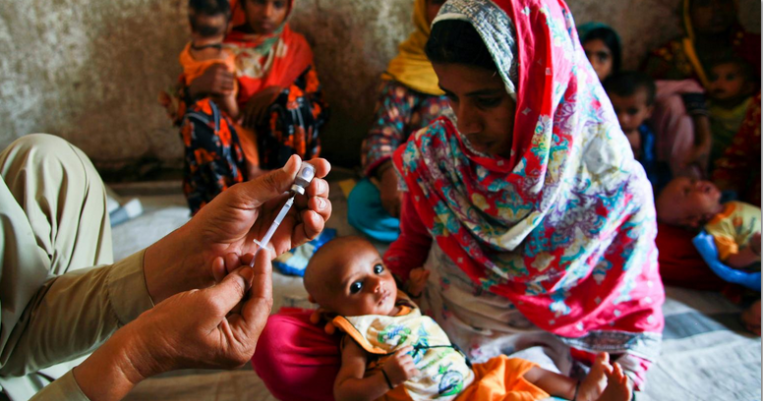
While Pakistan has an overall routine immunisation coverage of around 66% for fully immunised children (FIC), coverage in the province of Balochistan, which suffers from several political, tribal, and border conflicts, is much lower, at 29%. Demand-side barriers to immunisation in this context include: long distances to health facilities, low female literacy rate and lack of knowledge about immunisation, concern about vaccine safety and belief in local remedies, and lack of timely information and low confidence in the quality of services. This study assesses the feasibility of using mHealth intervention to address these issues through an artificial intelligence (AI) platform based on short-message service (SMS) and interactive voice response (IVR) to remind and persuade parents to get their children vaccinated in Quetta City, Balochistan.
The Expanded Programme on Immunization (EPI) Quetta initiated an automated platform with SMS and IVR, having developed messages in Urdu language (universally understood in Balochistan) and pilot-tested them. A unique number (6007) was used to send out the IVR and SMSs to the cellphones of the parents. There were three messages developed: (1) an IVR to ask parents if they had had their child vaccinated for the due vaccine in the immunisation schedule, (2) a public service message to persuade parents to take their children for vaccination, and (3) an IVR to the vaccinator reminding him/her of dropouts in their area of responsibility. Daily reminders and IVRs were sent to the cellphone numbers of all the mothers/fathers listed in the database/records. Responses were noted on the AI platform. If a parent answered "no" to question (1), the AI would generate appropriate response - e.g., sending the corresponding IVR to a vaccinator to approach them. After three days, the same parent was again approached with an IVR for a "yes" or "no" response.
Baseline data were collected from 1,600 eligible mothers/parents within the catchment areas of 75 basic health units (BHUs), and the AI platform was instituted with SMS and IVR starting in November 2017. After a period of about two months, an endline survey of 1,203 participants was performed. In addition, three key informant interviews (KIIs) were conducted, two with lady health supervisors (LHSs) and one with the World Health Organization (WHO) staff responsible for routine immunisation. There were also three focus group discussions (FGDs), each of which included 6-10 mothers with same literacy level.
Most of the respondents (both father and mothers of the children selected) were illiterate and had low incomes (under US$300 per month), though 67.8% owned a basic handset, and 30.8% owned an android mobile phone. At baseline, only 28.6% of the children were found to be fully immunised before the age of one.
Findings showed an increase in coverage for pentavalent, oral polio vaccine (OPV) and pneumococcal vaccines for first, second and third doses/boosters from the baseline to the endline data (see Figure 1 in the paper). There was a marked improvement in FIC following the intervention. According to the researchers, these data indicate that the delay in following vaccinations was reduced by the AI intervention. The AI platform reminded parents about vaccinations even if they had forgotten the vaccination date or lost the vaccination card. It was also found that the AI platform facilitated sharing responsibility of vaccinations between both parents.
Only 43.5% responded to the IVRs. Some of the main reasons for lack of response, when explored during FGDs, were: low literacy rate of mothers; mobile phones being with their husbands, which rang when their husbands were at work; and not knowing how to respond. Of those who responded, 80% said they had their child vaccinated on the due date.
In many cases, fathers were the owner of the mobile phone, and mothers did not have the access to it. However, despite being a patriarchal society, FGDs revealed that fathers showed a positive attitude and delivered the information related to vaccination to their wives and supported them to uptake the required vaccines for their children.
There were challenges in the implementation of the intervention. For example, the telecom service provider could not expand it to all cellular networks. Later in the project, a universal SMS portal was used for awareness outreach to all of the registered sample population. Reaching out to each child with a tailored/specific SMS or IVR was not possible.
Despite room for improvement, there was a high level of acceptance and desire to continue using the SMS and IVR services. One possible reason is that during the last decade, ownership of a handset among the populations has increased enormously, particularly in low- and middle-income countries (LMICs) like Pakistan. Generally, participants viewed the use of AI as beneficial in ensuring that children get all the needed vaccines. Some of the mothers were annoyed with the repeated calls and suggested that calls should be on the date of immunisation only. Participants recommended that the AI should be further developed with inclusion of the child's photo as a proof of identity, followed by SMS confirmation and data updated in the electronic records. "The technology should be developed based on working with the community to meet the needs expressed at the local level."
In conclusion: "Reminders through SMS and calls helped to sensitize and inform parents about vaccination and vaccination schedule which ultimately increased their demand for, and uptake of vaccines....[The] study demonstrates the potential for mHealth and AI to improve childhood immunization and addresses equity in the least developed areas of this country. The replication of the strategy in subnational immunization programmes could decrease morbidity and mortality due to VPDs [vaccine-preventable diseases]."
Journal of Global Health Reports. 2021;5:e2021095. doi:10.29392/001c.28999. Image credit: © UNICEF/PAKA2014-00354/Zaidi
- Log in to post comments