










































Increasing Vaccine Acceptance Using Evidence-Based Approaches and Policies: Insights from Research on Behavioural and Social Determinants Presented at the 7th Annual Vaccine Acceptance Meeting
University of Western Australia (Attwell); Perth Children's Hospital (Attwell); University of Erfurt (Betsch); Centre de Recherche du CHU de Québec-Université Laval (Dubé); Finnish Institute for Health and Welfare, or THL (Sivelä); Université de Sherbrooke (Gagneur); Università della Svizzera Italiana (Suggs); Swiss School of Public Health, or SSPH+ (Suggs); Imperial College London (Suggs); Fondation Mérieux (Picot); Sanofi Pasteur (Thomson - now with United Nations Children's Fund - UNICEF)
"The community of practice that has grown from the Fondation Mérieux annual meetings once again shared their experience with diverse, inspirational approaches to vaccine hesitancy that can be adapted to other settings."
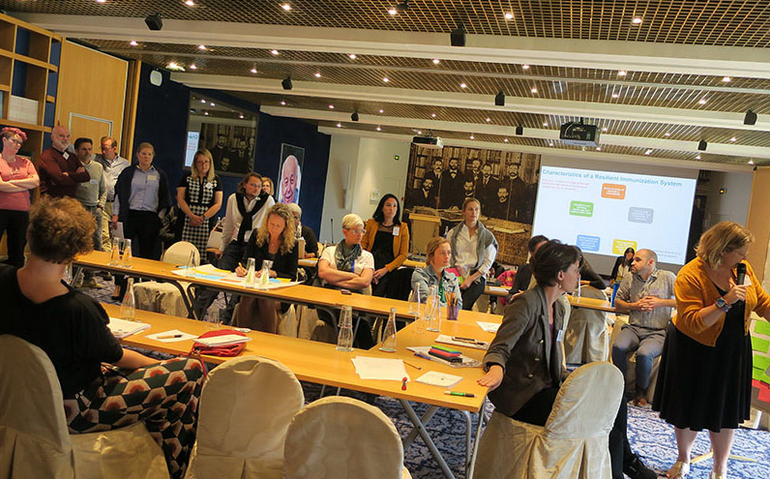
The field of vaccine acceptance research is growing, with the development, implementation, and evaluation of diverse, evidence-informed measurements and interventions to address vaccine hesitancy. These topics were at the heart of the Mérieux Foundation's 7th Annual Vaccine Acceptance Meeting, held September 23-25 2019, attended by 79 people from 24 countries and diverse sectors. This article summarises the discussions at the meeting.
Presentations on vaccine acceptance and uptake explored:
- Influences of motivation - In November 2018, a the World Health Organization (WHO) global expert group called Measuring Behavioural and Social Drivers of Vaccination (BeSD) was established to oversee the development of tools, including quantitative surveys and interview guides, for measuring and addressing the reasons for under-vaccination, and tracking consistent, comparable data. Following the introduction to BeSD's work, subsequent presentations focused on specific aspects of the behavioural and social drivers of vaccination. Clinical encounters with medical and allied health providers are a key example.
- Educating children - This approach for building vaccine confidence in future generations involves increasing technical knowledge, generating positive associations with vaccination, harnessing gamification, and supporting the rollout of vaccines to those in less prosperous nations.
- Other initiatives - For example, WHO and United Nations Children's Fund (UNICEF), in partnership with Gavi, the Vaccine Alliance (GAVI), the United States Centers for Disease Control and Prevention (CDC), and the Gates Foundation have set up The Vaccination Demand Hub to improve coordination and harmonise the delivery of support and technical assistance to countries.
- Behavioural insights - For example, the Behavioural Insights Team, created in 2010, assesses how psychological and behaviour insights, i.e. the way people make choices, respond to options, perceive the world, and behave, can be used to improve the design of policy. And the PromoVac study has shown how using motivational interviewing in an educational session fosters a patient-oriented and tailored session, welcoming parents at their individual level of knowledge while respecting their beliefs.
- Vaccine hesitancy and acceptance studies in low- and middle-income countries (LMICs) - In LMICs, study participation is sometimes motivated by political, social, and economic factors, e.g., the provision of free medical care. There are also other technical limitations and enablers that need to be considered in LMICs. However, examples are provided of work being done.
Presentations on training in vaccine acceptance looked, for example, at the International Pediatric Association Vaccine Trust Project, a multi-stakeholder global initiative that will aim to equip, empower, and galvanise health professionals to advocate vaccination through a blended-learning train-the-trainer programme containing eight evidence-based modules. "In addition to these more formal initiatives, healthcare providers need access to the right resources for effective communications that address hesitancy....Efforts should be focused on making such existing resources more easily available, for example via a central repository."
Presentations on resilience of vaccination systems focused on efforts to produce good health outcomes for all during a crisis and in its aftermath. "Resilience-building should draw from empirical research about existing and emerging threats to systems and populations." Furthermore: "Multicomponent strategies that ensure equitable access to vaccination services and quality of vaccination services (including training for healthcare professionals), as well as interventions to enhance vaccine confidence and ensure informed vaccination decision-making, are needed to promote vaccination programmes resilience. There is a need for country-level data to inform evidence-based communication strategies to address vaccination hesitancy. Misinformation on vaccination on the Internet and social media also needs to be addressed as part of resilience-building....Effective oversight and engagement with social media is another key pillar of vaccination systems resilience."
Presentations on mandatory vaccination looked at the various dimensions of this issue. In general: "Governments utilise a variety of levers from fines to exclusion from services such as schools and childcare and from welfare benefits, to impose consequences intended to motivate the vaccine-hesitant and change the behaviour of refusers. While restrictive mandates may play an important role in behaviour change and disease prevention, they also provoke concerns about balancing individual choice and liberty with disease prevention."
As noted here, throughout the meeting, presenters emphasised the importance of collaboration with partners and stakeholders and tailoring strategies to specific needs. Accordingly, the informal community of practice constituted by the meeting participants suggests that "it is possible to foster collaborations and to cross-fertilise by sharing new and exciting approaches, many of which themselves come from collaborations between members of the community of practice."
The 8th Annual Meeting, planned for September 2020 had to be deferred due to the COVID-19 pandemic. However, the community of practice plans to gather in the future to share new insights regarding maintaining vaccine demand during and after the pandemic and "will be well placed to lead global discussions about the rollout of severe acute respiratory syndrome coronavirus 2 (SARS-CoV-2) vaccines."
International Journal of Infectious Diseases, vol. 105, April 2021, Pages 188-93. https://doi.org/10.1016/j.ijid.2021.02.007; and Mérieux Foundation website, March 26 2021. Image credit: Mérieux Foundation
- Log in to post comments