










































International Adaptation and Validation of the Pro-VC-Be: Measuring the Psychosocial Determinants of Vaccine Confidence in Healthcare Professionals in European Countries
Observatoire Régional de la Santé (ORS) PACA (Garrison, Fressard, Verger); University of Turku (Karlsson, Soveri); University of Coimbra (Fasce, Rodrigues); University of Erfurt (Schmid, Taubert); Bernhard-Nocht-Institute for Tropical Medicine (Schmid, Taubert); University of Bristol (Holford, Lewandowsky); University of Potsdam (Lewandowsky); University of Western Australia (Lewandowsky); Abo Akademi University (Nynäs); University of Bristol (Anderson); University of Sherbrooke (Gagneur); Université Laval (Dubé)
"The ability to assess the psychosocial factors of vaccine confidence and their influence on vaccination behaviors in a systematic and culturally aware manner is important for the development and selection of interventions to increase HCPs' confidence in vaccines."
A recommendation from a healthcare professional (HCP) frequently drives patients' acceptance of vaccination for both themselves and their children. Research has also shown that HCPs with lower confidence in vaccines are less willing to recommend them to their patients. The original Professionals Vaccine Confidence and Behaviors (Pro-VC-Be) questionnaire is a validated tool to measure the determinants of vaccine confidence among several types of HCPs in French-speaking countries. The purpose of this study was to adapt the original Pro-VC-Be to be applicable in a wider range of contexts and to validate the adapted international version (I-Pro-VC-Be) across European countries.
First, the paper briefly presents the theoretical foundations of the original validated version (Pro-VC-Be) - see also Related Summaries, below - and describes its dimensions. In brief, the original Pro-VC-Be consists of 2 parts: questions probing recommendation (HCPs' tendency to recommend vaccines to their patients) and self-vaccination behaviours (HCPs' personal vaccine uptake), and questions measuring the psychosocial determinants of vaccine confidence and vaccination behaviours. The paper then presents the steps researchers took to adapt and validate it in several European countries in order to propose an international version. Two items measuring professional norms were added, outside of the I-Pro-VC-Be, to take potential cultural differences and social desirability bias into account.
Each participating country - Germany, Finland, France, and Portugal - conducted interviews with HCPs (N=28, at least 5 from each country) of various types from October to November 2021 to assess the meaningfulness and appropriateness of the items within each cultural context and to obtain information on whether the items were interpreted as intended. Several adaptations were made based on results of these cognitive interviews. Then, HCPs involved in vaccination (mainly general practitioners (GPs) and paediatricians) completed a cross-sectional online survey in 2022. The long version of the I-Pro-VC-Be consisted of 44 items: 10 concerning vaccination behaviours (recommendations to patients and self-vaccination) and 34 comprising the psychosocial determinants (10 factors), with the 2 added items measuring professional norms of HCPs. The short version consisted of 10 items. A 10-factor multigroup confirmatory factor analysis (MG-CFA) tested for measurement invariance across countries.
In all, 2,748 HCPs participated. The 10-factor structure fit was acceptable to good everywhere. The final MG-CFA model confirmed strong factorial invariance and showed very good fit. Both the long- and short-form I-Pro-VC-Be had good criterion validity with vaccination behaviours. For example, modified Poisson regression models showed, for the long-form version of the I-Pro-VC-Be, that HCPs with higher scores of safety perception, benefit/risk balance, collective responsibility, commitment to vaccination, self-efficacy, and trust in authorities were significantly more likely to report that they recommended vaccines to their patients nearly systematically (score >90%) than those with below-average scores.
Another result of the I-Pro-VC-Be validation process was the presence of reported "reluctant trust" in all 4 participating countries. Reluctant trust is considered the "leap of faith" lay people take when it comes to trusting health authorities, vaccination policies, and vaccines themselves, even if they still have doubts. The findings of this study confirm that reluctant trust is present even among highly educated groups (physicians), is cross-cultural, and exists in societies with strong professional vaccination norms. This finding is important as it reflects HCPs' hidden uncertainties or misunderstandings regarding vaccination that could lead to vaccine hesitancy if it not adequately addressed.
The final, validated I-Pro-VC-Be long-form tool with 43 items (10 regarding vaccination behaviours and 33 regarding psychosocial determinants) is publicly available for use in 6 languages. The final, recommended I-Pro-VC-Be short-form tool consists of 10 items, one for each dimension of the long-form tool. Two generalised items for perceived vaccine ("Vaccines are safe") and the perceived benefit/risk balance of vaccines ("The benefits of vaccines outweigh their potential risks") were recommended after this analysis was completed to offer an adaptable tool for various country and cultural contexts.
Thus, the results indicate that the questionnaire "accurately measured the same determinants of the core and intermediary factors in the same manner across various country and cultural contexts, including among countries with differing professional norms surrounding vaccination." These findings suggest that I-Pro-VC-Be is "suitable for conducting cross-national comparisons of determinants of vaccine confidence among HCPs. The existence and use of a standardized measure will also facilitate future meta-analyses of HCPs' vaccine confidence and related topics, such as the effectiveness of interventions", and may be "useful for investigating, for example, how country characteristics (i.e., health policy, education, social cohesion) may affect HCPs’ vaccine confidence and behaviors."
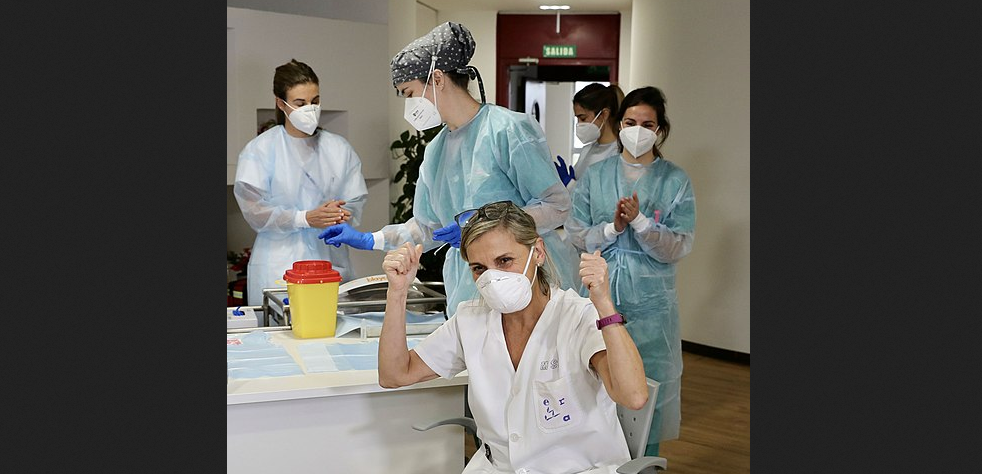
Expert Review of Vaccines. https://doi.org/10.1080/14760584.2023.2242479. Image caption/credit: Vaccination process against Covid-19 in Gijón (Asturias, Spain). Administración del Principado de Asturias via Wikimedia (CC BY-SA 4.0)
- Log in to post comments