










































Introducing FOAM: A Framework to Analyze Handwashing Behaviors to Design Effective Handwashing Programs
Water and Sanitation Program (WSP)
"FOAM is a framework designed to help in the development, monitoring, and evaluation of handwashing behavior change programs."
From the World Bank's Water and Sanitation Program (WSP), this report describes the strategy behind WSP's handwashing behaviour change programme, the Global Scaling Up Handwashing Project. This project, launched in November 2006, has been implemented in Peru, Senegal, Vietnam, and Tanzania. The focus is on learning how to apply promotional approaches to behaviour change to generate widespread and sustained improvements in handwashing with soap at scale among women of reproductive age (ages 15-49) and primary school-aged children (ages 5-9).
In response to the need for a common conceptual framework, WSP spearheaded the development of FOAM, which is based on behavioural determinants that either promote or constrain behaviour change. The framework, based on the PERForM framework of Population Services International, was developed through a systematic process that relied on group conceptual exercises building on theory and findings from research. This working paper explores the FOAM framework; it is intended for use by programme managers implementing handwashing behaviour change initiatives, as well as multilateral and bilateral agencies, academic institutions, and government and non-governmental organisations (NGOs) working in water and sanitation.
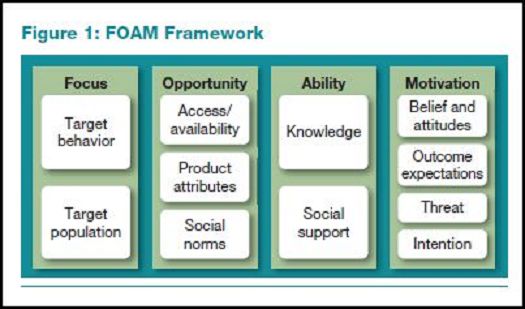
An excerpt from the paper follows which describes the framework: F [Focus], O [Opportunity], A [Ability], M [Motivation] (footnotes have been removed by the editor throughout):
"Focus: Who Is the Target Audience and What Is the Desired Behavior?
Clearly defining the target audience and the desired behavior are the critical elements of any intervention. Examples of audiences for handwashing behavior change include school children, primary caregivers of children under age five, and street vendors involved in food preparation. Handwashing with soap is the desired behavior, but implementers must also decide whether interventions will be aimed at promoting frequent and regular handwashing, or handwashing only at key moments, such as after defecation or before handling food. An intervention may also describe how handwashing should be performed (for example, the duration of handwashing, performance with or without running water, drying, and so forth).
Opportunity: Does an Individual Have the Resources to Perform a Behavior?
Derived from Diffusion of Innovation theory, health promotion, and quality-of-care research, opportunity determinants influence the chance of the behavior being performed. They include but are not limited to social norms, product attributes, and access to or availability of products or services. Opportunity determinants are often the most external factors affecting a person's behavior, over which they may have less control.
Ability: Is the Individual Capable of Performing the Particular Behavior?
Ability determinants reflect an individual's perceived or actual capacity to perform a given behavior (contingent on opportunity and motivation). Some ability determinants are knowledge, self-efficacy (an individual's belief in his capacity to carry out a specific behavior), and social support...
Motivation: Does the Individual Want to Perform the Behavior?
Motivation determines whether, given opportunity and ability, performing the behavior is in an individual's self-interest. Some motivation determinants are personal risk assessment (e.g., Am I at risk for HIV/AIDS?) and outcome expectations (e.g., What will happen if I get tested for HIV/AIDS?). FOAM's motivation determinants are drawn mostly from social cognition models of behavior change. Within the framework, motivation is thought to have a direct influence on behavior, though it is moderated by both ability and opportunity. For example, a minibus passenger may want to use a seatbelt because she fears the risk of an accident (motivation), but if there are no seatbelts installed (opportunity) or she does not know how to fasten a seatbelt (ability), then she cannot carry out this behavior. The reverse is equally feasible. A man may be near a kiosk that sells condoms (opportunity) and know how to use them (ability), but not perceive he is at risk of HIV/AIDS with his current partner (motivation).
Opportunity Determinants
In the context of handwashing, there are three opportunity determinants:
- Access/Availability...refers to access to soap and water for handwashing....Visual cues are...critical in encouraging the development of habitual behavior. If a handwashing station is next to a latrine, people are far more likely to wash their hands immediately after latrine use.
- Product Attributes: Soap and water have certain attributes that may function as either a catalyst or an obstacle to handwashing, depending on when and where the soap is used....For water, attributes such as clarity, color, and odor influence handwashing. The attributes of a handwashing facility, such as cleanliness and odor, may also influence its use and, therefore, handwashing behavior."
- Social Norms...are the rules that govern how individuals in a group or society behave....For example, an individual may learn that handwashing is the social norm by seeing others wash their hands in a public place....Realignment of social norms takes time and may require the intervention of a role model or figures of authority such as religious leaders or doctors who can persuade others, through public display or endorsement, to carry out a particular behavior...
Ability Determinants
There are two ability determinants in FOAM:
- Knowledge...It is important to emphasize that knowledge, while critical, is not adequate to spur behavior change. The knowledge-behavior gap explains in part why individuals engage in certain behaviors even when they are aware of the associated risks.
- Social Support...takes several forms: physical (a mother helps her child to work up lather from soap); emotional (a health worker praises a mother for washing her hands before feeding her infant); or informational (a teacher tells children why they should wash their hands with soap before eating). Support may also take the form of practical advice (a woman helps her neighbor build a handwashing station).
Motivation Determinants
Four determinants provide motivation for handwashing with soap:
- Attitudes and Beliefs...One key aspect of attitude or belief is an individual's perceptions about the main causes of events in his or her life: this is usually referred to as locus of control. Individuals with an internal locus of control have a strong sense of authority over their own lives....Individuals with an external locus of control are less likely to engage in healthy behavior and may display high levels of resignation and apathy about the future...
- Expectations...are perceptions of the consequences of handwashing with soap. If perceived outcomes are positive or beneficial, the behavior is more likely. The converse applies as well. For example, a mother may not wash her hands with a strong-smelling soap before she feeds her child if she expects this will cause the child to fuss. Expectations can also be longer term (mothers may perceive that handwashing will lead to decreased immunity)....Another type of expectation is the subjective norm, the anticipated opinion or approval of an important or influential person relative. For example a woman may perceive that she is expected by her mother-in-law to wash her hands before feeding an infant.
- Threat...has two dimensions: perceived susceptibility, which is an individual's assessment of the risk posed by a particular condition or illness, and perceived severity, an individual's assessment of the seriousness of the condition and its potential consequences....For example, a mother will worry more about a cold in a two-week-old baby than in a three-year-old child, particularly if she is aware babies are more susceptible to pneumonia...
- Intention...This might entail buying soap, fetching water, or ensuring a handwashing station is functional. Intention is thought to be a powerful motivator of behavior...
...The FOAM framework is not static; it builds on other hygiene behavior change approaches and programs....Users have an important role to play in refining and adapting it for country- or population-specific contexts, which means the FOAM framework is continually evolving to reflect current best practice...
Key Points [when applying the FOAM framework]:
- Formative research can assist program managers to research and understand target audiences, plan interventions, and allocate resources efficiently.
- Doer/non-doer analysis often reveals factors important in promoting behavior change.
- Research can include quantitive and qualitative studies...
- FOAM can be applied to do the following:
- Focus interventions
- Analyze results of available formative studies
- Inform the design of new research
- Inform the development of the program
- Monitor appropriate indicators..."
WSP website, February 8 2012; WSP website, February 8 2012; and emails from Amy Grossman and Jacqueline Devine to The Communication Initiative on February 9 2012 and June 8 2012, respectively.
- Log in to post comments