










































Iterative Adaptation of a Mobile Health Intervention Across Countries Using Human-Centered Design: Qualitative Study
Heidelberg University (Isler, Bärnighausen, Greuel, McMahon); Nouna Health Research Center (Sawadogo, Kagoné, Sié); University College London (Harling); Harvard TH Chan School of Public Health (Harling, Bärnighausen); Harvard University (Harling); Africa Health Research Institute (Harling, Bärnighausen); University of the Witwatersrand (Harling); Stanford University (Adam); Johns Hopkins University (McMahon)
"Design research provided valuable insights in terms of developing a framework for video adaptation across settings, which other interventionists and scholars can use to guide adaptations of similar interventions."
Culturally grounded, mobile health (mHealth) video interventions have had positive effects in diverse settings. Variations in terms of the meaning that individuals across cultures derive from a given message can however occur, even in seemingly straightforward formats. This study outlines experiences and priorities adapting a suite of South African maternal nutrition videos to the context of rural Burkina Faso. The process ultimately led to the development of a Video Adaptation Framework.
Developed by researchers working with the Philani Maternal Child Health and Nutrition Trust in South Africa, the initial suite of videos (viewable here) included messages related to child development, family planning, and healthy eating. As the formative study in Burkina Faso focused on maternal nutrition, the researchers adapted a relevant subset of the South African videos that covered food groups, special nutrients, and tips for eating well on a budget. They worked with community health workers (CHWs) and Mentor Mothers (MM), who visited mothers at home and informed them about maternal nutrition during pregnancy and breastfeeding by showing them the videos via tablets. The study team trained CHWs and MMs on the videos in terms of content (maternal nutrition) and delivery (how to use tablets).
The researchers had initially envisioned presenting the videos in a one-on-one format, but via observations, they learned that other family members (cowives and children) were interested in watching the videos, and some partners wanted to take a look. This preference was accommodated: first, by not repressing this natural change of delivery format and later, by explicitly allowing a mother to invite cowives and husbands to join the intervention.
The qualitative study in Burkina Faso was guided by principles of human-centred design (HCD), which directs researchers to capture details of an audience's needs and context and to maintain a focus on empathising with and addressing those needs throughout product development. In 2 urban health centres in Nouna town and 4 rural health centres in Nouna region, the researchers conducted 10 focus group discussions (FGDs) with mothers, MMs, and CHWs, as well as 30 in-depth interviews (IDIs) and 30 observations. These processes enabled the researchers to consider participants' ideas and concerns not only in relation to the original videos but also on the adapted versions to ensure that the final product would be attractive and relevant in this specific context.
The researchers propose a 3-pronged Video Adaptation Framework that places the aim of video adaptation at the centre of a triangle framed by end recipients, health workers, and the environment.
- End recipients (pregnant or lactating mothers) directed the researchers to: (i) align the appearance, priorities, and practices of the video's protagonist to those of Burkinabe women; (ii) be mindful of local realities - whether economic, health-related, or educational; and (iii) identify and routinely reiterate key points throughout videos and via reminder cards.
- Health workers (CHWs and MMs delivering the videos) guided the researchers to: (i) improve technology training, (ii) simplify language and images, and (iii) increase the frequency of their engagements with end recipients.
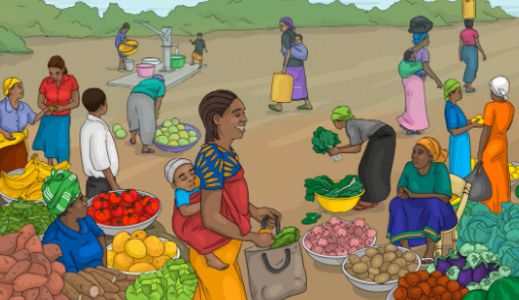
- In terms of the environment, respondents suggested that the videos localise climate, vegetation, diction, and how foods are depicted. For example, some respondents had problems understanding certain food names in Dioula, which was the second language for many of them. Therefore, the researchers used photos taken at the local market as a basis to make recognisable food illustrations. They also included zoom-ins to allow for quick identification of several foods. "In contrast to the mothers who saw the original videos, mothers who saw the adapted version were excited to recognize local foods: they repeated the food names and confirmatively clicked their tongues during video viewing."
Cultural sensitivity has been theorised to be categorised into 2 layers: the surface structure and the deep structure. Surface structure changes include changes to increase acceptability of an intervention through attention to observable differences between cultures such as brands, foods, or locations; the adaptation of the maternal nutrition videos fell almost exclusively into this category. Deep structure changes, which are necessary for programme impact, include influences on the health behaviour of the intended population such as family structures, religion, politics, and economics. The pregnant and breastfeeding women in this study underlined that their lives are embedded in social norms and gender rules that could inhibit their range of choices (despite personal preferences). Looking ahead, the researchers aim to further refine the intervention to account for gender and to more deeply examine how men's roles in fostering child nutrition could be bolstered in the videos.
In short: "The desires and needs of end recipients and health workers, coupled with recognition of the environment within which these actors operate (rural Burkina Faso), proved instrumental in the adaptation process and in the development of [the] Video Adaptation Framework." The researchers indicate that this framework may be generalisable to other interventions that aim to adapt health communication across settings.
JMIR Mhealth and Uhealth, Vol 7, No 11:e13604.
- Log in to post comments