










































Manual - Gender Action Learning System (GALS) Implementation Toolkit
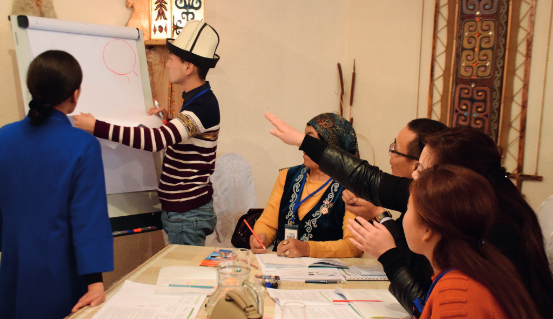
"New models for gender relationships become a 'normal' part of thinking and behavior for both men and women, where general principles of human rights are integrated progressively into real life as 'natural things' in an interesting and lively format..."
The Gender Action Learning System (GALS) is a community-led empowerment methodology to promote more harmonious and violence-free relationships in families and communities. It aims to connect and build synergies between various groups of people in a pursuit of the common vision of promoting a harmonious and life free of gender-based violence (GBV) for women and girls within their families and the wider communities.
The outcome of a multi-year effort to pilot and adapt the GALS methodology to the local context, this manual was developed within the framework of the European Union (EU)-funded project "Across Generations and Gender Borders - Communities Combatting Gender-Based Violence in Kyrgyzstan". Implemented by United Nations (UN) Women in Kyrgyzstan in partnership with HelpAge International and Agents of Change, the project focuses on non-consensual marriage practices by tackling the root causes of violence against women and girls, which include deeply rooted patriarchal attitudes, pervasive gender stereotypes, and harmful social norms.
The manual is a translation and adaptation of the manuals developed by Dr. Linda Mayoux, the author of the GAMEchange family of empowerment methodologies, and is based on the methodology piloted in the Kyrgyz Republic by the International Fund for Agricultural Development (IFAD) in 2016.
GALS is based on the principles of good practice in the field of adult education and participatory methodologies. However, the goal of GALS is not to increase the knowledge of participants by imposing it from outside, but instead to focus on examples of positive change already occurring - heightening interest in new changes, awareness, and discussion between participants. Its goal is to advocate for change at the macro-level by helping participants develop strong visions for change and concrete strategies and plans to change their lives for the better and, through personal experiences, broaden the minds of their family members, colleagues, and communities.
In the process of change as outlined in the manual, GALS supports leadership qualities of every person and helps women and men (in communities and organisations) identify their strengths, responsibilities, and contributions. GALS also helps participants identify their personal weaknesses and hone and exercise their listening skills, while further teaching them how to work with others. It provides a platform for each participant to take ownership of the process of change and supports them in the further dissemination of the concepts and transformation of others in their communities.
One of the key tools used in the GALS process is drawing, which is considered a practical exercise that is useful for thinking and accessing the subconscious mind and inner thoughts. It is also an important tool for inner change through analysis of one's own behaviour and relationships with other people. In addition, drawing can facilitate free expression of thoughts and ideas, including those that are difficult to say in words, and encourage free relationships within the group.
In total, 1,000 printed copies of the manual were published and distributed among partners from the Ministry of Labor and Social Development, international development organisations, representatives of local self-government, and civil society.
English; Kyrgyz; Russian
106 (English); 115 (Kyrgyz); 109 (Russian)
United Nations Kyrgyz Republic website, May 4 2021. Image credit: Linda Mayoux and Vitaliy Konovalov
- Log in to post comments