










































My Husband's Denial (O Meu Marido) [DVD]
Image
SummaryText
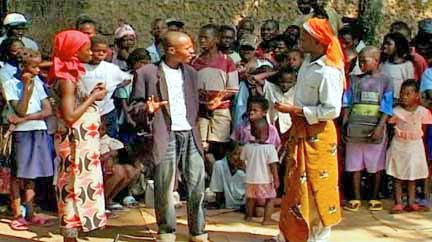
My Husband's Denial is a 20-minute video produced by Family Health International (FHI) in Mozambique which shows participatory performances of a grassroots theatre troupe called "O Teatro do Oprimido." The documentary combines footage of the theatre group's performances and the real-life experiences of community members around issues related to men getting tested for HIV and giving support to their pregnant wives. The video opens with members of the troupe deciding on the topic for their next presentation, which will be offered free of charge in the community and is advertised by word of mouth. They select the refusal of men to go for testing when their pregnant wives are known to be HIV-positive as the topic. During the community performances, the group's facilitator stops the action and asks the audience to define the problem. He then asks whether anyone can come up with a better solution and he invites anyone who wants to propose a solution to step into a role and propel the skit toward a different conclusion.
The video's footage of the theatre troupe acting out domestic dramas is interspersed with real-life scenes of pregnant women being tested for HIV and receiving their results. Several of the women refer to their husbands' reluctance to be tested, and they recount the excuses offered. Gradually, the camera settles on a calm, smiling woman whose actual experience provides the main counterpoint to the theatrical presentation. She is HIV-positive and pregnant. Her husband says he does not have time to go for the test. She suspects the real reason is that he is afraid of getting a positive result. She recalls how they met and fell in love. Viewers are introduced to her husband, "an appealing, soft-spoken man", as he reminisces about the same period. After he watches one of the skits, the camera follows the husband home, where he tells his wife that he has decided he will go for testing. She is thrilled and the following sequence shows him getting dressed to go for the test at the health centre.
The video is a Força Maior Production, directed by Rogério Majate, entirely made in Mozambique, and funded by the United States Agency for International Development (USAID). Alvim Cossa, director of O Teatro do Oprimido, provided advice on the group's methodology.
To order an English-subtitled copy of the 20-minute DVD, email publications@fhi.org with My Husband's Denial in the subject line. For a Portuguese copy of the DVD, write O Meu Marido in the subject line.
The video's footage of the theatre troupe acting out domestic dramas is interspersed with real-life scenes of pregnant women being tested for HIV and receiving their results. Several of the women refer to their husbands' reluctance to be tested, and they recount the excuses offered. Gradually, the camera settles on a calm, smiling woman whose actual experience provides the main counterpoint to the theatrical presentation. She is HIV-positive and pregnant. Her husband says he does not have time to go for the test. She suspects the real reason is that he is afraid of getting a positive result. She recalls how they met and fell in love. Viewers are introduced to her husband, "an appealing, soft-spoken man", as he reminisces about the same period. After he watches one of the skits, the camera follows the husband home, where he tells his wife that he has decided he will go for testing. She is thrilled and the following sequence shows him getting dressed to go for the test at the health centre.
The video is a Força Maior Production, directed by Rogério Majate, entirely made in Mozambique, and funded by the United States Agency for International Development (USAID). Alvim Cossa, director of O Teatro do Oprimido, provided advice on the group's methodology.
To order an English-subtitled copy of the 20-minute DVD, email publications@fhi.org with My Husband's Denial in the subject line. For a Portuguese copy of the DVD, write O Meu Marido in the subject line.
Publication Date
Languages
English, Portuguese
Source
FHI website on May 15 2008 and June 23 2009.

- Log in to post comments