










































Playing for Change: Improving People’s Lives Through Football
School of Public Health and Community Medicine, UNSW, Australia (Nathan, MacKenzie, Shwe, Bunde-Birouste), Centre for Health Equity Training Research and Evaluation, UNSW, Australia (Kemp), University of Nottingham, Ningbo, China (Evers)
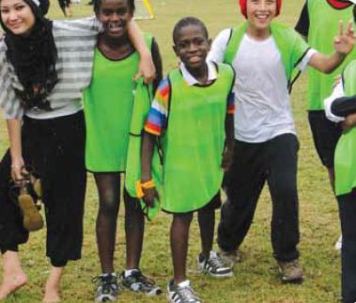
This research report examines a sport-for-development programme, Football United, involving refugee, immigrant, and disadvantaged youth and children in Australia.
Football United is a grassroots approach using a football (also known as soccer) development programme to foster social cohesion within areas with high refugee settlement in Australia through leadership, skills development, mentoring, and the creation of links with a range of local community leaders and organisations. Football United was conceived as a health promotion/social change intervention run by the University of New South Wales (UNSW) School of Public Health and Community Medicine. Developed through a participatory community building health promotion methodology, it has expanded from a number of small-scale activities (camps, weekly community programmes) to include regular school programmes, Saturday morning programmes, camps, large-scale tournaments, personal development programmes, and opportunities to represent Football United on a global scale. The study was funded by an Australian Research Council (ARC) Linkage Grant to investigate the implementation of Football United and its impacts.
The ARC research involved "a mixed methods design, following two Football United school-based programs..., compared with two similar schools with no involvement in Football United. The 'dose response' model used compared those with no involvement in the Football United program at a single point in time - enabling them to then participate in the program following measurement - with those who had lower or higher levels of participation...", reflecting the ongoing settlement process of refugee children and youth. Methods included a self-completed survey and face-to-face interviews with a sample of those who completed the survey, as well as interviews with key informants in the schools and wider community. "The ARC study results are complemented in this report with Football United’s ongoing monitoring and evaluation (M & E) findings to provide a synthesis of the programme’s overall impact."
Data showed that 84% of young people surveyed said they felt a bit or much better since coming to Football United. 85% of young people surveyed said Football United had helped in other ways (than football). Boys in Football United schools had significantly lower scores on a measure of peer-related problems than boys in comparison schools (p < 0.05, ARC study). Football United boys in the study had significantly higher scores on pro-social behaviour than boys surveyed at the Comparison schools (p < 0.05, ARC study). Football United participants reported significantly better other-group (affiliation with groups outside of homogeneous grouping) orientation than comparison school participants (p < 0.05, ARC study). 79% of Football United participants indicated they were not able to participate in organised club football (M & E findings).
Key recommendations include the following:
- "Create partnership with local communities in design and delivery.
- Run weekly programs for at least two terms (20 weeks) and offer multiple opportunities to participate at different levels, from being a playing participant through to coaching and coordinating at low or no cost to participants and build on and support existing school curricula objectives.
- Engage with the full diversity of participants by providing a safe, supported and structured environment underpinned by a focus on building local capacity, linkages and relationships within and across school, geographic, cultural and organisational boundaries.
- Tailor the approach to meet the needs of each local community with particular attention to participation by girls and young people who are learning English, and to maximise the building of cross cultural relationships.
- Go beyond just playing opportunities, to ensure the impacts we have found on peer, social and cross cultural relationships. These include active mentoring, building life skills and leadership opportunities and a values base that promotes respect, team work, and fair play.
- Utilise a school-based platform to offer a convenient, supportive and trusted location, familiar to young people and their families."
Emails from Dr. Anne W. Bunde-Birouste to The Communication Initiative on February 25 2013 and February 26 2014.
- Log in to post comments