










































Programming with Adolescent Boys to Promote Gender-equitable Masculinities
Gender and Adolescence: Global Evidence (GAGE)
"There ... is a lack of clear, synthesised evidence about working effectively with adolescent boys in low- and middle-income countries (LMICs) to promote gender-equitable masculinities. This review is intended as a contribution to filling that gap."
From the Gender and Adolescence: Global Evidence (GAGE) programme of the United Kingdom, this review of 36 studies explores what works with adolescent boys and young men to promote more gender-equitable masculinities. Written as a narrative review, it results from an assessment of studies "with a range of evaluation designs; the key requirements were adequate description of methodology and a valid comparison between participants and non-participants, or of attitudes and behaviour before and after participation." The reviewers chose a mix of qualitative and quantities studies with over half using the Gender-Equitable Men (GEM) Scale to measure attitude change.
Study limitations include:
- Lack of long-term studies - only three reported findings a year or more out from the programme end.
- Few compared impacts of different programme activities.
- None compared effectiveness of single-gender or mixed settings.
- Only one investigated comparing a school club programme versus a community club programme.
The review looked at programmes in 24 low and middle income countries (LMICs) primarily in sub-Saharan Africa and South Asia. " While a few involved some media activities alongside face-to-face informal education and discussion, the focus was very much on personal transformation as a route to social change..." aiming to change attitudes, norms, and behaviour. Age ranges varied: "Around half worked with young adolescents aged 10-12, generally as part of a larger age range, and two-thirds included boys and young men aged 14 and over (a few programmes spanned the entire adolescent age range of 10-19)....Most were run by non-governmental organisations (NGOs), though most partnered with government or research institutions; involvement of businesses or faith-based institutions was rare." All provided facilitator training, working to challenge their gender-inequitable beliefs and behaviour. Half involved community outreach via meetings or events, some worked in schools via curriculum integration for clubs.
In addition to health education and communication skills training, 16 of 34 programmes "had an explicit main objective to promote gender-equitable masculinities. The others focused on transforming gender norms more broadly, worked with boys as a stakeholder group in the context of girls’ empowerment programmes, or were youth development programmes with gender equality components. The core activity undertaken by almost all programmes was gender equality education; the most common modules included consent in sexual relationships, positive masculinities, and gender-based violence, which were covered by at least two-thirds of programmes." Sport training was common to 10 programmes, but there was little focus on economic empowerment - vocational training, financial literacy or savings and loan access. This was flagged as a weakness by participants.
Key impacts include:
- reductions in discriminatory attitudes
- increases in gender-equitable behaviour, with positive impacts on gender-based violence, communication with partners, gender divisions of labour, and interaction with girls outside the family.
- fewer evaluations recording positive changes in attitudes to child marriage, girls’ education, and attitudes to girls doing sport.
- some programmes achieving a 30% increase in the number of participants adopting more gender-equitable attitudes to gender roles.
Few or no changes were seen in some programmes on homophobic attitudes, "girls’ mobility (balancing increased commitment to free movement with concerns about girls’ safety), attitudes to sexual relationships, and behaviour around gender-based violence."
Recommendations for effective programmes include:
- "Ensure safe spaces and sufficient programme time for critical reflection....There is some evidence that gender-synchronised approaches (some single-sex, some mixed-group discussions) provide the greatest opportunities for learning, attitude and behaviour change."
- "Invest in good facilitation."
- "Plan for programmes of six months or more, and design them to promote regular attendance."
- "Schedule discussion of sensitive issues only after rapport has been developed between participants and facilitators..."
- "Reframe programmes to avoid casting boys and young men as ‘the problem’..." possibly including more vocational skills and economic strengthening components.
- "Pay greater attention to intersectionality and accessibility, and relevance of programmes to marginalised groups...."
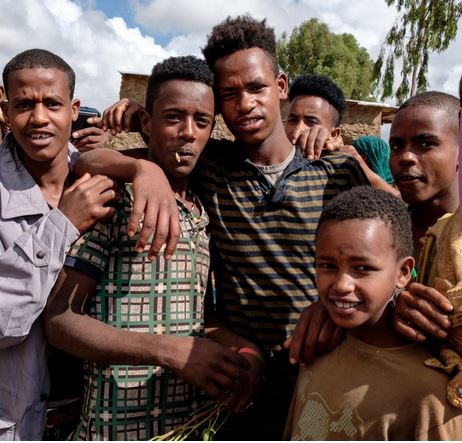
Innocenti Research Digest | Adolescence Issue 13, April 2019, accessed on August 8 2019. Image credit and caption: © Nathalie Bertrams/GAGE 2019, 'Qeerroo group in East Hararghe, Oromia, Ethiopia'
- Log in to post comments