










































Qualitative Assessment of Vaccine Hesitancy in Romania
Iuliu Hațieganu University of Medicine and Pharmacy
Health systems all over the world are confronted with a rise of cases in which individuals hesitate, delay, and even refuse vaccination, despite availability of quality vaccine services. In Romania, for example, measles and mumps vaccination uptake dropped from 95% in 2010 to 87% (for dose I) and 74.7% (dose II) in 2017. The scientific vaccination community advises that, in order to promote vaccine acceptance, we should understand the factors that determine vaccine hesitancy (VH) and tackle each of them individually. In March 2012, the Strategic Advisory Group of Experts (SAGE) on Immunization established a Working Group (WG) to address the problem of VH. The researchers of the present observational cross-sectional survey conducted field testing of the Vaccine Hesitancy Scale (VHS), as it was developed by the SAGE WG, in Cluj-Napoca city, Cluj County, Romania.
Created in 2015, the VHS is designed to quantify VH prevalence in a population, establish which vaccines generate the highest percentage of hesitancy, and allow a qualitative assessment of the individual's reasons for hesitance. It considers VH to be a decision-making process that depends on people's level of commitment to health/risk culture (1st axis) and on their confidence in health authorities and mainstream medicine (2nd axis).
A total of 452 individuals were included in the study. Participants were recruited from a source population consisting of parents and/or guardians (hereafter referred to as parents) who accompanied their children to any of the 4 paediatric clinics in Cluj-Napoca for a consultation and/or hospitalisation between the May 1 and June 30 2018. The VHS and Matrix of Determinants (MxDt) (recommended by SAGE WG) for reasons people gave to justify their hesitancy was interpreted by qualitative thematic analysis (QTA) to ensure the validity and reliability in detecting hesitancy across various cultural settings and to permit global comparisons.
The researchers found a VH of 30.3%, with a prevalence of those who refused a vaccination among hesitant individuals of 36.1%. Overall, 11.7% of parents reported refusing to vaccinate their child. Among the VH responders, the varicella vaccine generated 35% hesitancy, measles vaccine 27.7%, human papillomavirus (HPV) 24.1%, and mumps vaccine 23.4%. The QTA values for percent agreement ranged from 91% to 100%, and Cohen's Kappa values ranged from 0.45 to 0.95.
Among the contextual influences identified for VH were:
- "Media" - Of note here is the role of the internet and the emergent role of social social media such as Facebook, in particular, for its propensity to share anecdotal experiences, anti-vaccines campaign, and science-denigrating content.
- "Leaders and lobbies" - Comments illustrated, to varying degrees, the perception of the influence of parties following a certain agenda.
- "Perception of the pharmaceutical industry" - Whether VH or not, participants expressed concerns relating to conflicts of interests and the ethics of pharmaceutical companies; that is, the appeal of financial gain was often perceived as superseding the public health interests of the population.
Individual and group influences for VH were "beliefs," "knowledge," and "risk/benefits (perceived)". Vaccine- and vaccination-specific issues for VH were "risk/benefit (rational)" and "health care practitioners (trustworthiness, competence)". As an example of the latter: Some explicit statements pointed to the responsibility of doctors (and general practitioners (GPs), in particular) in their influencing role on vaccine issues.
Related to that example, the researchers note that some participants reported negative or insufficiently encouraging attitudes of doctors. VH among healthcare workers in Europe has been reported and is worrisome due to the key role of healthcare workers in fostering vaccine acceptance. Although studies in Romania have shown that increased knowledge among medical students was correlated with increased vaccine acceptance, the possession of adequate scientific knowledge is not sufficient for influencing behaviour related to vaccines. One study found that healthcare providers are often inadequately trained to manage difficult conversations with reluctant parents and identified this lack of preparation as an inhibiting factor for recommending vaccination.
One idea the researchers explore for promoting vaccine acceptance is the use of materials with positively framed messages (e.g., "vaccines keep you healthy"). They cite a qualitative study of VH mothers that found that short videos were received more favourably than the infographics, with most participants stating that videos did a better job of communicating the concepts because of the use of animation, colours, sounds, and familiar analogies. Another study out of the United States (US) and Australia emphasised the importance of pro-vaccine parent blogs and discussion groups pushing for policy change rather than public confrontation.
Based on the results, the researchers suggest the refinement of item 1 (communication & media environment) of the MxDt, which was associated with the second-highest number of iterations (314). One possible idea for refinement of this item might be the introduction in the matrix of an item related to trendsetters.
In conclusion, further work would be useful to fill in gaps from this study and to keep track of the VH phenomenon, which is evolving over time. This, in turn, could give public health authorities a chance to design adequate policies to deal with the factors of VH unveiled by the study, toward better vaccine acceptance.
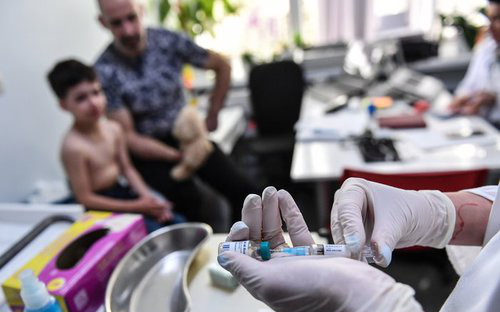
Medicina (Kaunas). 2019 Jun 17;55(6). pii: E282. doi: 10.3390/medicina55060282. Image caption/credit: A family physician prepares a measles vaccine in Bucharest, Romania. Doctors there say that parental hesitancy about vaccines and lack of faith in state institutions have hurt immunisation efforts. Credit: Daniel Mihailescu/AFP/Getty Images/npr.org
- Log in to post comments