










































From Radio Silence to Radyo Bakdaw...and Back to Normal? A Humanitarian Information Service from Internews in Guiuan, Eastern Samar, Philippines
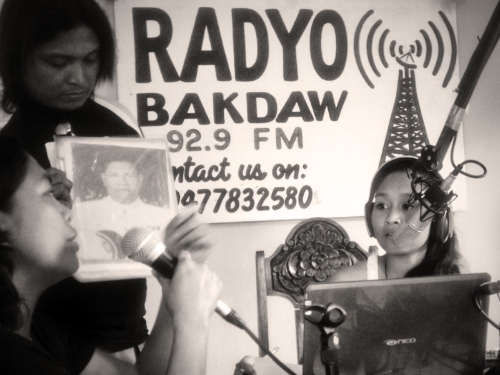
"Its presence improved efficiency, increased accountability and ensured the community its right to information, not just as abstract principles, but by putting simple ideas into practice, a radio which listens, information which is useful for the recovery, or, as the tagline of the radio put it, by 'helping you to help each other'."
Radyo Bakdaw, or "Radio Rise", was set up by Internews in Guiuan, Eastern Samar, after the typhoon Yolanda/Haiyan hit the Philippines on November 8 2013. In the months that followed, Internews trained local radio makers to become humanitarian reporters and gave a wider audience the chance to speak up, be listened to, and be part of the whole humanitarian response, as a "Humanitarian Information Service". This report examines the process of setting up and running the station through its various stages, also sharing challenges encountered and lessons learned. (For more on Radyo Bakdaw, see Related Summaries, below.)
Beginning on November 26 2013, Radyo Bakdaw was on air every day from 6 a.m. until 8 p.m., including during the first 2 major storms of 2014: Agathon and Basyang. It was staffed by: 1 team leader, 1 radio engineer, 1 studio technician, 1 administrative assistant, 1 driver, and 6 presenters/reporters. They produced 6 weekly thematic programmes on livelihoods, health, shelter, mental health, and youth, as well as one weekly karaoke contest, which could be considered a psycho-social relief activity. To expand on the latter, karaoke is part of the local popular culture and the competition for a live audience was the only form of entertainment in the region in the first few months after the disaster. For 2 hours every Friday afternoon, 15 local singers competed for the main prize: a solar radio. The singers were judged by 2 radio staff and 1 international member of the jury chosen among the international agencies active in the region on a rotating basis, which gave the community an opportunity to get to know the different people behind the logos and their mandates. This also served to introduce the Humanitarian Information Service in a more informal way to the agencies.
As the report explains, the radio station was designed from the start to be a community radio station, run by local people, with information relevant for their own community. To ensure the information was relevant, timely, and in sync, the production process was driven by questions received from the listeners. The answers could be found among the community ("where can I buy candles?"), local government ("when do schools reopen?"), or the humanitarian agencies ("how much rice do I get for my family?").
Some facts:
- The Radyo Bakdaw hotline received 40,286 text messages from listeners.
- More than 272 people were interviewed, both in the station and in their communities.
- More than 140 organisations provided information to communities through Radyo Bakdaw.
- During the weekly Radyo Repair Days in the region, Radyo Bakdaw technicians fixed 249 radios for free. Held every Sunday, these Days served to increase the number of listeners, to promote Radyo Bakdaw services, and to serve as an opportunity to ask listeners about what kinds of issues are prevalent in the respective community. Recorded frustrations were reported back to the radio staff and humanitarian community.
Internews developed the capacity and technical skill set of local broadcasters and helped them to become "humanitarian reporters". Twenty or so local radio broadcasters with very limited or no journalistic experience formed the core team. They were trained in daily workshops and received on-the-job and training on the production of useful information in attractive formats for listeners, with a strong sense of journalism ethics, including the importance of reliable, unbiased information. The team also received training in print journalism to allow for a more diverse output online and in local print media. In parallel, Internews organised training for 40 local journalists from the region, including the emergency radio station in Tacloban(Radyo Abante), the local commercial radio station in Guiuan (Radyo Natin), the Philippine Information Service, information officers from local government, and university students.
Internews also committed itself to an ongoing research, monitoring, and evaluation programme as an additional channel and source of information coming from the community and feeding into the humanitarian system. This entailed:
- Setting up a listeners' panel of 86 people across the region, connected and activated through text messages, for quick and continuous feedback;
- Training a local team in quantitative research methods, such as enumeration and data entry;
- Conducting a Cash for Work survey to identify potential frustrations and room for improvement;
- Conducting 10 focus group discussions with Barangay (local government) captains and councillors in 4 municipalities to identify their information needs;
- Conducting, analysing, and reporting on a community survey on information needs and Radyo Bakdaw involving 339 respondents in 19 Barangays in 9 municipal areas;
- Implementing an online survey among humanitarian agencies on their information needs and their collaboration with Radyo Bakdaw; and
- Testing thematic programming of Radyo Bakdaw with over 150 listeners and non-listeners via group and individual surveys and listening sessions in 10 Barangays.
Selected list of challenges encountered (see pages 24-25 for details about technical/equipment-related challenges):
- Recruiting staff with a background in media poses challenges when the media landscape is heavily political and openly biased, which also can reflect badly on a newly created channel, even when this promotes balanced and non-affiliated information.
- When local staff is part of the affected community, their priorities are similar to the rest of the population - ensuring their basic needs are being met (food, shelter, health) - making it hard to ask for long- and even short-term commitments.
- In training, available manuals are written for people with journalistic background and focus on content rather than on skills.
- Staff are accustomed to a commercial radio format, with a focus on music and advertisements. This was notable in their presentation style, which was "hyper" and supported with a lot of sound effects.
- Local government is not necessarily used to hearing criticism on air, even when it is included in a full report in which local politicians get the chance to explain and tackle the criticism.
- Documenting text messages in a timely, quantitative way as a useful source of information for the humanitarian response was beyond the capacity of the limited team.
- Not having a permanent radio engineer as part of the project became challenging whenever there were technical hiccups in a region where there is not a lot of expertise available.
In December 2013, 1 day before the end of the running budget, a 3-month budget extension came through, allowing Internews to continue its broadcasting and research and to expand its trainings also to other media professionals in the region. Among other activities, 6 thematic shows were added to the broadcasting schedule. This addition is described in the report as labour intensive and hard to combine with the day-to-day information flow and the need to find concrete solutions for questions asked by the listeners. "There seems to be a clear tension between improving the quality and diversity of radio broadcasting and the level of preparation/anticipation it involves, versus being able to act swiftly on newly emerging issues brought to the radio station by listeners. And by focusing more on well-produced in-house content, the very unique bond with the listener seems to get lost a bit. The cleaner, well-finished the content, the less people feel they can actually interfere, be part of the on-going story that is being written on air."
With the relationship with local government quickly deteriorating and no guarantees on the budget being extended, it was decided to go off air. The report explores how this came to pass.
Also included is a list of various lessons learned - e.g., on deployment of radio equipment to a disaster zone, on staff, on training, on content, on equipment, on procurement, on budget, on research, and on extensions. Some suggestions to emerge from these learnings:
- Explain to organisations and local government that the feedback from the community is to be taken seriously, even when it is not necessarily accurate, but that it always reveals frustration, which rather should be addressed than ignored.
- Make the editorial decision on what to broadcast and what not, keeping in mind the one goal: to be helpful and not to harm.
- In any humanitarian intervention, include a full-time researcher with relevant background right from the start who can design locally relevant tools to document and analyse feedback and activities. Any data gathered at the very start are relevant and needed by the humanitarian system.
CAMECO Media Development Literature, July 2018 - June 2019; and "In the Philippines, Radyo Bakdaw Journalists Find Purpose", Internews, March 5 2014 - both accessed on February 13 2020. Image credit: Internews
- Log in to post comments