










































A Review of 10 Years of Vasectomy Programming and Research in Low-Resource Settings
Institute for Reproductive Health, Georgetown University (Shattuck); Duke Clinical Research Institute (Perry); FHI 360 (Packer, Chin Quee)
"With...growing support and refinement of gender and male involvement programming, now is an opportune time to incorporate voluntary vasectomy services into national family planning strategies."
This peer-reviewed journal article reviews recent literature related to voluntary vasectomy programmes in low-resource settings to synthesise common barriers and facilitators to vasectomy uptake and identify recommendations to strengthen future vasectomy promotion efforts. According to research cited here, vasectomy is a highly effective and safe contraceptive method for couples who want to stop childbearing, but only 2.4% of men around the world use this method.
As part of the United States Agency for International Development (USAID)-funded Evidence Project, the authors conducted an extensive review of the vasectomy research literature and programmatic reports published between April 2005 and April 2015; of the more than 230 documents initially retrieved, they ultimately included 75 documents in the review. They synthesised the findings according to the Supply-Enabling Environment-Demand (SEED) Programming Model, which is based on the principle that programmes will be more successful and sustainable if they address the multifaceted determinants of health and if they include interventions that simultaneously: (i) address the availability and quality of services and other supply-related issues, (ii) strengthen the health system and foster an enabling environment for healthy sexual and reproductive health behaviour, and (iii) improve knowledge of sexual and reproductive health and promote demand for services.
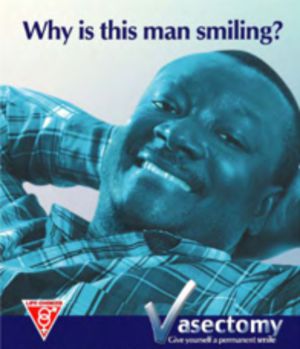
Regarding promoting demand for vasectomy services, they found there was a general lack of awareness about the method among both men and women, which often fueled erroneous assumptions about how vasectomy affects men. Several types of programmatic activities directly addressed knowledge gaps and negative misperceptions, including community-based and mass media communications, employer-based promotion, and group counseling. For example, the ACQUIRE Project led a vasectomy communication campaign called "Get a Permanent Smile" (see Related Summaries and poster image, below) in several low-resource settings. The campaign countered pervasive myths and rumours about vasectomy using various media outlets such as posters and television broadcasts staggered to coincide with seasonal periods of high media attention (in Bangladesh) and television and radio ads complemented by an information hotline and community outreach (in Ghana). Spikes in demand for vasectomy were tied to the communication activities.
For supply of services, the lack of or inaccurate knowledge about vasectomy was also prevalent among providers, particularly among community-based health workers. Programmatic activities to improve service delivery included the use of evidence-based vasectomy techniques such as no-scalpel vasectomy (NSV), whole-site trainings, task shifting, cascade training, and mobile outreach.
Finally, programmatic approaches to building a more enabling environment included engagement of governments and other community and religious leaders as well as campaigns with gender transformative messaging that countered common myths and encouraged men's positive engagement in family planning and reproductive health. For example, in Tanzania, the ACQUIRE Project identified Seventh-Day Adventists as advocates of all forms of contraception, including vasectomy, who even included information on contraception in their sermons. The Heri Seventh Day Adventist Mission Hospital in Tanzania, a focal point of the project's vasectomy promotion and training activities, provided vasectomy services and educational seminars about the benefits of contraception. This hospital became a regional centre of excellence in NSV and provided the majority of vasectomies over a 6-year period in the Kigoma region.
In summary, the literature review found that a successful vasectomy programme is comprised of the mutually reinforcing components of continual demand for services and access to and supply of well-trained providers. In addition, there is an underlying need for enabling policies within the cultural and gender environments that extend beyond vasectomy and include men not just as default partners of female family planning clients but as equal beneficiaries of family planning and reproductive health programmes in their own right. "The program literature provides examples of channels and activities that changed perceptions of vasectomy and integration of men into reproductive health services. Countering misperceptions across multiple media channels was found to be effective at increasing vasectomy demand. Examples and materials to support vasectomy integration are well established. Use of testimonials, media campaigns, and strategic timing of service delivery was found to facilitate uptake, while training tools have been well established and easily available. At the grassroots level, cadres of existing vasectomy providers are linking themselves with physicians in low-resource settings. Training these providers in low-resource settings and providing them with the necessary equipment is important, but their small scale has limited impact on national contraceptive prevalence rates or on the associated benefits of integrating vasectomy into a national family planning agenda."
As the authors note, World Vasectomy Day - the global campaign that fosters discussions about men's role in reproductive health - held its fourth annual event on November 18 2016 in Kenya. As evidenced in part by this event, "[m]omentum for vasectomy integration is rising and now the challenge is to appropriately pivot the focus of family planning and reproductive health services to include men in meaningful and impactful ways." That said: "Accelerating progress toward meaningful integration of vasectomy into a comprehensive contraceptive method mix is only possible when political and financial will are aligned and support the logistical and promotional activities of a male reproductive health agenda."
Global Health: Science and Practice, December 23 2016, vol. 4 no. 4, p. 647-660 doi: 10.9745/GHSP-D-16-00235 - sent via email from Catherine Packer to The Communication Initiative on January 13 2017. Image credit: ACQUIRE Project
- Log in to post comments