










































Strengthening HPV Vaccination Delivery: Findings from a Qualitative Service Evaluation of the Adolescent Girls' HPV Vaccination Programme in England
London School of Hygiene & Tropical Medicine (Paterson, Mounier-Jack, White, Chantler); Public Health England (Saliba, Yarwood, Ramsay)
Among the organisational factors in the delivery of school-based vaccination programmes that have been highlighted by researchers is engagement and communication with schools, girls, and their parents/guardians, and related consent procedures. The purpose of this service evaluation was to examine whether service-related factors may have contributed to a downward trend in adolescent girls' human papillomavirus (HPV) vaccination coverage in England and to identify best practices from the perspectives of service providers and commissioners.
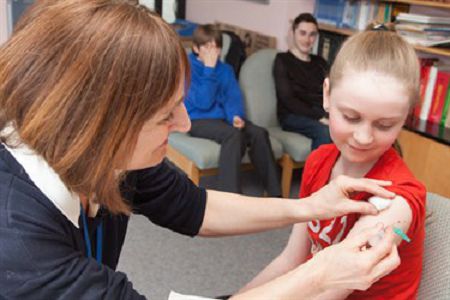
As is detailed in the article, in 2014, the number of HPV vaccine doses given to adolescent girls as part of the English school-based immunisation programme was reduced from 3 to 2. In 2015/16, there was a decline in HPV vaccination coverage in adolescent girls: from 86.7% for the 3-dose schedule in 2013/14 to 85.1% for the 2-dose schedule. To understand this trend, in May-August 2017, the researchers conducted semi-structured qualitative interviews with 39 participants responsible for commissioning or delivering immunisation programmes in 6 local authorities in England.
The investigation revealed that the slight decrease in coverage for HPV vaccine coverage since 2014 combined with interviewees' reported views of the complexity of organisational and logistical aspects of delivery may reflect a growing imbalance between workload capacity and/or a delivery model that needs to be adapted to its new expanded scope.
On the communication front, the findings highlight the importance of effective planning and data management for successful service provision of HPV vaccination, as well as close collaboration between commissioners, service providers, and data system managers. Another of the factors cited by interviewees was proactive engagement with schools and service providers equipped to respond to parental concerns. For example, in December 2016, a United Kingdom (UK)-based daytime television interview with a former glamour model sparked social media discussion about the safety of the HPV vaccine. A few interviewees stated that this had resulted in some vaccine hesitancy amongst parents. Although not presented as a major challenge, interviewees highlighted the need for nurses to be prepared (e.g., to have sufficient access to informational materials) to preempt, acknowledge, and address parents' concerns while providing information about the benefits and risks of the vaccine. Several participants noted the importance of these discussions.
In conclusion, "To maintain and improve the high HPV adolescent girls’ vaccine coverage rates achieved in England, in the context of an expanding school-based immunization programme, it is essential to strengthen the organizational capacity of the delivery system."
Journal of Public Health, fdz061, https://doi.org/10.1093/pubmed/fdz061. Image credit: Hounslow and Richmond Community Healthcare NHS Trust
- Log in to post comments