










































Strengthening the Link between Vaccine Predispositions and Vaccine Advocacy through Certainty
Universidad Autónoma de Madrid (Paredes, Moreno, Cano, Briñol); Universidad Villanueva (Cárdaba); Universidad Complutense de Madrid (Cuesta); Ohio State University (Petty)
"The more certain they are in their vaccine beliefs, the more likely they are to act in accord with them."
There is variance in the extent to which people believe vaccines are useful and advocate for their usage. This variation in the level of advocacy - that is, a person's willingness to share their opinion (in person, online, or in any other communication medium) with others - is important because most vaccines require having a high degree of social acceptance to work at the community level. In countries where certain political parties have not advocated for vaccination, supporters of such parties have significantly lower vaccination rates. This is one example in which vaccination advocacy could affect vaccine hesitancy. In order to predict relevant outcomes in this domain, different questionnaires have been developed and validated to measure people's attitudes towards vaccines. This research was designed to improve the ability of these kinds of instruments to predict vaccination advocacy by considering the certainty associated with the responses to vaccination scales.
Across two studies, participants completed the Beliefs about Medicines Questionnaire (BMQ) scale (Study 1), which assesses the beliefs people hold about medications, their known and unknown side effects, and potential adherence to prescribed treatments, or the Vaccination Attitudes Examination (VAX) scale (Study 2), which consists of a 12-item questionnaire formed by 4 specific subscales that evaluate: (i) mistrust of vaccine benefit, (ii) worries about unforeseen future effects, (iii) concerns about commercial profiteering, and (iv) preference for natural immunity. The certainty participants had in their responses to each scale was either measured (Study 1) or manipulated (Study 2). Intentions to advocate in favour of vaccination served as the criterion measure - e.g., by asking participants questions such as, "To what extent are you willing to share messages on social networks in favour of vaccines?" - in both studies.
Specifically, the goals of Study 1, which involved 186 undergraduate students from Universidad Complutense de Madrid, were to: (i) provide convergent evidence of the link between a vaccination-related scale and advocacy willingness, and (ii) test the more novel prediction that certainty in the scale responses (confidence participants had in their responses) would moderate the predictive validity of the scale. The results indicated a main effect of the BMQ scale, indicating that people scoring higher in the BMQ scale are more willing to spread pro-vaccine messages on social media. Among those with relatively higher certainty scores, the BMQ scale was positively associated with advocacy willingness; however, for those with lower certainty scores, the relationship between BMQ and advocacy willingness was not significant.
In Study 2, 202 undergraduate students from Universidad Complutense de Madrid completed the VAX scale and were asked to report their intentions towards supporting vaccines. Following completion of the scales, participants were assigned to write about a past personal experience in which they felt either confidence or doubt. The regression analysis indicated a main effect of the VAX scale on advocacy willingness, indicating that people scoring higher on the VAX scale were more willing to promote vaccination. The interaction between the VAX scale and certainty was significant: Among those assigned to the certainty condition, the VAX scale was associated with higher advocacy willingness; for those assigned to the doubt condition, there was a significant relationship between the VAX scale and advocacy willingness, although it was significantly weaker.
Thus, this research reaffirmed the predictive validity of the BMQ and VAX scales by showing their capability of predicting relevant vaccination-related outcomes. The studies also showed that responses to the scales were associated with advocacy willingness to a greater extent when participants were more certain of their responses to the scale (both measured and manipulated). Thus, as certainty increased, so too did the association between these scales and subsequent advocacy willingness. These findings show that in order to maximise the predictive validity of the scales, it would be advisable for these scales to be accompanied by an extra measure of the extent to which participants feel certain in their answers.
Furthermore, these results could help to explain the existence of individuals who, despite expressing favourable attitudes towards vaccines, do not translate these beliefs into pro-vaccination behaviours. The findings could be used to identify intended audiences for specific interventions aimed at increasing the certainty of their beliefs.
Prior research has revealed that certainty can moderate the reliance on mental constructs, including those assessed with validated instruments in various domains. The set of studies here examined whether certainty in one's responses to vaccination-related scales can also moderate the relationship between these vaccine inventories and vaccine-related outcomes. The core idea is that before advocating for vaccines or deciding to advocate, people are likely to consider not only their opinion toward vaccines but also how certain they are in their view.
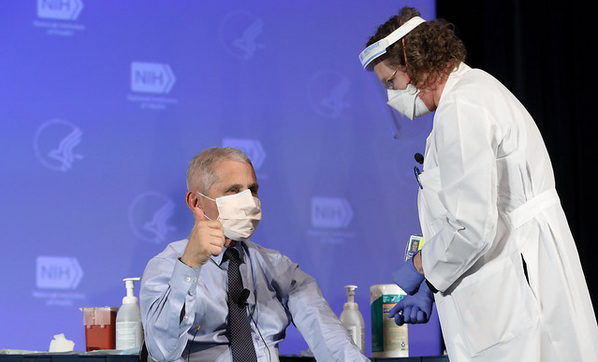
Vaccines 2022, 10, 1970. https://doi.org/10.3390/vaccines10111970. Image caption/credit: Dr. Anthony Fauci, National Institute of Allergy and Infectious Diseases (NIAID) Director, gives the thumbs up sign after receiving the Moderna COVID-19 vaccine at the HHS/NIH COVID-19 Vaccine Kick-Off event at NIH on 12/22/20. NIH Image Gallery via Flickr (Public Domain Mark 1.0)
- Log in to post comments