










































Unlocking the Mysteries of Medical Research: An Exhibition Plan
Malawi Liverpool Wellcome Trust
Researchers at the Malawi-Liverpool-Wellcome Trust Clinical Research Programme (MLW) are working to generate debate on the value of medical research to Malawian society through a participatory exhibition involving study communities and children studying science. Exploring research through the eyes of the researcher, medic, patient, and participant, the exhibition seeks to communicate knowledge from MLW research specifically, as well as foster a more general awareness of medical science, and, ultimately, health-related behaviour change. The final aims can be divided into:
- Develop resources that enhance the teaching of the science curriculum in schools;
- Make sometimes expensive equipment available on loan to schools; and
- Demonstrate that learning about science can be fun and increase interest in clinical research careers among school students.
This report details the pilot project's rationale, activities, strategies, and initial results.
As the background section within the report outlines, MLW's Science Communication team works to encourage dialogue with the local community by collaborating with Community Advisory Groups in rural areas and a programme of Science Cafes in Blantyre urban areas and schools. Communication with staff and the media is through staff forums and intranet. Publications and events are largely used to also engage with the media. Work with stakeholders and policymakers is through international and national initiatives and events such as AIDS Awareness Day. In 2007, a new building was planned to house the expanding research programme; building work began in 2010. A communication-based part of the plans includes an exhibition in the entrance and around the cafe area that would be used to inform visitors about medical science and clinical research, specifically, current research in Malawi. An initial grant application secured funding from the Wellcome Trust to undertake research on the sort of exhibition that would be suitable and the needs and interests of the intended audience. From the planning phase to the development of test exhibits and the exhibition, there will be a constant flow of ideas and information between the potential audience groups and the exhibition project team.
The themes at issue in this project are: (i) blood - including discussion about blood donation, transfusion, anaemia and the use of blood for testing and research; (ii) communicable diseases - including sexually transmitted infections (STIs such as HIV), malaria, tuberculosis (TB), pneumonia, cholera, and meningitis; (iii) non-communicable diseases (NCDs) - including heart disease, diabetes, blood pressure, obesity, epilepsy, and cancer; (iv) drugs and vaccines; and (v) DNA.
The part of the project described in the report was divided into two phases, the first (Phase I) involved:
- An assessment of general (non-science) museums in Malawi - summary of findings: "The majority of museums in Malawi have static displays that have often not changed for over 30 years....[However, t]he museum in Karonga has an interactive, modern display put together with advice, resources and funding from abroad. It provides a thought provoking and challenging exhibition but lacks local visitors and is unable to undertake any outreach activities."
- An examination of science (especially medical) museums in the United Kingdom (UK) and South Africa through international museum visits - summary of findings: "There is an emphasis on interactive exhibits which allow the visitor to discover the topic for themselves. The displays use sound, smell and touch which offers a complete experience and appeal to visitors. Models as well as re-created rooms (e.g. an operating theatres and pharmacy) give visitors a feel for the subject, although they do rely on having plenty of space. The historical perspective is important; both in the UK and South Africa there are displays about the history of diseases, such as tuberculosis (TB), herbal remedies and traditional African medicine, which are related to modern medicine. Personal stories help personalise the topic and allow the visitor to relate to the story; subjects that are related to everyday life are popular. It's important to give different perspectives in a story e.g. the researcher, the patient and the doctor. Bright colours and well produced graphic panels attract visitors' attention to the displays. Interpretation from a guide or through storytelling and music give a different perspective."
- Situational analysis of current science provision and communication in Malawi (particularly in Blantyre) - summary of findings: "For all [13] organisations [that participated in the research] in general, there are three main barriers or issues. The first is lack of resources. For media houses the issue is that they have very little access to experts or doctors who are usually too busy to record a programme, and they sometimes feel that ethically they are not supposed to talk about certain things....The second barrier is language. For most organisations medical/ science terms and jargon cannot easily be translated to suit local languages without taking away something and there is a general lack of the vernacular equivalents....The third challenge for those working with HIV is the stigma attached to the disease and a lack of understanding about it."
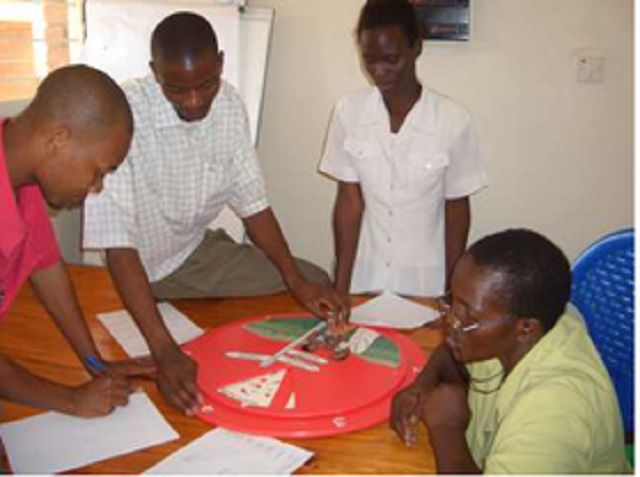
- A total of 15 consultative workshops with about 290 people from potential audience groups to assess interest and knowledge in medical research. The groups ranged from local villagers, school dropouts, and members of support groups to primary and secondary school pupils, university and college students, teachers, and medical researchers. Findings from these workshops are discussed in detail within the report.
As part of Phase II, using the consultation and research done in the first part of the project, the design firm, Headland Design Associates, chose 8 ideas to be developed into test exhibits (information panels and hands-on activities). There is also an additional activity, hand-painting, which is designed to stimulate discussion about DNA and how everyone is unique and to provide a lasting reminder of the participants who contributed to the project. The designers chose low technology to interpret the themes and used materials (wood and paint) and skills that would be available in Malawi. The exhibits have been produced in both English and Chichewa. These concepts were taken to the groups who had contributed to the research in the first part of the project and tried out and assessed. All this research has been used to produce resources such as a design brief and an activity plan for the final exhibition and outreach activities. The final part (Phase III) of the project will involve securing funding and developing the actual exhibition and outreach materials. The curricula (upper primary and secondary) have a range of topics that will relate to the 5 themes of the exhibition. These topics were reflected in the findings from the workshops and relate to current research taking place in MLW.
An excerpt from the report follows (footnote numbers removed by the Editor):
"The evaluation of the initial workshops demonstrates that this project has already had a potential impact on the health seeking behaviour of those who had taken part. 'For village people like ourselves, you've opened our eyes and ears. With this information that we have not only been told but touched and seen, we should be able to tell others and guide them in their health.' Most of the participants were unaware of the work done by MLW; the workshops themselves raised awareness of the organisation and encouraged pupils to consider studying science further. The researchers and medical staff at MLW and Queen's Hospital have been very interested in the project and are keen to learn more about some of the cultural issues that have been explored through the workshops.
In the first workshops much of the medical equipment was described as 'fearful' and participants explained that they didn't know how things like a thermometer works....The discussion was often around visiting the doctor or hospital. One participant said that 'When you bring a serious patient to the hospital, doctors do not appear to care and allow you to wait for a long time before the patient is attended'....The workshop leader spent some time explaining that patients were entitled to question the doctor about treatment or investigations. Participants felt empowered and 22 participants in the first workshop said that they felt more confident about visiting a doctor or the hospital. This is a small impact but demonstrates that object based workshops can enable discussion about health related issues. In all the workshops participants said that they learnt something new about medicine or disease.
In the workshops in schools 98% of the pupils said that they had learnt something new about science. The teachers were impressed with the interactive exhibits. 'This is well constructed, and because most science subjects come towards lunch or in the afternoon when the students attention span and their brains are tired, brilliant colours and interactive learning aids like these would help rekindle attention and interest for learning in the students.'
The questions that arose out of the discussions during the first phase were used to develop the test exhibits and all participants in the second phase of workshops said that they had learnt something new, 63 participants gave specific examples of things that they had learnt about diseases or medicine.
During the workshops there were questions and discussions about traditional medicine and in the later workshops the team introduced the subject, as it had become clear that this was an important issue which is very much part of life in Malawi. One of the test exhibits explored modern medical equipment and asked some questions about traditional medicine and its role today, this exhibit sparked debate in all the workshops."
Pages 55-58 of the report feature charts that illustrate specific areas of intended impact of phases 1 and 2, along with (for each impact sought): activities that have been carried out, outputs, indicators, and achievements.
Email from Tamara Chipasula to The Communication Initiative on September 6 2012.
- Log in to post comments