










































Usability and Acceptability of a Mobile App for Behavior Change and to Improve Immunization Coverage among Children in Pakistan: A Mixed-Methods Study
Aga Khan University (Kazi, Ahsan, Mughis, Jamal, Allana, Raza, Muneer, Mughal, Kaleemuddin); NED University of Engineering and Technology (Sameen, Ahmed, Qazi); University of Surrey (Abbasi, Stergioulas); The Hague University of Applied Sciences (Stergioulas); National Centre of Artificial Intelligence (Qazi)
"[T]here is a scarcity of data addressing the behavior-change initiatives and strategies that are effective at engaging participants and improving immunization coverage using a mobile application from Pakistan."
Lack of awareness about vaccines and vaccination schedules, caregiver forgetfulness, and vaccine misconceptions/misinformations are a few of the major drivers of Pakistan's low rates of immunisation. The disruption of routine immunisation (RI) services during the COVID-19 pandemic exacerbated these issues and increased the risk of outbreaks of vaccine-preventable diseases. Conversely, the pandemic highlighted the promise of mobile health (mHealth) to address immunisation-related challenges in low- and middle-income countries (LMICs) such as Pakistan, with its increasing mobile phone access and internet connectivity. The aim of this study was to learn about caregivers' attitudes toward the usability and acceptability of behaviour change smartphone applications (apps) for improving immunisation coverage in Pakistan.
Featuring a mixed-method design, the study was conducted between November 2019 and April 2020 at Aga Khan University Hospital. Parents (n=105) visiting the community health centre (CHC) for their children's vaccination appointments were recruited; all of them had access to a mobile phone, and 99% owned a smartphone. The study was conducted in two stages. Stage 1 consisted of 11 qualitative interviews that grasped the parents' attitudes about and perceived challenges related to immunisation, as well as their feelings about acceptability and accessibility of a smartphone-based behaviour-change ap to increase vaccine uptake. Stage 1 was followed by Stage 2, in which data were collected through a questionnaire based on data from the qualitative interviews.
The majority of participants agreed that immunisation plays an important role in protecting their child from illnesses that cause morbidity and mortality. When asked about their preferences with regard to visiting the tertiary care hospital's vaccination centre, caregivers reported the health staff to be experienced, well trained, cooperative, and trusted. Alongside providing details of current vaccination, they guided parents about missed vaccines and following the appointment schedule. Because of these and other factors, parents preferred to visit CHC for vaccination in contrast to other facilities, where services are free of charge. Almost all of them emphasised the importance of using a pre-appointment method at vaccination centre in order to reduce the waiting time.
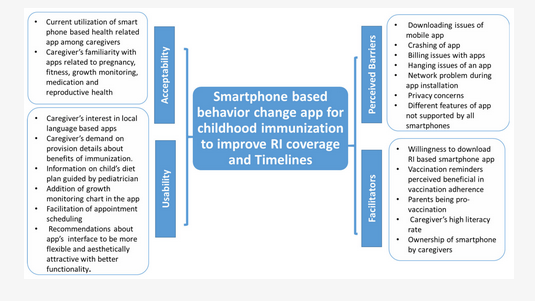
Participants were interested in an app related to immunisation and had several suggestions for what they would expect from such a tool. For example, they would prefer content to be offered in their native language for better comprehension and communication of vaccine-related information. (Urdu was the most preferred language for the app.) The majority of mothers demanded additional vaccine-related information from the app, such as notifications of vaccine availability at the vaccination centre, doctors' appointments for vaccination, and introduction of any new vaccine for the children. Some respondents appreciated the provision of religious content for immunisation and perceived it essential for the behaviour change of caregivers. Most mothers believed adding more pictures, colours, and videos that would make the vaccination app more likeable and interesting for caregivers. In addition, supplementation of relevant research articles on children's health and feeding issues would be convenient and could make parents more confident and empowered about their child's health.
Mothers were also asked about their basic knowledge and usage of any mobile phone-based app to gain an insight into their usage and acceptability of technology for health. Most of mothers self-reported to have previously heard about mobile-based health apps, but few mothers reported having ever downloaded any health app on their mobile phones. Those who downloaded them used them mainly during their pregnancy and found them helpful.
Further to understand the barriers related to use of a smartphone-based app, respondents were asked about the technical challenges they faced while downloading apps in general. They highlighted network issues during app installation and concerns such as the crashing of apps after installation, different types of features of the app not being supported by all kinds of smartphones, the hanging of mobile apps, and server down complaints that resulted in irritation and discontentment. To understand privacy-related aspects of mobile apps, mothers were asked whether they review the terms and policies of any app before installing it on their mobile phone. The majority of respondents reported that they do not, citing their length. However, they would be inclined to carefully read a health-based app's privacy policy for their child.
Phase 2 of the study revealed that approximately 95.2% of participants agreed to accept SMS (text messaging) immunisation updates, and 78.1% preferred a call from the health centre. The majority of them identified forgetfulness as a significant contributor to the failure to adhere to the RI schedule.
The results of this study will help the authors to create a behaviour change app with features in a local language whose aim will be to improve RI coverage in Pakistan. Such a cost-effective and user-friendly mHealth artificial intelligence (AI)-based smartphone app could raise awareness about the importance of timely vaccination and support the continuity of vaccination service. Going forward, parents' perspectives should be incorporated into such interventions: "Qualitative evaluation of user perceptions should remain a priority in optimizing mobile data technologies to overcome regular immunization challenges in developing countries such as Pakistan and beyond."
International Journal of Environmental Research and Public Health 2021, 18, 9527. https://doi.org/10.3390/ijerph18189527.
- Log in to post comments