










































The Use of Design Thinking in MNCH Programs: A Case Study of the Community Benefits Health (CBH) Pilot, Ghana
JSI Research & Training Institute, Inc.
"[F]indings suggest that community involvement in the CBH incentive scheme and exposure to the CBH health messaging strategy are likely to have influenced the evolution of community behavior around supporting women’s health seeking decisions."
A fundamental rationale for the use of design thinking is that it provides insights into user experience, needs, and desires and helps to translate these insights into tailored interventions or products, increasing the likelihood of user adoption and reducing the risk of intervention failure. Grounded in this approach, the Innovations for Maternal, Newborn, and Child Health (MNCH) Initiative (Innovations) developed and piloted interventions to address common barriers to improving the effectiveness of basic MNCH health services in low-resource settings. This case study focuses on the use of design thinking in Innovations' Community Benefits Health (CBH) pilot, which aimed to improve MNCH-related behaviours among women of childbearing age by influencing community-wide social norms over the 2-year pilot period in select Ghanaian communities.
Central to the design thinking approach is that designers gain insights into the lives of end users and other key actors to develop empathy for them. In CBH, end users were community members, which included influencers like community leaders, mothers-in-law, husbands, and mothers in most cases. A second element of design thinking is the use of facilitation techniques to stimulate divergent thinking by multidisciplinary teams to generate a wide range of possible ideas for addressing a particular challenge or complex problem, followed by convergent thinking to gradually refine solutions. Finally, design thinking often integrates the iteration of ideas and solutions on a small scale to test ideas and refine them with end users before introducing them on a wider scale.
As the report outlines, Concern Worldwide applied design thinking techniques to develop and refine the CBH pilot. A ThinkPlace designer worked with project implementers and communities to conduct the design thinking phase. ProNet North, the Ghanaian implementing organisation, facilitated this effort, drawing on their knowledge of and experience in Wa West District. The application of design thinking occurred in four phases: Intent; Research, Discovery, and Synthesis; Co-creation and Validation; and Defining the Implementation Approach. Based on iterative community feedback, the team selected two possible incentives from which communities in the messaging-plus-incentive intervention arms (see below) could choose. The core design team also developed an 8-step process of change management to maximise community engagement and participation in encouraging positive MNCH-related behaviours among women. This process involved: informing the community about pilot goals and objectives; building trusted relationships with community members, including community leaders and influencers; co-designing the incentives with community members; establishing the ommunity Governance Committees (CGC); designing a strategy for change; engaging the whole community in the change process; evaluating the change; and handing over the incentives to the communities.
The CBH pilot was implemented between April 2014 and March 2016 in six communities located in three districts (Jirapa, Lambussie, and Wa West) in Ghana's Upper West Region. Evaluation of pilot impact compared the relative influence of health messaging in one study arm with a strategy that combined health messaging and the promise of a community-wide nonmonetary incentive in the other arm. A third study arm served as the control. Specifically:
- The health messaging strategy included: video and drama presentations at the community level; home visits from peer educators; the use of community influencers, like community leaders, to influence behaviour change; community meetings facilitated by community health officers; and posters and radio programmes that created awareness about the importance of antenatal care (ANC), skilled birth attendance, and postpartum care services in addition to encouraging early initiation and exclusive breastfeeding.
- In one of the intervention arms (the messaging-plus-incentive arm), the pilot team also introduced the concept of a community-wide incentive scheme to encourage community engagement in women's health decision-making and community support for behaviour change. Each community chose its own incentive from a shortlist of options. The incentive scheme was designed as to benefit all members of the community, not simply individuals. The CBH team awarded the incentives in a series of "win celebrations", which took place when communities achieved agreed steps, such as an increase in the number of men participating in health education sessions.
The CBH evaluation employed a mixed-method, quasi-experimental design involving approximately 2,800 households and a household, a men's, and a women's questionnaire. With respect to behaviour change, the study determined that exposure to the CBH programme overall significantly improved uptake of three of the six study outcome behaviors: early initiation of ANC, ANC4 (fourth visit), and skilled birth attendance across both intervention groups. The evaluation showed no significant influence on behaviour related to breastfeeding or PNC (postnatal care).
With respect to the influence of CBH on community involvement in women's health seeking behaviour - one of the hypothesised drivers of women's behaviour change - the evaluation revealed a shift in the type of people in whom women confided and the people from whom women sought advice about pregnancy and breastfeeding compared to baseline. For example, prior to the intervention, women spoke primarily with health providers about pregnancy and breastfeeding. Following the CBH intervention, women reported that they increasingly spoke with family members and friends who lived in the same household and community about pregnancy and breastfeeding. The majority of respondents noted that the community overall discussed issues related to pregnancy and breastfeeding more frequently than before.
The report considers the role design thinking played in the process and outcomes of this pilot. For example, design phase insights reinforced the idea of engaging many types of potential community influencers in supporting women to use health services more frequently for MNCH care and to initiate breastfeeding early and breastfeed exclusively for six months. The resulting programme strategy focused on expanding women's networks of influencers around health seeking decisions and on raising awareness among community members around the importance of maternal and newborn health.
From their review of the application of design thinking in CBH, the authors observe that design thinking played a positive but limited role in influencing aspects of the shape, implementation, and outcome of the pilot. They outline some barriers to design thinking influence but ultimately conclude that design thinking "reinforced broad-based implementation strategies to improve health-seeking and health-promoting behaviors, building on traditional community structures and practices, and it deepened and refined understanding of community needs and behaviors among the CBH team. The most beneficial aspect of design thinking in CBH was the introduction of novel ways of co-designing aspects of the program strategy with communities and prototyping incentives with program staff and communities to increase the chances that communities would accept their role in CBH."
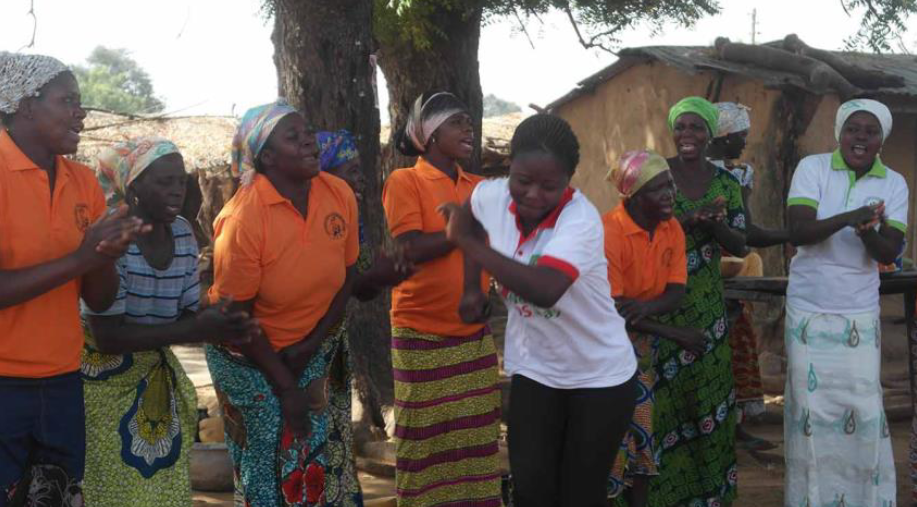
JSI website, January 26 2023. Image caption/credit: Community health nurses participating in a design workshop, Volta Region, Ghana. Photo courtesy of Concern Worldwide
- Log in to post comments