










































Using a Community-Led Video Approach to Promote Maternal, Infant, and Young Child Nutrition in Odisha, India
London School of Hygiene and Tropical Medicine and Leverhulme Centre for Integrative Research on Agriculture and Health - LCIRAH (Kadiyala); Independent Consultant (Roopnaraine); International Food Policy Research Institute (Margolies, Cyriac)
In October 2012, the Strengthening Partnerships, Results, and Innovations in Nutrition Globally (SPRING) project began a collaboration with Digital Green (DG) and the Voluntary Association for Rural Reconstruction and Appropriate Technology (VARRAT) which resulted in a 12-month pilot intervention in 30 villages in Keonjhar district of Odisha. The goal of the pilot, funded by the United States Agency for International Development (USAID), was to test the feasibility of leveraging the DG approach for agriculture (implemented in India, Ethiopia, and Ghana) to promote maternal, infant, and young child nutrition (MIYCN)-related behaviours and care practices including child feeding, care during pregnancy, and handwashing.
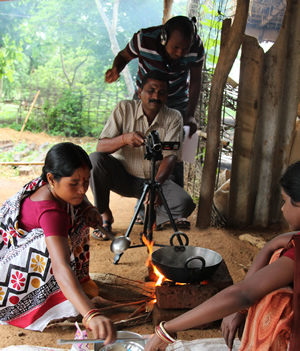
As detailed here, the DG approach involves (a) participatory identification of content and local production of low-cost videos to improve agriculture practices (DG generally relies on a positive deviance approach. Local farmers who are early adopters of certain agricultural practices or who demonstrate innovation or positive outcomes on their farms are invited to "star" in demonstration, discussion, or testimonial extension videos); (b) group discussion that uses the videos as a basis for mediated instruction, where a mediator encourages the audience to discuss the video content; and c) follow-up home visits to support and monitor the adoption of the practices or behaviours being promoted through the videos. (In addition to using simple, low-cost audio and video equipment for the production of community videos, and low-cost battery-operated pico projectors for their dissemination, this approach systematically monitors its efforts and provides access to data through an online data dashboard.) In Odisha, DG has partnered with VARRAT since 2011 to produce and disseminate videos focused on improved agricultural and livelihoods practices. Working in 130 rural villages in the Keonjhar District in northern Odisha, DG and VARRAT have employed 4 full-time, community-based Community Resource Persons (CRPs) to develop, shoot, and edit short videos as well as 37 Community Service Providers (CSPs) to facilitate weekly or bi-weekly video screenings and discussions with members of village-level SHGs and serve as a resource for individuals seeking to change their practices.
During the 1-year intervention that adapted this approach, 10 short (10-15 minute) locally produced MIYCN-focused videos were developed and disseminated in bi-weekly self-help group (SHG) meetings. (Click here to view the videos, an example of which is included, below.) Following the formative research, MIYCN trainings, and production of the first videos, 10 videos in the local language of Odia were rolled out from April through September 2013. Barriers and facilitating factors, identified through discussions with mothers, mothers-in-laws, Anganwadi workers, Accredited Social Health Activists (ASHAs), and teachers in the community, have been emphasised. The topics included: (i) importance of handwashing with soap; (ii) importance of the first 1,000 days; (iii) importance of iron-folic acid (IFA) supplementation during adolescence and pregnancy; (iv) maternal diet and food taboos; (v) maternal workload during pregnancy and breastfeeding; (vi) exclusive breastfeeding for the first 6 months; (vii) accommodating breastfeeding for working mothers; (viii) introduction of complementary feeding; (ix) complementary feeding (6-24 months): quantity, frequency, diversity, consistency; (x) importance of and strategies to improve dietary diversity. Two SHGs, of approximately 10-15 women per SHG, in each of the 30 villages were officially included in the pilot intervention. Each SHG participated in 2 nutrition-focused video screenings or "dissemination" per month so that each of the 10 videos were screened in all 30 villages during the intervention period.
In June 2013, in order to assess the feasibility of using the Digital Green approach for promoting MIYCN-related behaviours among participants in women farmer SHGs, the International Food Policy Research Institute (IFPRI) and the London School of Hygiene and Tropical Medicine conducted a mixed methods study using interviews with programme personnel, SHG members, mothers-in-law, husbands, agriculture and health workers, and actors in the videos. The key research topics focused both on processes and uptake. Process-related objectives were: (i) to examine the capacity of VARRAT to produce MIYCN video content and facilitate MIYCN video dissemination, using the SPRING/Digital Green collaborative approach; (ii) to explore the key factors, both enabling and limiting, affecting the application of the SPRING/Digital Green collaborative approach to MIYCN promotion. Uptake-related objectives were: (i) explore retention and comprehension of video content viewed by SHG members; (ii) assess the reception and acceptability of the MIYCN topics covered and practices promoted in the piloted videos for SHG members and other key stakeholders; (iii) report on SHG members' experiences with trials of new behaviours and identify their motivations for experimenting (or not) with new behaviours; and understand intra-community diffusion of MIYCN messages promoted in the pilot MIYCN videos.
The key results and the implications for the next phase of the intervention development are presented in detail in the text of the report and in brief in Table A. However, in sum, the DG videos were found to be one of the key sources of nutrition-related information within the communities. Study findings demonstrated that the use of community videos by agriculture extension workers was feasible in terms of the capacity of partners to produce them and facilitate sessions on nutrition topics, and that the topics were acceptable and appreciated by community members. Acceptability of the intervention by SHG members and their families as well as the frontline health workers was found to be strong. The frontline workers view the intervention as complementary to their role. In fact, demand for the nutrition videos was so high that the number of SHGs reached doubled from 60 to 120. Large majorities of interviewed SHG members retained knowledge on key MIYCN practices, and over two-thirds said they shared information with at least one other person. Despite the fact that the intervention is nascent and this study was not designed to measure behaviour change, there were distinct indications of trial of the nutrition and hygiene behaviours promoted in the videos. For example, all respondents who received information about the benefits of handwashing reported testing one or more behaviours (e.g., use of soap, rubbing palms together, washing hands before preparing foods). Respondents explained that they liked the fact that it emphasised keeping the family free of germs and disease. Similarly, 86% of respondents who were eligible for IFA supplementation and received information about the importance of IFA tablets reported having taken these tablets. However, "[i]ncreasing exposure to messages by repeating the videos and creating new videos to disseminate these messages and reinforcing them through other mechanism will be essential to improve their diffusion and enable behavior change."
The study identified several issues with respect to integrating nutrition into the DG platform. For example, while economic determinants are predominant in agriculture, for MIYCN, socio-cultural determinants (like taboos and beliefs - e.g., that pregnant women's diets should be restricted both in quantity and quality) make creating storyboards for effective "messaging" more complex. Furthermore, the abstract nature of the topic makes it difficult for people to relate to cause and effect, which in turn affects comprehension as well as willingness to try the disseminated practices and share information. Mothers tend to spend time in maternal homes during late pregnancy and early lactation periods; thus, unlike agriculture, wider adoption of practices to promote MIYCN hinges on diffusion of the messages.
Going forward, it is noted that continued investments in improving MIYCN-related capacity (e.g., training CSPs in communication and facilitation skills and CRPs in technological skills and providing peer-to-peer learning opportunities) among VARRAT staff is critical. Synergies with existing government systems and frontline workers should be continued, and avenues for strengthening them further should be explored. Along these lines, the success of the SPRING/DG collaborative approach for MIYCN is describing as hinging on the strength of SHGs as institutions and their ability to stimulate social change required for MIYCN. Therefore, efforts should be stepped up to "strengthen SHGs to become the change agents to help young mothers to negotiate sociocultural barriers, demystify negative cultural norms, and establish mechanisms to support mothers adopt optimal MIYCN practices, ensure optimal implementation of government programs and engage other mechanism to bring MIYCN on to the community agenda."
SPRING website, accessed February 1 2016; and "Community Video for Nutrition Guide: Using Participatory, Community-Led Videos to Improve Maternal, Infant, and Young Child" [PDF]. Image credit: John Nicholson/SPRING
- Log in to post comments