










































Using Social Media Influencers to Increase Knowledge and Positive Attitudes toward the Flu Vaccine
The Public Good Projects (Bonnevie, Rosenberg, Kummeth, Goldbarg, Smyser); Northwestern University School of Communications (Wartella)
"Given that African Americans and Hispanics are disproportionately affected by COVID-19 and are less likely to get the flu vaccine compared to other demographic groups, it is critical to employ new approaches that can deliver positive messages about vaccination to these groups..."
Vaccination coverage among African Americans and Hispanics in the United States (US) is lower than that of their White and Asian counterparts. These disparities may be due to negative perceptions of the flu vaccine, mistrust of the medical community and government, and poor awareness of the benefits of flu vaccination - leading to social norms that discourage vaccination among these groups. In response, researchers have explored strategies to reach them with positive messages about flu vaccination, using methods that can be applied on a large scale. One such strategy is use of social media influencers, who have shown promise in achieving high levels of digital engagement that may be effective in promoting various health behaviours. The objectives of the present study were to assess the feasibility and potential acceptability of delivering a flu vaccination promotion campaign through the use of influencers and to describe differences in flu-related attitudes before and after implementation of the campaign.
From October 2018 to March 2019, The Public Good Projects (PGP) implemented a digital campaign employing user-generated content from social media micro influencers, defined as people with 500 to 10,000 followers on at least one social media account. As compared to celebrities or other influencers with large followings, micro influencers may be more likely to be perceived as trusted friends or aspirational peers and thus may be well positioned to impact perceptions of vaccines at the interpersonal level (per behaviour change models such as the Social Ecological Model).
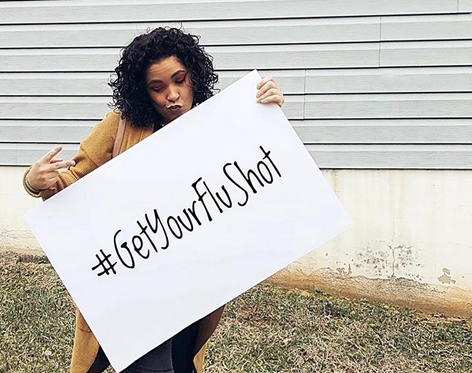
Specifically, PGP sent an open call to all legitimate influencers who met the eligibility criteria, including that their following consisted of a primarily African American or Hispanic audience located within the geographic area that received the campaign. They then asked the 117 influencers who answered the call to choose from a selection of previously vetted messages pertaining to flu vaccination and to create their own original, user-generated content (messages, images, and/or videos), in either English or Spanish, promoting flu vaccination. PGP asked the influencers to create posts that tied into relatable moments and holidays, and to include a link to STOP FLU, the campaign website. Content was intentionally unbranded ("native advertising") to ensure that it aligned with the look and feel of their pages.
Cross-sectional pre- and post-campaign surveys were conducted within regions that received the campaign and control regions to examine potential campaign impact. The baseline survey was conducted prior to the US flu season, from August 22 2018 to September 21 2018, and the follow-up survey was conducted after the end of the typical flu season, from March 1 2019 to April 8 2019. Evaluation survey questions were guided by the Theory of Planned Behavior, which states that behaviour is determined by attitudes, perceptions of social norms, and beliefs of control or self-efficacy to accomplish the intended behaviour change.
Throughout the campaign period, the influencers reached a potential of 9.9 million individuals on social media and generated 69,495 engagements (likes, shares, or comments), on par with general marketing industry standards. Spanish-language posts appeared to be more engaging; the researchers theorise that individuals within the Spanish-speaking community may not being accustomed to seeing health information in a language and style that resonates with them, so they felt more compelled to engage with the content. Furthermore, STOP FLU attracted 16,064 unique homepage views and page views on its Vaccine Finder page.
In terms of impact:
- Respondents in the campaign region reported slightly higher vaccination rates at follow-up, with nearly 45% receiving the vaccine in the campaign group and 42% receiving it in the control group; however, the difference was not significant.
- The campaign area had significantly higher percentages at follow-up versus baseline of those who: believe it is never too late to get a flu vaccine (p < .05), disagreed that healthy people do not need to get the flu vaccine (p < .05), believe the government closely monitors the safety of the flu vaccine (p < .05), and agreed that respondents would get the flu vaccine if everyone else was getting it (p < .05). Across these measures, the control area did not show a significantly higher percentages of agreement from baseline to follow-up.
- The campaign group showed a significantly lower percentage of those who believe that the side effects of the flu vaccine are worse than the flu (p < .05) from baseline (34%) to follow-up (32%), while the control group showed a higher percentage for this measure (p < .05) from baseline (35%) to follow-up (37%).
- At follow-up, 14.1% of respondents in the campaign region reported seeing positive flu promotion posts from someone they follow on their social media accounts. They reported higher vaccination coverage compared to those who had not seen flu promotions (50.9% vs 43.3%) and significantly more often agreed that the vaccine is effective (58.2% vs 46.8%), that the vaccine is the best way to protect others from the flu (67.1% vs 55.5%), and that the vaccine is worth the time and effort (67.1% vs 59.1%).
Apart from the targeted reaching of African American and Hispanic communities, the researchers note that baseline results from the campaign area showed that nearly 25% of respondents overall had already received the flu vaccine for the upcoming year, while just over 30% intended to do so, and around 15% were unsure. However, the follow-up showed final vaccination coverage around 45% of the sample. This suggests that future campaigns may wish to try to reach both those who intend on getting the vaccine (but do not) and those who are unsure if they will get the vaccine. "Future studies should examine the feasibility of using an influencer-driven model to reach that group who express intention or hesitancy, but may be more receptive to receiving the vaccine. This methodology also has promising implications in communicating information about other topics that are hotly debated, including other non-seasonal vaccinations, particularly in light of recent measles outbreaks..." The researchers add that future studies could also examine how to address the challenge of evaluating behaviour change fostered by native advertising strategies that place the message at the centre of the campaign.
In conclusion: "This study suggests that flu campaigns using a ground-up rather than top-down approach can feasibly reach at-risk groups with lower vaccination rates, and shows the potentials of using an influencer-based model to communicate information about flu vaccination on a large scale."
PLoS ONE 15(10):e0240828. https://doi.org/10.1371/journal.pone.0240828. Image credit: Lauren Glitters via Instagram - from the STOP FLU
- Log in to post comments