










































Community Health Worker Use of Smart Devices for Health Promotion: Scoping Review
Heidelberg University (Greuel, Sy, Bärnighausen, Adam, Vandormael); Africa Health Research Institute (Bärnighausen, Harling); Harvard University (Bärnighausen, Harling); Stanford University (Adam); Icahn School of Medicine at Mount Sinai (Gates); University College London (Harling); University of the Witwatersrand (Harling); University of KwaZulu-Natal (Harling)
"If used appropriately, smart devices may catalyze health promotion, benefitting CHWs and clients alike..."
Community health workers (CHWs) have become essential to the promotion of healthy behaviours, yet their work may be complicated by challenges such as resistance to the change of existing behaviours, disbelief of health messages, limited community health literacy, insufficient CHW communication skills and knowledge, lack of community interest and respect for CHWs, and CHWs' lack of adequate supplies. Facing these challenges, CHWs have called for educational communication materials that can be carried to the households they visit. This scoping review examines to what extent mobile health in the form of "smart" devices (e.g., smartphones and tablets) in low- and middle-income countries (LMICs) may enhance the delivery of public health messages in CHW-client interactions.
The researchers conducted a structured search of the PubMed and LILACS databases using subject heading terms in 4 categories: technology user, technology device, use of technology, and outcome. Eligibility criteria included publication since January 2007, CHWs delivering a health message aided by a smart device, and face-to-face communication between CHWs and clients. The 12 eligible studies, all but 2 (83%) of which are qualitative, were analysed using a modified version of the Partners in Health conceptual framework. The included studies - all published between 2010 and 2021 - were conducted in South Africa, Nigeria, Burkina Faso, Lesotho, and India.
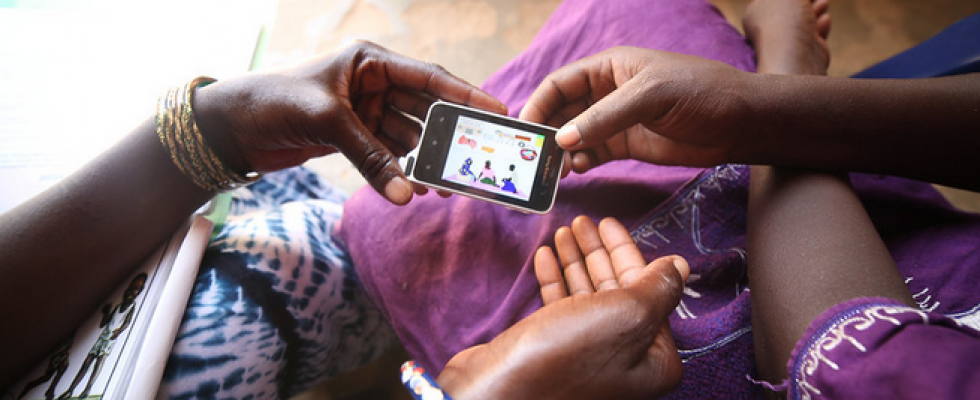
For example, Birukila et al. assessed the acceptance of videos containing messages to promote polio immunisation in rural and urban Nigeria. The videos - described as pictorial, digitalized flipcharts - were shown to parents and caregivers in 21,242 households on CHWs; smartphones. Almost all (99.9%) of the 11,612 caregivers who watched the videos claimed that these videos met their health information needs, and 85.4% of the 12,418 mobile phone owners agreed to receive the videos via Bluetooth. Over the study period, CHWs shared the videos around 100 times a day.
Overall, the review found that smart devices mitigate challenges encountered by CHWs by improving: their knowledge, motivation, and creativity (e.g., through self-made videos); their status within the community; and the credibility of their health messages. The technology stimulated interest in both CHWs and clients - and sometimes even in bystanders and neighbours. By stimulating community interest, health messages may be conveyed more effectively. Because this interest may wane over time as recipients and others become accustomed to the technology, frequent innovations (in the form of new videos, apps, etc.) may therefore be necessary. Media content produced locally or reflecting local customs was strongly embraced and "has the potential to affect health behaviors more powerfully than material conceptualized elsewhere."
Despite the ability of mHealth to alleviate some challenges encountered by CHWs identified in these studies, there are also key drawbacks, such as equivocal effects on CHW-client interactions. On the one hand, CHW-moderated group video sessions generated considerable discussion, and devices were particularly beneficial for sensitive topics such as sexual health. On the other hand, interactions suffered, as CHWs were tempted to replace educational conversations with clients by passively watching video content. Furthermore, older and less educated CHWs reported some technical difficulties that compromised the advantages brought about by mobile devices. Adequate CHW training ameliorated these difficulties. "CHWs should be familiarized with the technology and instructed on employing it as a complement to their interactions with clients, not as a replacement thereof."
In terms of the question of whether mHealth helps CHWs improve clients' health behaviours, CHWs in one study included in the review provided anecdotal evidence that their use of smart devices could have contributed to the uptake of vaccinations. However, only 1 study (8%) considered client health behaviour change as an end point, revealing a major research gap. In addition: "Further research should focus on mHealth's influence on the quality of CHW-client interactions and how a stimulating synergy between technology and interactions can be achieved."
In conclusion: "Smart mobile devices may augment CHWs' field performance and enhance face-to-face interactions with clients, yet they also generate new challenges. The available evidence is scarce, mostly qualitative, and focused on a limited range of health outcomes. Future research should include larger-scale interventions across a wide range of health outcomes and feature client health behavior change as an end point."
JMIR Mhealth Uhealth 2023;11:e42023. Image caption credit: Community health workers, Senegal 2013. Ericsson via Flickr (CC BY-NC-ND 2.0)
- Log in to post comments