










































Whose Knowledge Counts? Involving Communities in Intervention and Trial Design Using Community Conversations
Affiliation
University College London (Burgess, Colbourn, King); University College Hospital (Shittu, Falade); Karolinska Institutet (Shittu, Iuliano, Bakare, King); Save the Children (Haruna, Valentine); University of Ibadan (Bakare, Falade); Royal Children's Hospital (Graham); Johns Hopkins University (McCollum)
Date
Summary
"What methods will enable us to normalise more meaningful community engagement at the heart of trial practices?"
Scholars and activists consistently advocate for the importance of community participation and involvement in health research. In the context of trials, this approach has typically involved small-scale qualitative work, with limited opportunities for citizens to contribute to the structure and nature of the trial. This paper reports on efforts to move past typical formative trial work through application of the community conversations (CCs) methodology to inform a pragmatic cluster randomised controlled trial (RCT) evaluating a complex intervention to reduce under-5 mortality in Nigeria.
Used here to involve communities in mapping the contexts that would shape the feasibility and acceptability of participatory interventions to address childhood infectious diseases in Northern Nigeria, the CC method enables community-centred dialogue through a light-touch role for the facilitator. The method encourages critical thinking among participants, stimulates finding tailored solutions to the problem detected, and can lead to lasting community empowerment. Opportunities are created for diverse stakeholders to develop critical consciousness about the relationships between structural contexts and their experiences.
Formative research was carried out as part of a larger Integrated Sustainable childhood Pneumonia and Infectious disease Reduction in Nigeria (INSPIRING) programme in Jigawa State Nigeria, which uses a cluster RCT approach to impact evaluation. The intervention is a locally adapted "whole systems strengthening" package of 3 evidence-based activities: community participatory learning and action (PLA) groups; partnership-defined quality scorecards (PDQSs); and training and engagement between caregivers and health facility staff. The inclusion of community members in the co-design process was achieved through an adapted CC approach that included 4 of the 5 CC stages - relationship building, concern identification, concern exploration, and reflection and Review.
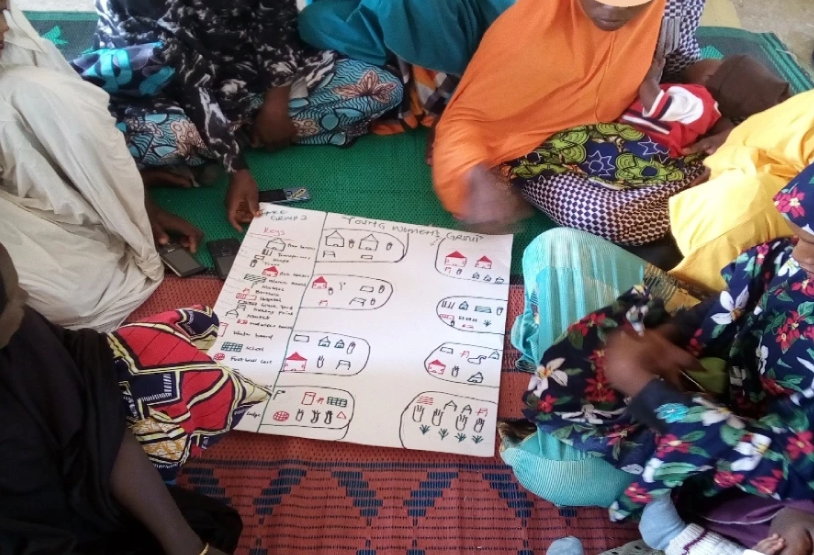
Specifically, from November 2019 to March 2020, the researchers conducted 12 rounds of CCs with 320 caregivers of under-5 children in 6 administrative wards in Kiyawa Local Government Area (LGA), Jigawa state. Conversations were structured around participatory learning and action activities, using drawings and discussion to reduce barriers to entry. During activities, participants were placed in subgroups: younger women (18-30 years of age), older women (31-49 years), and men (18 years above). Discussions were conducted over three 2-hour sessions, facilitated by community researchers. Following an initial analysis to extract priority issues and perspectives on intervention structure, smaller focus group discussions were completed with participants in 5 new sites. A sample activity: community mapping, which began with a process of identifying landmarks and resources in relation to child health but expanded beyond this to enquire about how different groups make use of this space based on dynamics such as social identity processes, communities of practice and action, and symbolic communities.
This process helped uncovering hidden processes that shape the impact of INSPIRING's PLA and PDQS interventions, including:
The researchers "also believe that through dialogue coordinated in a respectful and open forum, the approach established opportunities for interpersonal transformation, with young women able to feel heard and have their views acknowledged in forums where this is often unlikely. Key to this, was the use of visual and image-based activities - as these ensured that even those with low literacy were not excluded from dialogue opportunities. Thus, the activities not only gave members a sense of ownership over the intervention, but had the opportunity to improve future communication within community networks more broadly."
In addition, embedding CC methodology within trial design processes provides a pathway to engage everyday citizens as experts in the processes of knowledge production in more meaningful ways. In turn, the researchers were able to glean community members' priorities and perspectives, increasing the likelihood of uptake when the formal intervention was rolled out because of a deep understanding of the varied contexts and experiences of these contexts among participants.
However, some challenges emerged through this experience and may help guide future researchers using CCs in trial research:
Scholars and activists consistently advocate for the importance of community participation and involvement in health research. In the context of trials, this approach has typically involved small-scale qualitative work, with limited opportunities for citizens to contribute to the structure and nature of the trial. This paper reports on efforts to move past typical formative trial work through application of the community conversations (CCs) methodology to inform a pragmatic cluster randomised controlled trial (RCT) evaluating a complex intervention to reduce under-5 mortality in Nigeria.
Used here to involve communities in mapping the contexts that would shape the feasibility and acceptability of participatory interventions to address childhood infectious diseases in Northern Nigeria, the CC method enables community-centred dialogue through a light-touch role for the facilitator. The method encourages critical thinking among participants, stimulates finding tailored solutions to the problem detected, and can lead to lasting community empowerment. Opportunities are created for diverse stakeholders to develop critical consciousness about the relationships between structural contexts and their experiences.
Formative research was carried out as part of a larger Integrated Sustainable childhood Pneumonia and Infectious disease Reduction in Nigeria (INSPIRING) programme in Jigawa State Nigeria, which uses a cluster RCT approach to impact evaluation. The intervention is a locally adapted "whole systems strengthening" package of 3 evidence-based activities: community participatory learning and action (PLA) groups; partnership-defined quality scorecards (PDQSs); and training and engagement between caregivers and health facility staff. The inclusion of community members in the co-design process was achieved through an adapted CC approach that included 4 of the 5 CC stages - relationship building, concern identification, concern exploration, and reflection and Review.
Specifically, from November 2019 to March 2020, the researchers conducted 12 rounds of CCs with 320 caregivers of under-5 children in 6 administrative wards in Kiyawa Local Government Area (LGA), Jigawa state. Conversations were structured around participatory learning and action activities, using drawings and discussion to reduce barriers to entry. During activities, participants were placed in subgroups: younger women (18-30 years of age), older women (31-49 years), and men (18 years above). Discussions were conducted over three 2-hour sessions, facilitated by community researchers. Following an initial analysis to extract priority issues and perspectives on intervention structure, smaller focus group discussions were completed with participants in 5 new sites. A sample activity: community mapping, which began with a process of identifying landmarks and resources in relation to child health but expanded beyond this to enquire about how different groups make use of this space based on dynamics such as social identity processes, communities of practice and action, and symbolic communities.
This process helped uncovering hidden processes that shape the impact of INSPIRING's PLA and PDQS interventions, including:
- Power dynamics between stakeholders in communities - The CCs revealed that gendered power relations shape the use of space and ownership over decision-making linked to child health. In most cases, dissemination of information/innovation begins with the district head and moves downward throughout the community. Women were seen as the least likely to be seen as a source of knowledge outside of child-related dynamics. Given evidence which suggests that an underappreciation of power relationships can negatively impact community health interventions, two actions were taken: (i) adding a module within the PLA intervention manual on family relationships and power in the household; and (ii) ensuring that PLA groups were facilitated with women and men separated initially, then bringing them together for specific planning meetings in preparation for reporting activities to the community link aspects of the INSPIRING intervention.
- Problematising the use of space - For example, participants from all wards agreed that there were clear gendered rules about the use of space in communities. In light of this, plans for the community link intervention where men's and women's groups were required to meet and establish shared plans and priorities to be considered at health forums could only continue with explicit permissions for these meetings from the district head.
- Reflections of systems of compensation for community interventions - In the 6 wards where full CC activities were carried out, financial compensation was identified as important. This feedback informed the research team decision to have an approach to compensation that contributed useful materials to a household (i.e., baby carriers for women); they also allowed groups to decide on the timing and locations of their meetings throughout the study.
The researchers "also believe that through dialogue coordinated in a respectful and open forum, the approach established opportunities for interpersonal transformation, with young women able to feel heard and have their views acknowledged in forums where this is often unlikely. Key to this, was the use of visual and image-based activities - as these ensured that even those with low literacy were not excluded from dialogue opportunities. Thus, the activities not only gave members a sense of ownership over the intervention, but had the opportunity to improve future communication within community networks more broadly."
In addition, embedding CC methodology within trial design processes provides a pathway to engage everyday citizens as experts in the processes of knowledge production in more meaningful ways. In turn, the researchers were able to glean community members' priorities and perspectives, increasing the likelihood of uptake when the formal intervention was rolled out because of a deep understanding of the varied contexts and experiences of these contexts among participants.
However, some challenges emerged through this experience and may help guide future researchers using CCs in trial research:
- The type and aim of participation in trial development matters. Nominal participation and instrumental participation might only serve the purposes of practitioners and formal institutions.
- In implementing this methodology, the purpose should be well communicated not only to study participants, but also to the broader community as well. (In this case, community members who had not heard about the CC meeting initially felt that it was a political gathering and questioned why they were excluded, and they tried to politicise it.)
- Appropriate compensation schedules that align with the time investment of communities are critical and are an equitable way to acknowledge the importance of everyday knowledge to scientific processes especially when this method extends for longer periods.
- It is imperative that qualitative aspects of the formative research of research are appropriately costed.
Source
Trials (2023) 24:385. https://doi.org/10.1186/s13063-023-07320-1. Image credit: INSPIRING Project Consortium
- Log in to post comments