










































Fighting the Flu with Technology
LoHud.com
According to this article from the website LoHud.com, governments are tapping into the resources of corporations like IBM and Google for their expertise in manipulating data to fight disease. The article includes a number of examples of the use of information and communication technology projects focused on pandemic study, including both avian and swine flu.
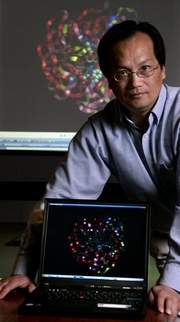
The first example is the use of IBM's Blue Gene supercomputer at the Thomas J. Watson Research Center in Yorktown, New York, United States (US). Joseph M. Jasinski, director of IBM's Healthcare and Lifesciences Institute, said IBM has offered its help to the Ministry of Health in Mexico to tackle the swine flu outbreak. Researcher Ruhong Zhou is entering data to seek answers to questions on the possible pandemic proportions of swine flu. Zhou has been working on avian flu and the risks of a global pandemic since 2006 and has recently focused his work on the swine flu, called the "novel influenza A (H1N1)", originating in Mexico. He is doing his analysis using Blue Gene's 80,000 processors. Zhou focuses his research on using computer models to imagine how the flu virus might mutate. He is also creating computer models to find out which mutations might cause the virus to become resistant to Tamiflu and Relenza, the influenza antiviral drugs recommended by the US Centers for Disease Control and Prevention (CDC) for use against the new H1N1 virus.
Zhou is part of IBM's Global Pandemic Initiative, which pairs the Big Blue computer with the World Health Organization (WHO), the CDC, and other public health institutions to develop a way to easily share information. About 15 people out of the 100 in IBM's Life Sciences unit are part of the Global Pandemic Initiative. The team includes chemists like Zhou as well as molecular biologists, computer scientists, and a certified lab technician. Zhou's work is part of a collaborative effort between IBM and the Scripps Research Institute called Project Checkmate that tracks the possible mutations of viruses based on information from various regions, currently, the genome sequence for the new H1N1 collected from cases in New York, Texas, and California, US.
The article discusses the renewed interest in pandemic preparedness after an observed public "fatigue" surrounding disease warning information. The lasting effect of pandemic alerts and preparation, as stated by Jasinski, is that public health officials respond much more quickly with planned school closings. Tracking of disease outbreaks is also watched more closely. For example, Google is working with the CDC on seasonal flu trends in a pilot project in Texas, according to Louise S. Gresham, director of health security and epidemiology at the US Nuclear Threat Initiative's Global Health and Security Initiative. She states that public health is ripe for new technology since so much information is currently poorly integrated. She cites as problematic the gap between a doctor's seeing a patient and that case being placed into a public database.
A further use of IBM's technology is a tool called the Spatiotemporal Epidemiological Modeler, or STEM, which can create computer models of how a disease spreads using data like population and transportation systems. According to Jasinski, it can be used to build models of how a disease might spread. Researchers can plug in variables, like what would happen if schools or airports were closed or everyone received the Tamiflu vaccine.
In addition, IBM has developed other tools as well, including a web-based system for public health officials to share data about disease outbreaks that's been piloted in the Middle East to study the spread of food-borne pathogens such as salmonella and shigella.
Avian Influenza Daily Digest on May 12 2009. Photo: Matthew Brown/The Journal News.
- Log in to post comments