










































WHO Leadership Video Conference
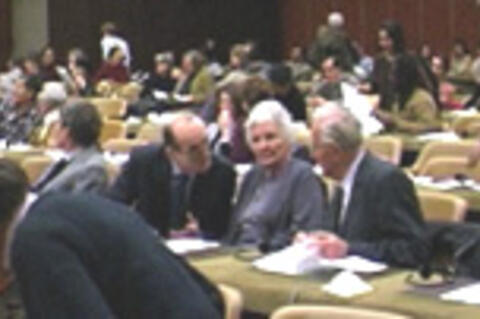
This initiative provided an opportunity for health ministers, civil society organisations, and others with an interest in health to ask candidates to address publicly - and share their views on - the critical issues in global health today. During the event, listeners and viewers had the opportunity to email questions to the candidates. The candidates who took part were: Pascoal Manuel Mocumbi, Prime Minister and former Health Minister of Mozambique; Ismail Sallam, professor of cardiac surgery and Egypt's former Minister of Health and Population; and Joseph Williams, medical doctor, parliamentarian, and former Prime Minister of the Cook Islands. (The 4 remaining candidates were not able to attend).
Audiences in Geneva, Switzerland, and people around the world asked the candidates were asked a series of questions from and around the world. International links included the Nelson Mandela School of Medicine and the Medical Research Council in South Africa, the World Bank Institute and the George Washington University in the United States, Canal Saude (Health Channel) in Brazil, and health experts in Ethiopia, India, Japan, and Sweden.
The videoconference was broadcast on the Kaiser Family Foundation website and globally via the WorldSpace satellite system, a technology that allows access to areas of the world with no internet access or telecommunications infrastructure. It was rebroadcast throughout Brazil by Canal Saude and throughout Africa on the Commonwealth Broadcasting Association's radio network.
Unanswered questions were forwarded to the successful candidate (Dr. Lee Jong-wook, who died on May 22 2006 following a sudden illness), and the replies were posted on the Exchange and IHN websites.
Health.
The event was organised by the Interactive Health Network (IHN)'s World Health Channel and supported by Exchange, the NGO [non-governmental organisation] Forum for Health, and the Kaiser Family Foundation. Other co-sponsors included the International eHealth Association, Canal Saude (Brazil's health channel), the People's Health Movement, the Academy of International Health Philanthropy, the International Hospital Federation, Healthlink Worldwide, Medact, Panos Institute (London), The Communication Initiative, and the International People's Health Council. Commercial sponsors included World Space and Direct Visual.
Email from Andrew Chetley to The Communication Initiative on August 18 2010; and Exchange website, August 26 2010.
- Log in to post comments