










































Fast Car: Travelling Safely around the World
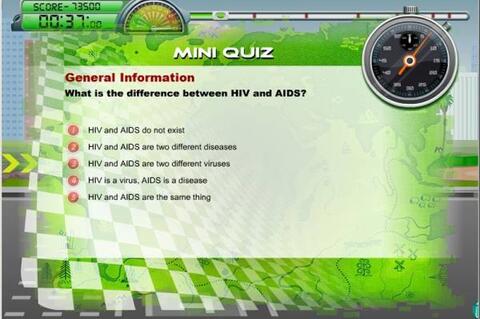
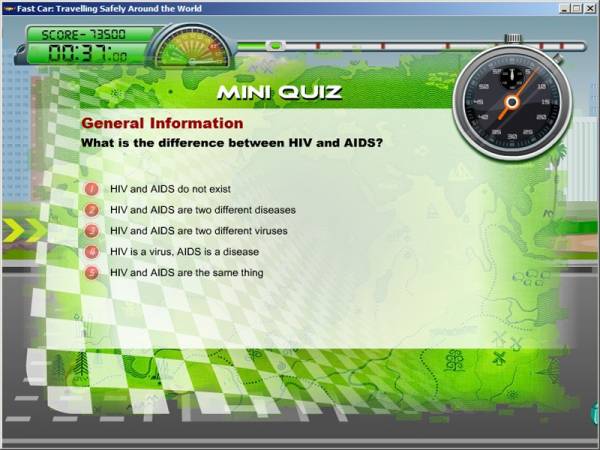
This information and communication technology (ICT)-based effort uses the entertainment-education (EE) strategy to provide access to knowledge on HIV and AIDS and to actively engage young people. The idea is that, by gaining an accurate understanding of these issues and preventive practices, youth may be mobilised to change their behaviour.
In the game, a player can race on circuits on 5 continents, and virtually visit some of the UNESCO World Heritage sites (911 properties forming part of the cultural and natural heritage which the World Heritage Committee considers as having outstanding universal value). It also presents images of sites and interesting facts about them as players race by. The scientific content focuses on HIV and AIDS prevention, treatment, and cure, with particular attention to HIV virus life cycle, challenges for the development of new treatment, and antiviral resistance.
Click here to view a video preview of Fast Car.
HIV/AIDS, Youth.
According to UNESCO, "Teenagers often want to talk to their parents about HIV-related issues, but may find it difficult to do so. Children may worry about parents' disapproval and have fears about the risk of becoming infected with HIV. Parents are often shy, lack accurate information about HIV and AIDS, or do not have sufficient skills to speak about prevention with their children, and teachers frequently assume that parents will talk with children at home." Fast Car is designed to address these gaps.
Two storylines were tested in Kiev (Ukraine), involving community groups of 15- to 21-year-old young people during sessions organised by the Program for Appropriate Technology in Health (PATH). Ms. Katya Gamazina, PATH Program Director in Ukraine, said: "these interactive multimedia tools can help both teachers and parents discuss with children sensitive issues, such as safe behavior for HIV and AIDS prevention".
Dr. Barbara Mueller from the Department of Virology of the Heidelberg University Hospital believes that "such interactive multimedia tools could be used both for teaching and learning purposes at schools and some also at universities."
The following local researchers and experts contributed content for the game: Path Ukraine (Ukraine), the Institution of Social Development (Vietnam), and University Hospital of Heidelberg, Department of Virology (Germany). Lakshya Digital Pvt. Ltd. (India) helped UNESCO develop the game concept and realise it technically.
"Interactive multimedia tools for youth to help combat HIV and AIDS", July 17 2009; "UNESCO Launches First Computer Game for Young People on HIV and AIDS", December 23 2010; and email from Irmgarda Kasinskaite-Buddeberg to The Communication Initiative on January 5 2011.

- Log in to post comments