










































Ending Child Marriage in Ethiopia: Shaping/Redefining Communication for Development Actions Based on Lessons Learned from Global and Ethiopian Evidence
United Nations Children's Fund (UNICEF)
"By focusing on increasing female teachers and supporting girls' completion of primary school (or more years of schooling) I believe we could play a catalytic role in changing the perception of valuing girls' education by all, and potentially this could contribute to ending child marriage."
In this presentation, Mariana Muzzi examines several solutions that have been implemented by different organisations, including UNICEF, in the effort to address the practice of child marriage, reflecting especially on the importance of girls' education.
To contextualise UNICEF's focus on education, she points to the 2011 International Center for Research on Women (ICRW) study "Solutions to End Child Marriage - What the evidence Shows" (see Related Summaries, below), which was based on the analysis of 23 documented and evaluated programmes that attempted to measure change in child marriage-related behaviours, knowledge, and/or attitudes among relevant stakeholders. These programmes were implemented between 1973 and 2009, with several of the programmes continuing through the present, and evaluations were published between 1991 and 2010. Findings of this study indicate that the following 5 strategies/approaches can be considered possible solutions to ending child marriage: (i) empowering girls with information, skills, and support networks; (ii) educating and mobilising parents and community members; (iii) enhancing the accessibility and quality of formal schooling for girls; (iv) offering economic support and incentives for girls and their families such as conditional cash transfers (CCTs); and (v) fostering an enabling legal and policy framework.
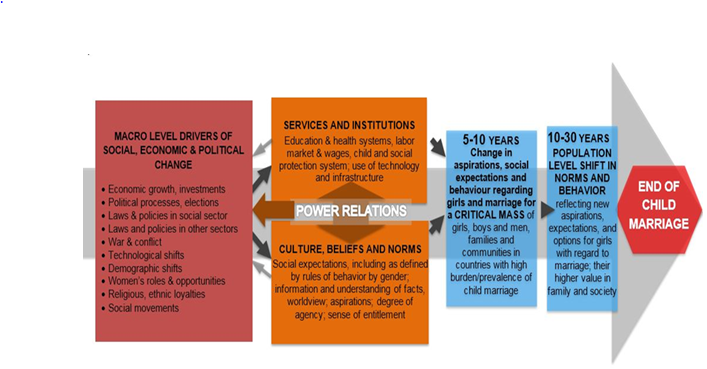
Continuing with her look at what has been done to date, Muzzi explores, in Slide 4, the theory of change that has driven the work of Girls Not Brides. Slides 5 and 6 show UNICEF's theory of change, designed with the intention of 10-30 year population-level shifts in norms and behaviours around child marriage so as to end the practice. In Slide 8, Muzzi describes the UNICEF-United Nations Population Fund (UNFPA) Global Programme to Accelerate Action to End Child Marriage. Outcomes include: (i) Adolescent girls at risk of and affected by child marriage are better able to express and exercise their choices; (ii) households demonstrate positive attitudes and behaviours towards investing in and supporting adolescent girls; (iii) relevant sectoral systems deliver quality and cost-effective services to meet the needs of adolescent girls; (iv) national laws, policy frameworks and mechanisms to protect and promote adolescent girls' rights are in line with international standards and are properly resourced; and (v) government(s) and partners within and across countries support the generation and use of robust data and evidence to inform policy and programming, track progress, and document lessons.
Muzzi examines some research that may partially challenge one of the 5 solutions suggested in the 2011 ICRW study. In India, findings from the assessment of the Government of the State of Haryana's CCT programme called "Apni Beti Apna Dhan" ("Our Daughter, Our Wealth") indicate that cash transfers had no effect on the age of marriage and only a marginal effect on keeping girls in school up until the 8th grade. Also, girls enrolled in the scheme were more likely to get married at 18 with parents using the money for dowry, highlighting that financial incentives alone cannot shift entrenched gender norms. "We find that the CCT as designed was insufficient to change these prevailing gender roles and expectations; in fact, the program may even have reinforced notions that girls are a burden, as the money was often seen as intended to offset the costs of getting them married." And in Ethiopia, preliminary findings from the National Alliance to End Child marriage-commissioned, Overseas Development Institute (ODI)-conducted study "The Patterning and Drivers of Child Marriage in Ethiopia's Hotspot Districts" indicate that economic poverty does not emerge as a strong driver of child marriage. "While we surely cannot dismiss the economic component as a possible factor in perpetuation child marriage and the low value of girls, nor do we wish to categorically dismiss CCTs, we may wish to invest more heavily in testing and documenting sets of interventions that take into greater consideration the social nature of the practice and in identifying and supporting the social dynamics that favour its demise. Possibly CCTs could play a more positive role as part of a mix of interventions that derives from a more deliberate application of a social norms perspective."
Other preliminary findings of the ODI-conducted research in Ethiopia include:
- Girls' "agency" - Adolescent decision-making is a double-edged sword: In some locales it is allowing girls to choose education over marriage, but in others it is facilitating girls' early marriage. "Girls themselves are sometimes complicit in child marriage. In some cases, they wish to avoid the stigma directed at 'mature', unmarried girls and elect to marry as children solely to avoid being the subject of community gossip or insulted as qomoqär (left standing) or haftuu (unwanted). In other cases, most notably across Oromia, girls are 'choosing' to marry, sometimes very early, because they believe themselves in love, want the prestige of being a married woman, or wish to assert their independence from their parents."
- Role of religious leaders as male agents of change: "Whilst programmes which involve clergy/religious leaders as male role models have proven to be effective and are considered 'good practice', traditional and religious leaders also perpetuate the prevailing social norm that marriages should be arranged before or soon after puberty: Parents' fear of girls' emergent sexuality, which in many cases is supported by both religious tradition and religious leaders, has traditionally encouraged them to arrange child marriage either before or soon after puberty. This timing ensures girls will not sully family honour, but also - and critically from their parents' perspective - protects them from damaging their chances of attracting a good husband." Also, findings reveal that some clergy themselves marry girls below age 18 and many/most bless/celebrate marriages of girls below age 18.
Muzzi references a recent (2015) Population Council study of a United States Agency for International Development (USAID)-funded project, the Building an Evidence Base to Delay Child Marriage, which evaluated the effectiveness of 4 strategies to delay the age at marriage among girls aged 12–17 in parts of Ethiopia, Tanzania, and Burkina Faso with a high prevalence of child marriage. The study found that in Ethiopia, it was possible to delay child marriage with interventions that included a mix of economic support and communication for development (C4D) strategies. In communities where girls were offered educational support, girls 12–14 were 94% less likely to be married at endline than were girls in that age range at baseline (adjusted odds ratio (OR) 0.06, 95% confidence interval (CI) 0.01–0.51). In communities where girls were offered two chickens for every year they remained unmarried and in school, girls aged 15–17 were half as likely to be married at endline than were girls in that age range at baseline (adjusted OR 0.50, 95% CI 0.29–0.83). In communities that were engaged in conversations about the value of educating girls and the harms of child marriage, girls 12–14 were two-thirds less likely to be married at endline than were girls in that age range at baseline (adjusted OR 0.37, 95% CI 0.18–0.76). In communities where all the strategies were employed, girls 15–17 were two-thirds less likely to be married at endline than were girls in that age range at baseline (adjusted OR 0.32, 95% CI 0.19–0.55).
Taking all of this research into account, the question for Muzzi is how can we implement C4D interventions on valuing girls' education if (i) parents don't see opportunities for educated girls (why will I send my girl to school if there are no jobs for her?) and (ii) secondary schools are rare? So, Muzzi claims, we should discuss some promising solutions, both related to education, namely: (i) ensuring transition from primary to secondary school and (ii) increasing the number of female teachers. Despite being pretty clear cut, the first one is costly. The second complementary strategy of increasing female teachers aims at addressing some of the root causes of child marriage, pertaining to parents/communities/families not valuing girls' education, as they see girls as either mothers or child bearers. Muzzi explains the rationale as follows: Increasing the number of female teachers shows/demonstrates that girls can have an alternative to being mother or child bearer (i.e. having a job). From the few jobs available in rural contexts, teacher and health worker are the ones that are easier for parents/communities to accept for their girls (furthermore, there are a potentially large number of positions). In addition, once there are more female teachers on board, then it would be easier to get more women into the other existing jobs, as potentially the social norm of only seeing girls as wives/mothers/child bearers will have shifted. And more so, in contexts where school-related gender-based violence is present, the higher number of female teachers (especially in a secondary school setting) reduces the incidence of this type of violence.
Applied to the UNICEF Ethiopia context, Muzzi asserts that these results indicate the need to re-align UNICEF efforts to support education interventions, and/or advocate for increased government expenditure or development partners' investment in education, to achieve increased girls' completion of primary school and transition into secondary school. Gender disparities are not significant throughout the country. But one of the main issue hampering girls' (and boys') access to education is availability of the service. As per Education Management Information System (EMIS) 2012-2013 Ministry of Education (MoE) data, approximately 12 million enrol in primary school (1st cycle / grades 1-4), but less than half of these (5.5 million) enrol in 2nd cycle / grades 5-8. The situation becomes even more acute when transitioning into secondary education, as only roughly half a million children are enrolled in secondary schooling (1st cycle/grades 9-10), which is roughly 5% of the children that initially enrolled in primary school. The reason, Muzzi says, is that there are few secondary school teachers and there are few secondary school facilities. In Ethiopia, there are 30,534 primary schools and only 1,912 secondary schools. Strategies for addressing this deficit may include: "traditional activities" of ensuring secondary schools actually exist with teachers who are capable of teaching present; more "innovative" approaches of upgrading 25% of primary school facilities to include grades 9 and 10; and distance learning blended options of learning, using primary school facilities as a learning hub. Nationally, 37% of teachers are female in primary schools, dropping to 15% in secondary school classrooms. Strategies to address disparities could include the aforementioned action of increasing girls' completion of primary and secondary school (so that there are enough educated girls to become teachers in the first place) and advocacy to institutionalise a quota system (positive discrimination) with targets by year to progressively reach parity of female and male teachers in 5-10 years' time. This solution would most likely be need to be coupled with support to housing for female teachers in remote areas, etc. UNICEF would need to assess what would be UNICEF's value added, possibly advocacy for targets on gender parity.
What are the communication solutions to delivering messages around ending child marriage? Official Ethiopia Demographic and Health Survey (EDHS) 2011 data on exposure to mass media indicate that nationally, on average, 18% of men and women watch television at least once a week, and 30% of men and women listen to radio at least once a week. Men both listen to radio and watch TV more than women, a gap that is more pronounced in terms of radio listenership. An audience survey conducted in 2011 also indicates that radio is perceived as most accessible and reliable tool information gathering across the country, and that Ethiopians use radio as their primary source for receiving news and information. Urban areas have the highest percentage of TV viewers, with almost double the number of audiences in urban areas watching television daily than those living in rural communities. Between 2005 and 2010, internet users grew by 172%; however, the penetration rate is still very low at 4% and is mainly urban. Mobile phones provide the biggest percentage of internet uses. 38.8% of the population is on mobile, hence digital media such as bulk SMS (text) messages have a significant reach. Non-mass-media sources of information (word of mouth, working with community influencers and working through established community networks/platforms, such as Equb and Edir, women development armies, health development armies, parent-teacher associations, and health extension workers) remain very popular among both rural and urban communities, as 52% from rural areas and 36% in urban areas get information from family and friends. Another strong media or platform present in different parts of Ethiopia are the traditional and religious media which have direct interaction and acceptance by the community. These include Mesjids, churches, Dago and "Mebloe" in Afar, and religious ceremonies like "Senbete".
Muzzi concludes her presentation with several questions: Amongst the identified/evaluated global solutions to end child marriage, how much of the focus should be on C4D/SBCC versus, for instance, service delivery? Amongst communication initiatives in place, are we implementing the "right" ones? How do we measure and know we are doing the "right" thing? Whose behaviours would we like/need to influence to increase our results for girls and to end child marriage (religious leaders? girls?)?
SBCC Summit website, March 9 2016.
- Log in to post comments