










































Mobilising Communities for Malaria Prevention and Control in Mozambique
Malaria Consortium
"This learning brief shares Malaria Consortium’s experience in partnering with existing community structures and building the capacity of community-based volunteers to deliver key messages around malaria, to increase uptake of prevention and treatment services within communities in Mozambique."
This learning brief from the Malaria Consortium, part of a broader project documentation exercise [See source link below for more information], documents an intervention of the Malaria Prevention and Control project in Mozambique to, in part, increase community preventative behaviours and timely healthcare seeking through building capacity of community-based structures to enable them to engage in behaviour change communication activities.
Objectives included:
- "Increase knowledge among families and communities concerning malaria....;
- Promote communities’ uptake of malaria prevention methods, including the correct and consistent use of long lasting insecticidal mosquito nets, allowing indoor residual spraying in their homes, and uptake of intermittent preventive treatment by pregnant women at antenatal care services.
- Increase timely healthcare seeking at health facilities or from trained community health workers for the diagnosis and treatment for those with signs and symptoms of malaria."
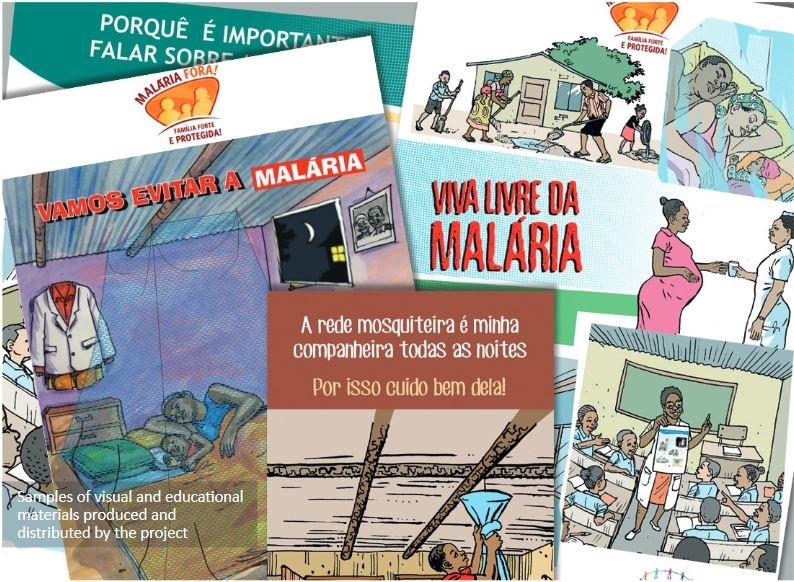
Activities included: mapping of community groups; building a database for the health district services; and assessing community-based needs to develop the processes, strategies, curricula, materials, and training tools for partners, who could then "replicate these in the roll-out of training packages in their own community groups." Materials for 12,475 volunteers from 548 community groups included flashcards and flipcharts with key messages around malaria prevention and control. Principles of active adult learning were used such as role play, drama, games, small group work, and visual tools. Volunteers had t-shirts, caps, pens, and a piece of capulana (local cloth) to increase visibility. "After the training, community volunteers worked with health centre staff and community leaders, developing monthly plans and conducting community outreach and mobilisation activities including lectures, theatre performances, home visits, and community meetings in strategic locations including markets, churches and mosques. Community groups shared progress reports and discussed activities and challenges in monthly meetings with health staff, and also received quarterly support supervision visits from Malaria Consortium field officers."
From baseline, volunteers reported on regular monitoring showing improved prevention awareness and a shift in behaviour toward better mosquito net use and careseeking at health centres rather than with traditional healers. "As part of a qualitative study conducted in 2014 in some districts about net use and care practices, community members interviewed considered volunteers to be the most effective channel for receiving information about health, expressing a great appreciation of their continuous awareness and education work." Tools, techniques and interpersonal communication, especially in home visits was useful in dispelling hearsay and disinformation.
Data on volunteer retention showed a high level except where there was a period without a field officer. Regular supervision and support and connection to a health centre appeared to be useful, as well as social recognition and opportunities for training and personal development, but the fact that other sectors use monetary remuneration for local volunteers was a challenge to the system. "Studies, including in Mozambique, have shown that community workers are motivated in many ways, including by hopes for better job opportunities, social relationships with beneficiaries, socio-moral values and the desire to reduce others’ suffering and promote values of community service...."
"Key Findings:
- Community volunteers have become the primary and preferred sources of information on malaria and have contributed to improved knowledge and increased demand for malaria diagnosis and treatment services.
- The interpersonal communication participatory techniques, such as drama performances during malaria prevention sessions, which were used by community groups, proved to be appealing to the target audience, offering learning through entertainment.
- Partnering with volunteers from existing community structures is an effective approach to reach a broad audience in rural communities with key messages on malaria prevention and control in Mozambique."
Malaria Consortium website, December 12 2018.
- Log in to post comments