










































The Mediated Amplification of a Crisis: Communicating the A/H1N1 Pandemic in Press Releases and Press Coverage in Europe
University of Erfurt (Rossmann, Meyer); University of Lugano (Schulz)
In spring 2009, the World Health Organization (WHO) announced the emergence of the A/H1N1 virus and, on June 11 of that year, raised the pandemic alert to the highest level. In the aftermath, health authorities were criticised for failures in crisis communication efforts, and the media were accused of amplifying the pandemic. Considering these criticisms, this article uses A/H1N1 as a case for examining risk amplification processes that may occur in the transfer of information from press releases to print news media during a health crisis.
During the A/H1N1 pandemic, 2 different phases were observed in the public debate. When officials first announced the pandemic, the public was strongly afraid of contracting the A/H1N1 virus. However, after the introduction of the new vaccine, concerns seemed to transfer to the possible side effects of the vaccine, consequently leading to hesitancy and low vaccination rates.
The researchers describe the function of communication in a public health crisis, which is to (i) provide information about risks, symptoms, or treatment of a disease; (ii) enable the public to evaluate risks and deal with the threats; and (iii) encourage the public to take appropriate precautions and increase compliance with health care and social interventions. Crisis communication must not, however, create panic.
The social amplification of risk framework (SARF) theorises how and why risks are amplified, and how this may result in increased public worries. It provides a frame to examine whether the media indeed exaggerated the pandemic, as critics alleged. SARF specifies 4 attributes that may influence amplifications in the flow of information: (i) the volume of information, (ii) the degree of debates about risks, (iii) dramatisation, and (iv) symbolic connotations. According to SARF, amplifications may occur at 2 stages: the transfer of information about the risk, and the response mechanisms of the society. The former stage is relevant in this study.
In particular, this study refers to the communication of risks in press releases and news coverage. The researchers analyse news media because, as noted above, they are crucial intermediaries for communicating risk information to the public, especially in crisis situations. This study also analyses press releases because journalists, on their part, often rely on them during health crises, which require specialised knowledge many journalists do not have. The researchers assume press releases to neither attenuate or amplify risks but, rather, inform adequately.
Looking at media in 10 European countries (Belgium, Czech Republic, France, Germany, Italy, Portugal, Romania, Spain, Sweden, and the United Kingdom) between March 2009 and March 2011, the researchers conducted a quantitative content analysis of: (i) press releases disseminated by international organisations (WHO, European Centre for Disease Prevention and Control (ECDC), and European Union (EU) Public Health) and health ministries; and (ii) newspapers (2 dailies per country (one quality and one tabloid newspaper), choosing the one with the highest reach. In Italy and Spain, no tabloid papers exist that are comparable to those in other European countries; therefore, the researchers coded 2 quality newspapers in these countries. The coding period included all relevant phases, starting from the prepandemic phase and outbreak of A/H1N1 (March 2009), continuing with the pandemic phase (starting in June 2009) and the vaccination phase (starting in September 2009), and ending with the postpandemic phase that started in February 2010 and also includes the second winter season of 2010/2011, when another slight increase in virus dissemination was detected.
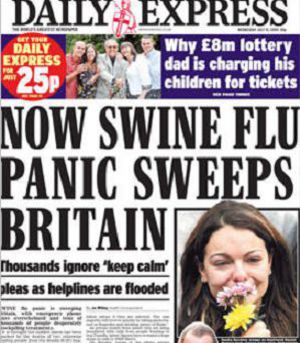
Altogether, 243 press releases, 1,243 quality press articles, and 834 tabloid press articles were coded. In short, consistent with research on news values and framing (discussed in the paper), the results suggest that quality and tabloid papers alike amplified A/H1N1 risks by emphasising conflict and damage, presenting information in a more dramatised way, and using risk-amplifying frames to a greater extent and risk-attenuating frames to a lesser extent than press releases.
More specifically, even if patterns of emphasis and frames were somewhat similar in press releases and press coverage, the latter emphasised conflict (e.g., experts debate about the effectiveness of vaccination) and dramatising content (damage, death, alarming messages, emotionalisation, and personification) more strongly than the former. This fact confirms previous findings in the context of news value research indicating that news values serve not only as a reason for news selection, but are also the result of the news-editing processes. Moreover, frames emphasising risks (consequence, uncertainty, conflict) appeared more often in press coverage than press releases, while press releases framed A/H1N1-related information more often in risk-attenuating terms (reassurance, new evidence, action). Thus, the results confirm previous studies in the context of SARF, finding that the media work as an "amplification station" in the transfer of risk information.
In keeping with the overall results, there were strong amplifications in press coverage compared with press releases in the vaccination phase. A possible reason for this finding is that the vaccine was widely discussed in European media in spite of clear information provided by health institutions. Health authorities clearly recommended the A/H1N1 vaccine as soon as it was available, which is why they probably only released a few press releases at that time. Journalists (and the public) instead tended to question the quality and effectiveness of the vaccine. Considering the observed vaccination hesitancy, the increased volume of media coverage during this time might be one possible factor that contributed to this reaction.
To some extent, the quality and tabloid press differed in how risk information was presented. While tabloid press articles seemed to follow the leading quality press with regards to content and framing of health crisis coverage, they exhibited a stronger emphasis on drama and emotion in the way they presented information.
The researchers conclude that it is in the nature of crisis communication efforts that news factors like damage and risk-related frames are mentioned in press releases that seek to inform the press (and via the press the public) about possible health threats. As this study found and has been discussed in previous literature, the media do not just take over these factors as depicted in press releases but, rather, emphasise them. However, other factors also contributing to an amplification of risks could be avoided more easily, such as conflict, personification, and emotionalisation. Thus, the researchers say, health institutions should try to reduce the use of such factors in their press releases to improve the crisis communication efforts in order to inform the public without causing panic.
Risk Analysis, Vol. 38, No. 2, 2018. https://doi.org/10.1111/risa.12841. Image credit: The English Blog
- Log in to post comments