










































Perceived Trust in the Health System among Mothers and Nurses and Its Relationship to the Issue of Vaccinations among the Arab Population of Israel: A Qualitative Research Study
University of Haifa
"What is the explanation for the particularly high response rate among the Arab population with respect to vaccinations?"
Trust has been defined as "the willingness to accept a vulnerable situation based on a positive expectation regarding the actions of others". Research points to a positive correlation between an individual's trust in healthcare workers and the decision to get vaccinations. Studies have found that various minorities and ethnic population groups worldwide tend to place less trust in the healthcare system. Factors such as values, norms, religious and cultural beliefs, language, and difficulties in communicating with medical personnel not belonging to the minority group are among the factors that have been cited to explain this finding. Research indicates that on the one hand the level of trust in the health system among the Arab population, a minority group, has dropped over the years, while on the other hand the rates of vaccination remain high. Hence, the current study seeks to examine these contradictory findings from the perspective of trust.
The research employs the qualitative phenomenological research method, using personal interviews to identify and analyse perceived trust among mothers of young children and teenagers (n=70) and among nurses (n=20) in the Arab population in the context of vaccinations and the high response rate to vaccinations against seasonal flu and against the human papillomavirus (HPV) among this population.
With respect to routine childhood vaccinations, all the interviewees (70/70) expressed positive and supportive attitudes. Most of interviewed mothers (63/70) gave their children the HPV vaccine. With respect to influenza vaccinations, the mothers (45/70) indicated they vaccinated their children against the flu because it was given in the school setting.
The interviewees proposed a variety of reasons for the high response to vaccination among the Arab minority population compared to among the Jewish population: belief that vaccination provides generic protection from disease, acknowledgement of the success of vaccinations in eradicating all kinds of diseases, issues related to the political status of the Arab population as a minority group (e.g., because of the constant threat of discrimination, the population tends to rush to get vaccinated out of fear that this right will disappear), and perceptions of vaccination as obligatory for all citizens (even though vaccinations in Israel are in fact not obligatory under the law).
In the interviews, the nurses attempted to explain the low vaccination response rate among the Jewish population compared to the Arab population. The nurses (20/20) emphasised that the high awareness among the Jewish population regarding the scientific controversy surrounding vaccinations stemmed from their high literacy. Some of the nurses (9/20) explained that the Jewish parents' hesitancy about the vaccinations derived from their skepticism regarding the vaccines' safety and effectiveness. Others (4/20) noted that some doctors do not recommend the HPV vaccination consistently.
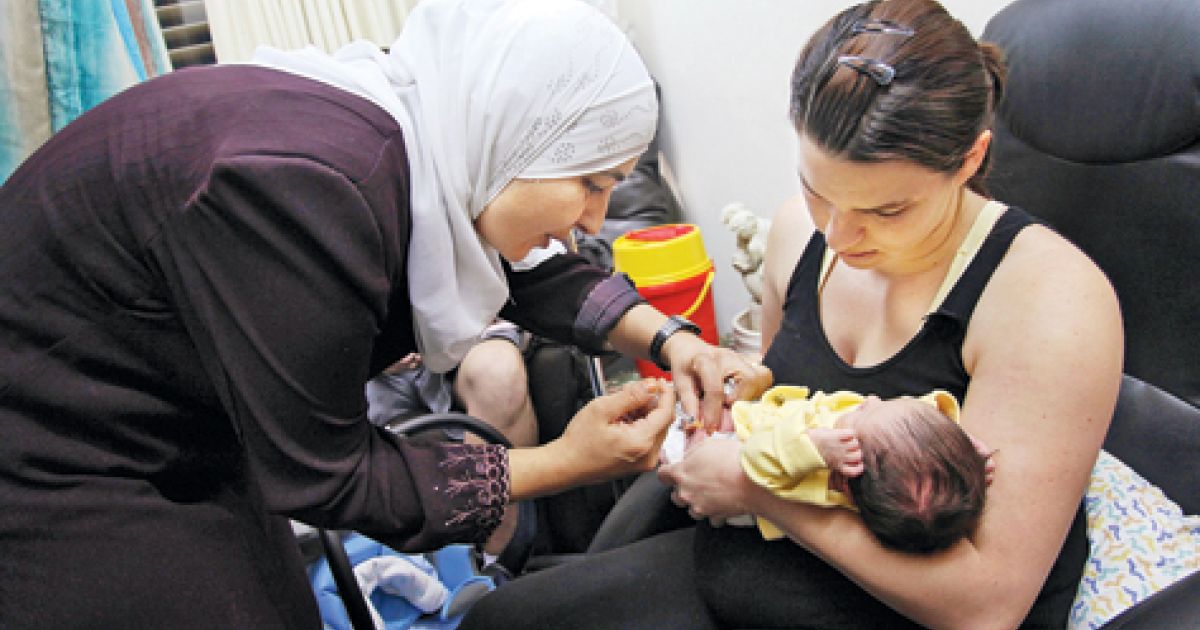
The research findings point to varying degrees of trust in the establishment (Ministry of Health), the organisations (the health maintenance organisations and the hospitals), and the medical staff. When the mothers were asked about their trust in the Israeli health system, some claimed they did not trust the system (39/70), citing the system's economic interests. The participants placed the highest trust in the nurses working in the Tipat Halav Family Health Centers run by the Ministry of Health. Most of the mothers (66/70) indicated that the Tipat Halav nurse is the most reliable source of information about health topics in general and about vaccinations in particular. Some mentioned the nurses' empathy and their willingness to listen. In contrast, a large portion of the mothers (45/70) reported they did not trust their family physician. They noted that their trust in the family doctor had declined, citing various reasons for this in the interviews.
The interviewees consider the explanatory materials to be limited, superficial, and not culturally appropriate. To the question that specifically referred to how the Ministry of Health conveyed information about vaccinations, all of the mothers (70/70) complained about the low quality of the information given. All the mothers (70/70) underscored the problematic translations of the explanatory materials regarding vaccinations and the use of terminology that is not culturally appropriate.
In short, the Arab mothers' perception of the agents, that is, the nurses, as trustworthy and their view of the product, that is, the vaccine, as positive, meet two important criteria for generating trust in vaccinations as noted in the literature. These positive attitudes alongside reports that no importance is attributed to the explanatory materials due to their low quality may cause the population to accept vaccination recommendations as they are and to delegate responsibility and authority to the state. As a group accustomed to feeling discriminated against, it is significant that they see vaccinations as something the state gives equally to all its citizens. In addition, most of the mothers perceive the vaccinations as obligatory for all citizens. That is, the mothers see vaccinations as their civil duty.
"Future research should continue to examine the discourse in Arab society regarding vaccinations and assess how the explanatory materials, the health literacy of the population and the level of trust are related to actual behavior with respect to vaccinations among the Arab population."
Vaccine, Volume 38, Issue 1, 3 January 2020, Pages 29-38. https://doi.org/10.1016/j.vaccine.2019.10.002. Image credit: Haaretz
- Log in to post comments