










































Construction and Validation of an Educational Technology on Human Papillomavirus Vaccine for Adolescents
Universidade Estadual do Ceará (Cruz, de Carvalho); Centro Universitário Christus (Vasconcelos); Centro Universitário Católica de Quixadá (Maniva)
"[C]omic-type educational technology can potentiate new health education practices by providing clear, objective, and safe information about the human papillomavirus vaccine through...dynamic and enjoyable reading."
The school environment presents a potential space for incorporating knowledge, attitudes, and practices of health promotion. The adoption of technologies in the school, such as booklets, comics, and videos, could possibily support students' learning and perception of risk/vulnerability related to vaccination, for example. In Brazil, adherence to the human papillomavirus (HPV) vaccine is considered unsatisfactory, mainly in relation to the second dose, being below the goal recommended by the Ministry of Health. Thus, this study aimed to build and validate a comic-type educational technology on the HPV vaccine.
The study was carried out in 3 municipal schools of Horizonte, in the State of Ceará, Brazil, from July 2017 to July 2018. These schools are part of the "Programa Saúde na Escola" ("Health Programme at the School") in the municipality. After the project was sent for approval by the Research Ethics Committee of the State University of Ceará, the theoretical basis for the elaboration of the comics was made through a literature review and 2 meetings that were held with 10 adolescents from the 7th grade in one of the schools linked to the "Programa Saúde na Escola" in the municipality. At that time, the youngsters reported their doubts about the vaccine and what they would like to see in educational material about the HPV vaccine. For example, the young people suggested that the story feature drawings of teenagers (both sick and healthy) talking about the vaccine, highlighting the future of a young man who has not been given the vaccine - all in a fun story with romance and teachings.
The comic book validation was carried out with 11 judges, including 8 health professionals and specialists in sexual health and adolescence, who evaluated the content, and 3 technical judges (designers), who evaluated only the appearance. In addition, 32 students participated in validation of the comics; involving them in the process was thought to be important to ensure the relevance of the material.
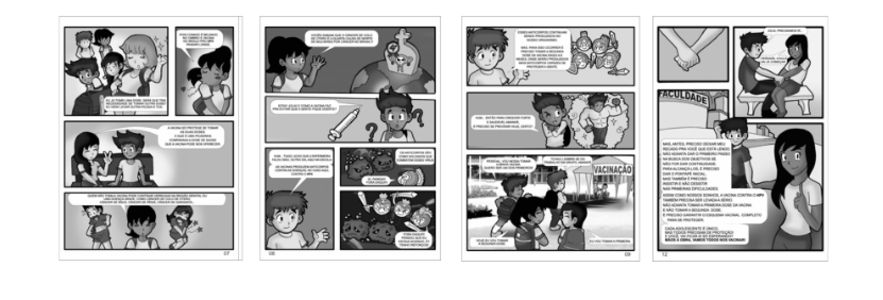
After validation with the judges, the comics were presented to adolescents aged 11-14 during the health education activities of the "Programa Saúde na Escola". The 12-page comic book was published with 2-sided printing, in coloured ink, with the title "KICK HPV OUT". The adolescents emphasised the teaching the story offered and praised the colours and the attractiveness of the drawings. Organisers then returned to the designer to make the changes suggested by the adolescents, which gave rise to the final version of the comic book.
The final version is composed of 6 characters with similar age range to the intended audience of the vaccine. The story addresses romance, dreams, football, the classroom, and future of adolescents - yet with having as its main focus the HPV vaccine. The closing pages include a reflection on the need to complete the entire vaccination scheme (not just a single dose) so that the vaccine can work effectively to support adolescent health.
Reflecting on the findings, the organisers note that "the literature points out that adolescents consider comics interesting, stimulating and somewhat different from what they are accustomed to reading..., since the learning can be achieved in a playful way. These educational technologies are well accepted by adolescents, since they present in a ludic way themes that are considered controversial and embarrassing, which provides a dialogic, participatory and reflexive relationship of various subjects involving myths and taboos..."
The organisers suggest that this educational material can be used both by health professionals, especially nurses, in the implementation of health education for adolescents, and by education professionals in classrooms, through workshops as an alternative to the traditional educational practices. Interested professionals can contact the authors of this research to request a version for printing. However, they emphasise the importance of updating educational technology, since scientific knowledge about the HPV vaccine is constantly being renewed.
Escola Anna Nery vol. 23 no. 3. https://doi.org/10.1590/2177-9465-ean-2019-0050
- Log in to post comments