










































Enforcement May Crowd Out Voluntary Support for COVID-19 Policies, Especially Where Trust in Government Is Weak and in a Liberal Society
University of Konstanz, and Thurgau Institute of Economics
"What is the appropriate role of enforcement and explicit incentives as opposed to people's sense of responsibility and voluntary compliance in combating the COVID-19 pandemic?"
To contain the spread of COVID-19, nations are faced with decisions about the extent to which policies should pursue voluntary as opposed to enforced compliance with measures such as mask-wearing and vaccination. Most anti-COVID-19 policies involve dilemmas where all-encompassing cooperation maximises the well-being of all citizens, but each individual has an incentive to free ride on others' cooperation. According to the literature, people expect enforcement to ensure higher cooperation in the population. On the other hand, enforcement and incentives can reduce intrinsic motivation to comply, a phenomenon termed "motivational crowding out". This paper explores the extent to which people in Germany agree to follow five measures - use of contact-tracing apps, vaccination, contact restrictions, limitations on travel, and mask-wearing - under two conditions: if the regulation is strongly advised by the government but remains voluntary, and if it is enforced. Based on the findings, the paper examines policy implications in the context of COVID-19 and beyond.
The online survey with 4,799 participants was conducted by the Cluster of Excellence "The Politics of Inequality" at the University of Konstanz from April 29 to May 8 2020, a time in Germany when stay-at-home orders were in place, national borders were closed, the wearing of masks had been compulsory for a few days, vaccine development was in progress, and contact-tracing apps were being discussed. In discussing the survey's contents/approach, the researcher notes: "To study the possibility that enforcement may crowd out civic values it is essential not to confound social motives for adopting a measure on the one hand with obedience to the law on the other. Therefore,...[the] questions ask about the respondent's attitude toward the measure and not whether a person would comply with a legally imposed and enforced measure."
The survey found that voluntary agreement to comply with/use the measure in question is always either higher than agreement under enforced measures (contact-tracing app, limiting contacts, and vaccination) or virtually identical (limiting travels and wearing masks). In fact, across all domains, roughly 50% to 70% of respondents strongly agree to adhere to voluntary anti-COVID-19 regulations; in contrast, for example, less than 20% totally agree to use the contact-tracing app under enforcement. Control aversion - that is, lower agreement under enforced than under voluntary conditions - occurs across all policies, with its frequency varying between 25% (traveling) and 40% (app).
In this study, control aversion was linked to the following covariates: (dis)trust, preexisting health issues, and experience under the coercive regime of East Germany. Namely:
- The less respondents trust the German government in general and, specifically, the government's information about the coronavirus outbreak, the more control-averse they are in all five domains. On the other hand, the more respondents believe that "most people" can be trusted, the more control-averse they are. This finding is consistent with the view that trust in others reflects a belief that strong communities and social capital are sufficiently effective in ensuring compliance.
- Control aversion is stronger among healthy respondents who do not belong to the COVID-19 risk group and thus have a low risk of a severe outcome in case of an infection.
- The more respondents were exposed to the communist regime of East Germany (e.g., having spent childhood in a federal state belonging to East Germany and its interaction with age), the less control-averse they are. For example, those brought up in East Germany prior to 1990 were subject to ubiquitous surveillance, compulsory vaccination, and restrictions on movements. Such people are less averse to enforced anti-COVID-19 measures.
What are potential mechanisms behind crowding out in this study? First, enforcement may signal the government's belief that people cannot be trusted to be socially responsible, which may prompt negative responses to the policy. Second, enforcement might relieve the citizen of any need to engage in moral deliberation and thus crowd out moral convictions. Third, enforcement may compromise personal autonomy.
The researcher notes that enforcement might create less resistance in countries with coercive regimes, where trust in government is high, or among people in places (e.g., retirement communities) with a higher risk of mortality in case of an infection. Instead of suggesting that enforcement will be ineffective in other settings, the researcher indicates that the results invite policymakers to attempt to mitigate crowding out. Furthermore, some of the determinants discussed in the study are themselves subject to evolution. For example, political decisions are likely to affect trust in the veracity of the government's information about the pandemic. The study's data "support the potential power of such trustworthy information channels to increase compliance and reduce adverse effects of enforcement."
Policy implications include:
- There are three policies for which a good case can be made in favour of enforcement: limiting contacts (especially large gatherings), wearing masks, and restricting travel. These measures share these two characteristics: The measures are observable to others, and they require repeated cooperation. In the case of wearing masks, the survey suggests that noncompliance to a voluntary mask-wearing policy would be substantial; along with the feasibility of enforcement and only moderate control aversion, this finding indicates that enforcement would be a valuable approach.
- In contrast, in the case of a contract-tracing app, 40% respond negatively to enforcement. Such heavy opposition evoked by a policy that is difficult to impose (e.g., people could simply leave their mobile phone at home) speaks against its enforced implementation.
- With respect to vaccination, the data support voluntary regimes. In the survey, two-thirds of Germans say they would agree to get vaccinated voluntarily, whereas enforcement would evoke considerable opposition. Given the findings on trust, citizens' compliance will depend on their trust not only in their government but especially in the particular vaccines; therefore, informing the public transparently will be essential.
In conclusion: "Effective states govern by some combination of enforcement and voluntary compliance....The results of this study suggest that interventions to combat COVID-19, future pandemics, and potentially also other societal challenges such as climate change vary in the extent to which enforcement may encounter opposition that would not be provoked by appeals to voluntary participation."
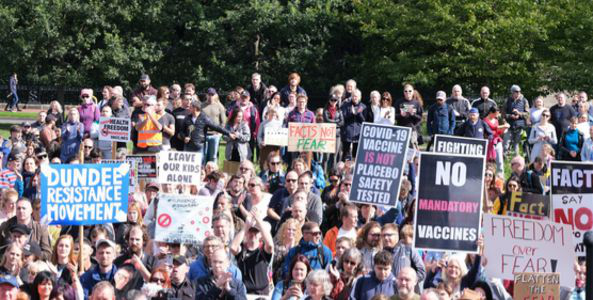
PNAS 2021 Vol. 118 No. 1 e2016385118 - sourced from an email from Katrin Schmelz to The Communication Initiative on June 25 2021; and email from Katrin Schmelz to The Communication Initiative on July 13 2021. Image credit: Michal Beim via Wikimedia - licensed under the Creative Commons - Share Alike 4.0 International license.
- Log in to post comments