










































Development of Personas to Communicate Narrative-Based Information About the HPV Vaccine on Twitter
Drexel University (Massey, Chiang, Rose, Murray, Rockett, Togo, Klassen); State University of New York, or SUNY (Manganello); Thomas Jefferson University (Leader)
"With increasing usage of social media for health information among parents, it is important for researchers to consider marketing and design thinking to create health communication messages that resonate with audiences."
The use of stories is a strategy in persuasive communication to reach audiences of diverse backgrounds and literacy levels. In the case of vaccine science and communication, sharing stories, such as through multimedia and interpersonal conversation, has the potential to communicate science to non-expert audiences, to address concerns that are rooted in emotions, and to foster vaccine confidence. Often used in human-centred design (HCD) approaches, personas are based on real-life typologies of people that can be used to convey health messages through relatable narrative storylines. This article describes the development of personas to deliver narrative-focused health education for parents on Twitter, with the goal of increasing uptake of human papillomavirus (HPV) vaccination among adolescents in the United States (US).
The researchers used a mixed-method approach to develop personas that represented both a breadth and depth of HPV vaccine understanding and experiences among parents who are still deciding or hesitant about the HPV vaccine. The approach was informed by studies that had used HCD and involved participation by a parent advisory board (PAB). In May 2020, the researchers conducted virtual focus groups (n = 6) with parents (n = 48) of adolescents ages 9-14 to gain a deeper understanding of their experiences and conversations (or lack thereof) with other parents about the HPV vaccine, and if hearing from other parents about their experiences was important to them when deciding to vaccinate. For quantitative data, the researchers examined the 2018 National Immunization Survey (NIS)-Teen to identify parental vaccine concerns at a population level, and they used an application programming interface (API) to collect public posts from Twitter and Instagram that included relevant hashtags such as #hpvvaccine.
Sample findings from this formative research process:
- Parents in focus groups stated they wanted to hear about experiences from other parents but did not know how to start this conversation. Parents thought hearing about other parent experiences would not be sufficient to help strengthen their confidence, but would be a necessary complement to the science and evidence supporting the HPV vaccine.
- NIS-Teen data revealed that among parents whose adolescents had not started or started but not completed the HPV vaccination in 2018, 30% were not likely at all, 15% were not too likely, and 9% were unsure about vaccinating their adolescents in the next 12 months. Compared to "not too likely" parents, "not likely at all" parents had greater concerns for HPV vaccine safety, had not received a physician recommendation, and lacked knowledge about the vaccine. Differences in mothers' versus fathers' reasoning behind the decision indicate that tailored HPV vaccination communication should be considered.
- Social media data demonstrated that positive sentiment about the HPV vaccine was more prevalent than negative. Misinformation was to found to take many forms, but at the same time demonstrates patterns and consistent elements.
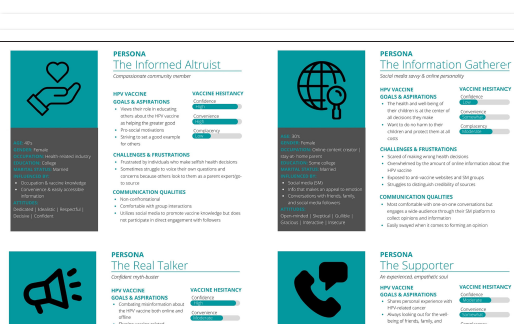
These data sources were used to identify and develop key characteristics for personas to reflect a range of parents and their diverse understandings and experiences related to HPV vaccination. The personas feature unique characteristics, including demographics, goals and aspirations, challenges and frustrations, communication needs, and the elements of confidence, convenience, and complacency that make up the 3C model. Specifically, the four personas that emerged were, in brief:
- The Informed Altruist, a college-educated parent who promotes the collective good of HPV vaccination and has pro-social motivations in all aspects of life. This personal ranks "high" in both confidence and convenience and ranks "low" in complacency.
- The Real Talker, a curt but personable parent who is driven to inform, educate, and myth-bust when it comes to relaying information about the HPV vaccine to friends and family. This personal ranks "high" in confidence, "moderate" in convenience, and "low" in complacency.
- The Information Gatherer, an open-minded yet cautious parent who relies on his or her online communities and network to learn about the HPV vaccine and help inform HPV-vaccination-related decision making. This persona ranks "low" in confidence, "somewhat" in convenience, and "moderate" in complacency.
- The Supporter, a kind, encouraging, and empathetic parent and grandparent who is known within the community to be the "go-to" person for support, as he or she is well-attuned to the interests and well-being of others. This persona ranks "moderate" in confidence, "somewhat" in convenience, and "low" in complacency.
While this study does not describe message or narrative development, this is the next natural step in the process: using personas to guide and inform ethical message creation on social media. Narratives surrounding the personas must not only be ethical but engaging enough to capture the attention of social media users. It is also important to consider how personas can be used to deliver messages that are both culturally competent and health literate to further ensure acceptance and understanding of the information being provided.
With those considerations in mind, each persona will be the foundation for a character, or person, that discusses the HPV vaccine based on the persona's experiences and life motivations. The characters will interact with one another and be used to create a story; however, this is not required: Personas can also be used to create messages that are standalone that are meant to reach people who think or act in a similar way.
The researchers note that, while these personas were developed specifically for an intervention on Twitter, this approach and actual personas could be (and should be) adapted or applied to various digital environments and social media platforms. Because the methodology is flexibly designed to address the diverse preferences and needs of parents for HPV vaccine information, additional personas may also be added for specific parent populations. Furthermore, this approach can be applied to emerging health needs.
In conclusion: "combining the use of personas with narratives and storytelling can provide a meaningful and memorable way to organize and communicate health information at the population-level while at the same time relating to individual experiences."
Frontiers in Digital Health, 04 August 2021 | https://doi.org/10.3389/fdgth.2021.682639
- Log in to post comments