










































Human Papillomavirus (HPV) Vaccine Introduction in Sikkim State: Best Practices from the First Statewide Multiple-Age Cohort HPV Vaccine Introduction in India - 2018-2019
World Health Organization (WHO) Country Office for India (Ahmed, VanderEnde, Harvey, Bhatnagar, Kaur, Roy, Singh); Government of Sikkim (Denzongpa); Government of India (Haldar); United States Centers for Disease Control and Prevention, or CDC (Loharikar)
"Sikkim State employed widespread and comprehensive efforts for advocacy, communication, and social mobilization to build community awareness, ensure high visibility of the campaign, and build public confidence in the HPV vaccine."
Cervical cancer cases represent 10% of the total number of cancer cases among women in Sikkim state, India. To address this problem, the Government of Sikkim introduced human papillomavirus (HPV) vaccination for all girls aged 9-13 years via a school-based vaccination delivery strategy, with age-eligible girls not attending school encouraged to be vaccinated at schools or health facilities using community linkages for social mobilisation. This article describes HPV vaccine introduction and implementation in Sikkim state and shares collective findings from a post-introduction evaluation.
In 2019, concurrent with the second-dose campaign, the researchers interviewed 279 key stakeholders (health and education officials, school personnel, health workers, community leaders, and age-eligible girls), reviewed planning documents, and conducted 29 observations of cold chain sites in two purposefully-sampled community areas in each of the four districts of Sikkim.
Based on reported administrative data, Sikkim achieved more than 95% coverage for the first HPV vaccine dose and more than 90% coverage for the second dose in each district via two campaigns; no severe adverse events were reported. The evaluation team found high acceptance and demand for the HPV vaccine among stakeholders across health and education sectors at all levels. Among 24 health workers interviewed, 22 (92%) reported that they did not encounter vaccine hesitancy or refusal from caregivers or girls. Of the 199 girls interviewed, 157 (79%) correctly identified the benefits of the HPV vaccine.
Synthesised findings on HPV vaccine programme decision-making, planning, and implementation are described in the article. Communication-related highlights include:
- The state health department led the HPV vaccine introduction planning, in partnership with the World Health Organization (WHO)-India, and developed an operational plan that included, for example, community social mobilisation plans. Recently developed micro-planning tools and social mobilisation materials were distributed to districts and local levels before the vaccination launch.
- The education departments at state and district-levels supported schools to identify nodal (focal) teachers to lead preparations for HPV vaccine delivery at their school. WhatsApp communications, HPV vaccine coordination group conference calls, and routine task force meetings at district and community block levels were among the mechanisms used to coordinate with, and within, the education department(s).
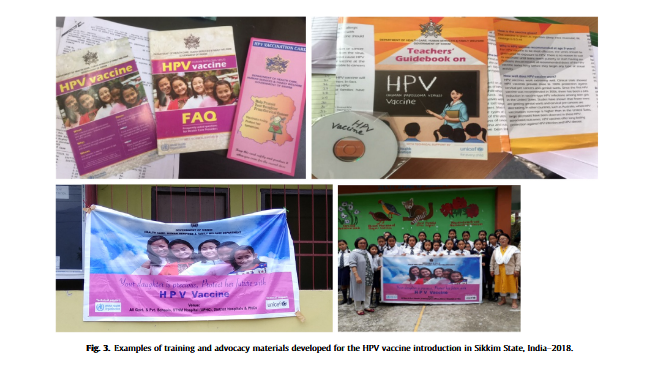
- Training materials (e.g., operational guidelines, frequently asked questions (FAQs) for healthcare workers, teachers' handbooks, and leaflets for community health workers) were developed through a partnership between the state immunisation programme and WHO-India. All four districts in Sikkim conducted a total of 100 training workshops at district and community levels for over 3,000 stakeholders (e.g., public health, education, political leaders, non-governmental organisations (NGOs), and religious leaders), including cascaded trainings for health workers, nodal teachers, and community health workers. Trainings consisted of slide presentations, print materials, and discussions. Following the trainings, all schools conducted parent-teacher meetings and community sensitisation meetings together with health workers to raise awareness about the HPV vaccination campaign and address any questions.
- Communication materials (teacher guidebooks, FAQs, leaflets, banners, and posters) were developed by the state government with support from development partners; all materials were field-tested. Materials were visibly displayed in all areas visited during the post-introduction evaluation.
- Advocacy efforts were undertaken to sensitise technical stakeholders, such as the government, state and district officials, private paediatricians, local political leaders, and community leaders, using one-on-one meetings, workshops, and cascade trainings. This approach was designed to ensure uniformity of messages disseminated among key stakeholders, who went on to act as advocates for the HPV vaccine in their communities.
- Media engagement was part of the plan, with state public health officials holding sensitisation workshops for representatives of major radio and print media outlets. A state-level crisis communication spokesperson was designated to respond to any media inquiry during the HPV vaccination campaigns. Also, there was extensive media coverage of district- and state-level launching ceremonies, which featured the presence of prominent political and community influencers, including the State Chief Minister.
- A promotional documentary video about the HPV vaccine introduction in Sikkim was developed by the state government, following the first HPV vaccination round. This video aimed to build confidence among community members and showcase the initiative.
- A state Government plan for proactive response to misinformation, rumours, or community concerns about the HPV vaccine that arose before and during the campaign was developed before starting the vaccination campaign.
- At the local level, school rallies, drawing competitions, and mikings (community announcements by megaphone or microphone) were conducted in the local language to disseminate campaign messages to the community.
- To track girls who moved after the first dose, health workers and public health officials communicated through social media channels and made repeated phone calls to caregivers. Health workers maintained lists of girls who missed first or second dose HPV vaccination at the school and mobilised them to go to the nearest health facility.
- The evaluation team noted a few gaps in communication planning. Districts and health centres did not have a structured crisis communication plan, and no tailored messaging was provided to the health workers or school staff to counter misinformation, rumours, or lack of vaccine acceptance. Furthermore, caregiver leaflets were only available in English; community members suggested that the back of the leaflet be translated to Nepali for future HPV vaccination campaigns.
Thus, this evaluation found that the first year of HPV vaccination in Sikkim was successful due to "strong political leadership and commitment, mandatory school enrollment policy for children [under] 14 years of age, the exceptional collaboration between health and education sectors at all levels, ownership of the program by the education department, and robust advocacy and social mobilization strategies."
Going forward, Sikkim plans to continue offering the HPV vaccine to 9-year-old girls by designating two months per year when the vaccine will be delivered in schools. "Timely vaccine procurement, a continued partnership between health and education, refresher trainings for health workers and school personnel, and seamless community social mobilization will be critical for program sustainability and continued high HPV vaccine coverage."
The researchers conclude by suggesting that Sikkim's introduction of the HPV vaccine to multiple-age cohorts of girls via school-based vaccination demonstrates a model that could be replicated in other regions in India or similar low- and middle-income country (LMIC) settings.
- Log in to post comments