










































Identifying False Human Papillomavirus (HPV) Vaccine Information and Corresponding Risk Perceptions From Twitter: Advanced Predictive Models
University of Illinois at Urbana-Champaign (Tomaszewski, Morales, Chin); Virginia Polytechnic Institute and State University (Lourentzou); University of Illinois at Chicago (Caskey, Liu, Schwartz)
"...showed the feasibility of discerning misinformation from factual information regarding HPV vaccines using the text of tweets..."
Social media has become an important information source for people to exchange vaccine-related opinions and form their attitudes toward vaccines. Vaccine hesitancy related to human papillomavirus (HPV) vaccination is in part due to false information about HPV vaccines on social media. The goal of the study is to develop a systematic and generalisable approach to identifying these types of messages before they go viral and contribute to the existing problem of low HPV vaccine uptake.
Based on a corpus related to HPV vaccines with tweets published from December 2013 until December 2017, the study used machine learning and natural language processing to develop a series of classification models and causality mining methods to identify and examine true and false HPV-vaccine-related information on Twitter. These highly technical methods are detailed in the article.
In short, the researchers found that a convolutional neural network (CNN) model outperformed all other models in identifying tweets containing false HPV-vaccine-related information. They also developed bottom-up, unsupervised causality mining models (where the models work on their own to discover patterns and information that was previously undetected) to identify HPV vaccine candidate effects for capturing risk perceptions of HPV vaccines. For example, for the predicted false tweets, one cluster contained terms relating to infertility misconceptions of the HPV vaccine, such as "premature ovarian failure" and "early menopause on young girls".
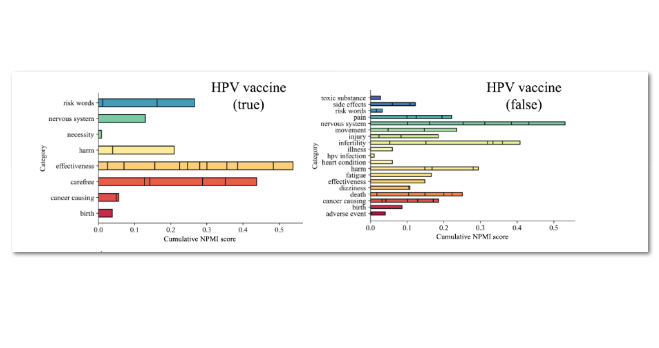
To examine the risk perceptions pertaining to HPV vaccines, the researchers leveraged techniques called "false information classifier" and "effect ranker" to categorise perceptions around the costs and benefits of HPV vaccines. In general, people discussed the benefits or low risk of harms in the true HPV vaccine tweets and various adverse events in the false HPV vaccine tweets. The main effects associated with the HPV vaccines in the true HPV vaccine tweets were about the prevention of HPV infection-related cancer and the denial of risk of increased unprotected sexual behaviour of the vaccinated teens. The main effects associated with the HPV vaccines in the false HPV vaccine tweets regarded infertility-related conditions, child developmental disorder, toxic ingredients in the HPV vaccines, and death. The researchers explain, "the findings from causality mining aided us in identifying the major concerns related to HPV vaccines, whose solutions could then be prioritized."
Furthermore, false information contained mostly loss-framed messages focusing on the potential risk of vaccines covering a variety of topics using more diverse vocabulary, while true information contained both gain- and loss-framed messages focusing on the effectiveness of vaccines covering fewer topics using relatively limited vocabulary.
In conclusion, this study "has demonstrated a systematic, automatic approach to developing computational models for identifying false HPV-vaccine-related information and its associated effects on social media. This approach could be generalized to other social media health information and provide insights into estimating the potential effects of a given health topic."
Journal of Medical Internet Research 2021;23(9):e30451. doi:10.2196/30451.
- Log in to post comments