
























Health action with informed and engaged societies
After nearly 28 years, The Communication Initiative (The CI) Global is entering a new chapter. Following a period of transition, the global website has been transferred to the University of the Witwatersrand (Wits) in South Africa, where it will be administered by the Social and Behaviour Change Communication Division. Wits' commitment to social change and justice makes it a trusted steward for The CI's legacy and future.
 
Co-founder Victoria Martin is pleased to see this work continue under Wits' leadership. Victoria knows that co-founder Warren Feek (1953–2024) would have felt deep pride in The CI Global's Africa-led direction.
 
We honour the team and partners who sustained The CI for decades. Meanwhile, La Iniciativa de Comunicación (CILA) continues independently at cila.comminitcila.com and is linked with The CI Global site.
Time to read
less than
1 minute
Read so far

Community Participation - Reduced Childhood Mortality
0 comments

Strategy researched

Community participation and employment of village health workers to support home-based child care (HBCC) in an impoverished area

Impact achieved

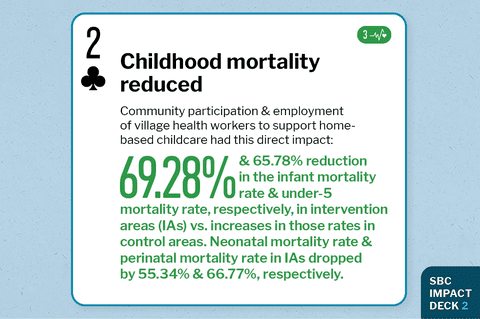
69.28% and 65.78% reduction in the infant mortality rate (IMR) and under-5 mortality rate (U5MR), respectively, in intervention areas (IAs) vs. increases in those rates in control areas. Neonatal mortality rate (NMR) and perinatal mortality rate (PMR) in IAs showed reductions from 50.76 to 22.67 (by 55.34%) and from 75.06 to 24.94 (by 66.77%) respectively. The impact was sustained for 10 years following the trial, compared with the standard of care clusters.

Country of study

India

Research methodology

Cluster RCT

Journal

BMJ Global Health; 2022

Journal paper title and link

Effect of home-based childcare on childhood mortality in rural Maharashtra, India: a cluster randomised controlled trial

Excerpt from Abstract

"The IMR and U5MR in IA were reduced from 106.60 and 147.21 to 32.75 and 50.38 (reduction by 69.28% and 65.78%, respectively) compared with increases in CA [control areas/clusters] from 67.67 and 105.3 to 86.83 and 122.8, respectively, from baseline to end of intervention. NMR and PMR in IA [intervention clusters/areas] showed reductions from 50.76 to 22.67 (by 55.34%) and from 75.06 to 24.94 (by 66.77%) respectively. These gains extended to villages in the service and replication phases."