










































The Evaluation of Guidance Counselor Training for Vibes
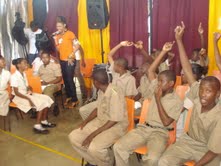
Carried out by Family Health International (FHI) and Hope Enterprises, Inc., this evaluation explores the "Vibes" methodology as introduced in September 2001 to 108 guidance counsellors working for the Jamaica Ministry of Education, Youth and Culture (MOEYC).
FHI first partnered with the Jamaica-based Ashe Caribbean Performing Arts Ensemble and Academy (Ashe) in 1995, providing funding and technical assistance to develop "Preparing for the Vibes in the World of Sexuality." The songs and dances show the challenges and problems that arise when a group of teenagers on the brink of becoming sexually active are taken on a "journey" into the world of sexuality. The United States Agency for International Development (USAID)/Jamaica in 1998 supported Ashe, the Jamaican Ministry of Education, and FHI in developing a health and family life education curriculum and training guidance counsellors, school nurses, teachers, and youth group leaders to educate young people about reproductive health (RH). FHI describes the "Vibes" methodology, also known as the Excite and Involve Young People (EIC) Model, as "an innovative and creative method of teaching, where education comes alive, where young people dance out myths related to sex and sexuality, act out stereotypes, and sing about preventing unintended pregnancy and sexually transmitted infections (STIs), including HIV....For the EIC Model to be effective, the guidance counselor, teacher, or school nurse must trained to be a successful facilitator. The Vibes methodology helps to desensitize facilitators to issues related to sex and sexuality..."
FHI conducted a 2-phase evaluation of this training from 2001 through 2003. The focus of Phase 1 (conducted during academic year 2001-2002) was on the perceptions of the newly trained guidance counsellors of their experiences implementing the methodology. Also during this first phase, formative research was done with 12- to 14-year-olds for the development of a self-esteem inventory to be used in Phase 2. Eleven guidance counsellors were chosen from the original 108 to participate in Phase 2, which was conducted during academic year 2002-2003. ) These counsellors agreed to integrate the use of the Vibes methodology for a core set of Health and Family Life Education (HFLE) curriculum topics. Students taught the "integrated" curriculum were compared to a matched set of schools/classes being taught the "standard" curriculum. A school-based survey was administered in December 2002 (pre-test) and again in May 2003 (post-test). Focus group discussions (FGDs) were held with "Vibes" and "control" guidance counsellors at the end of the exposure period.
Survey results demonstrated differences between what was being taught using the integrated and standard curricula and how it was being taught.
- The following topics were recalled being taught by a higher percentage of students in the integrated curriculum classes compared to the standard curriculum classes: abstinence, consequences of pregnancy, costs of having a baby, gender equality, talking to parents about sex, rape, media, being happy being who I am, why people have sex, being prepared for sex, stages between attraction and intercourse, talking to dates about having sex, and having a positive attitude.
- The following activities were reported by a greater percentage of students in the integrated curriculum classrooms compared to students in the standard curriculum classrooms: making a commitment to abstain/reclaim virginity, making a commitment to protect oneself when having sex, participating in games/energisers, skits, singing, dancing, role-playing, seeing condoms, watching videos, listening to songs or music, drawing, using a workbook or keeping a journal, doing homework assignments, singing "I love myself," and talking in large groups.
- Increases in RH/HIV/AIDS knowledge increased from pre-test to post-test, but there was no effect of type for curriculum. No differences were found: i) between curricula; ii) over time in sexual attitudes; or iii) in the percentages of students who had ever had sex.
During FGDs at the end of the 2002-2003 academic year, guidance counsellors who had taught the integrated curriculum described the Vibes methodology as an interesting, informative, and creative way for children to learn. They noted that the methodology encourages more class participation and gives students confidence to discuss topics related to sex and RH that they were otherwise too shy or too scared to talk about with adults or peers. Guidance counsellors described changes they could see in classroom behaviour that they attributed to the trust and self- control exercises in the Vibes manual. Because of these exercises, they felt that children were more likely to stop and think before acting aggressively. They also felt that the role playing exercises were especially powerful behaviour change tools. In one exercise, boys and girls are asked to reverse gender roles; the guidance counsellors reported a change in how boys treated girls following this role play, including noticeably less use of derogatory language and inappropriate touching.
While the guidance counsellors believed that the advantages of the Vibes methodology outweighed the standard HFLE approach, they felt it was correct to integrate Vibes into the standard curriculum because there were some topics not covered in the Vibes manual that are required by the MOEYC. No changes in knowledge, sexual attitudes, or behaviour could be attributed to the integration of the Vibes methodology into the HFLE curriculum; however, it is likely that the exposure time was too short to detect any differences between the two teaching methods. The evaluators conclude that "[c]learly the guidance counselors themselves were favorably impressed with the Vibes methodology and reported changes in their classrooms in behaviors that were not measured through our survey methodology."
Email from Conroy B. Wilson to Soul Beat Africa on March 10 2010; and Ashe Performing Arts Company website and FHI website, both accessed April 6 2010.
Comments

history of guidance and counselling
there is nothing in the information given about that gives even a brief history of counselling in jamaica
- Log in to post comments