










































Closing Equity Gaps in Immunisation: Relevance of Human Rights-based and Behavioural Economics Approaches
Equity Reference Group for Immunisation (ERG)
"Community mobilisation is where the HRBA intersects with behavioural economics: working directly with marginalised communities and incentivising them towards health-seeking behaviour restores their right to health with tools drawn from a behavioural economic framework."
The United Nations Children's Fund (UNICEF) and the Bill and Melinda Gates Foundation have convened a high-level Equity Reference Group for Immunisation (ERG) to identify new approaches and best practices to accelerate progress on equity in immunisation. This ERG scoping review examines literature on human-rights-based approaches (HRBA) and behavioural economics approaches, concentrating on ways in which these have helped close equity gaps in health outcomes and other social protections.
The ERG begins by summarising the value added of each approach, followed by specific areas and case studies in which the approaches have helped close equity gaps. In brief:
- Drawing on inalienable rights outlined in international conventions, an HRBA ensures that every individual, regardless of location, immigration status, gender, or income level, is afforded the same opportunity to live a healthy and fulfilled life. When the right to health is made explicit in national legislation and policy, advocacy groups are able to demand an extension of services and resources to under-served areas. With strategies such as robust capacity building, including facilitated discussions, micro-lending, and participatory planning, disadvantaged communities can themselves become effective advocates for long-term social change. Key case studies and successes outlined include:
- Promoting pro-poor treatment for HIV/AIDS in Southern Africa;
- Overcoming gender gaps in maternal and child health in Nepal;
- Facilitating multi-sector approaches to equity in health (e.g., a community mobilisation initiative to reduce incidents of tuberculosis in Tanzania and Peru); and
- Engaging the private sector in the fight for health equity.
- In examining the social forces behind decisions to seek out health care, behavioural economics identifies specific mechanisms to overcome various barriers to changing health-seeking behaviours. This approach recognises that health decisions are influenced by factors such as strong social support networks, so it is critical to identify the most effective interventions in promoting behaviour change in socially challenging settings (e.g., informal settlements in urban areas). Key case studies and successes outlined include:
- Leveraging patient discernment in choosing high-quality healthcare providers;
- Improving presentation of behaviour change information (e.g., by engaging multiple learning modalities);
- Providing conditional cash and reward transfers; and
- Building social networks to promote behaviour change (e.g., by training community health workers and "peer promoters" to teach health-seeking behaviours).
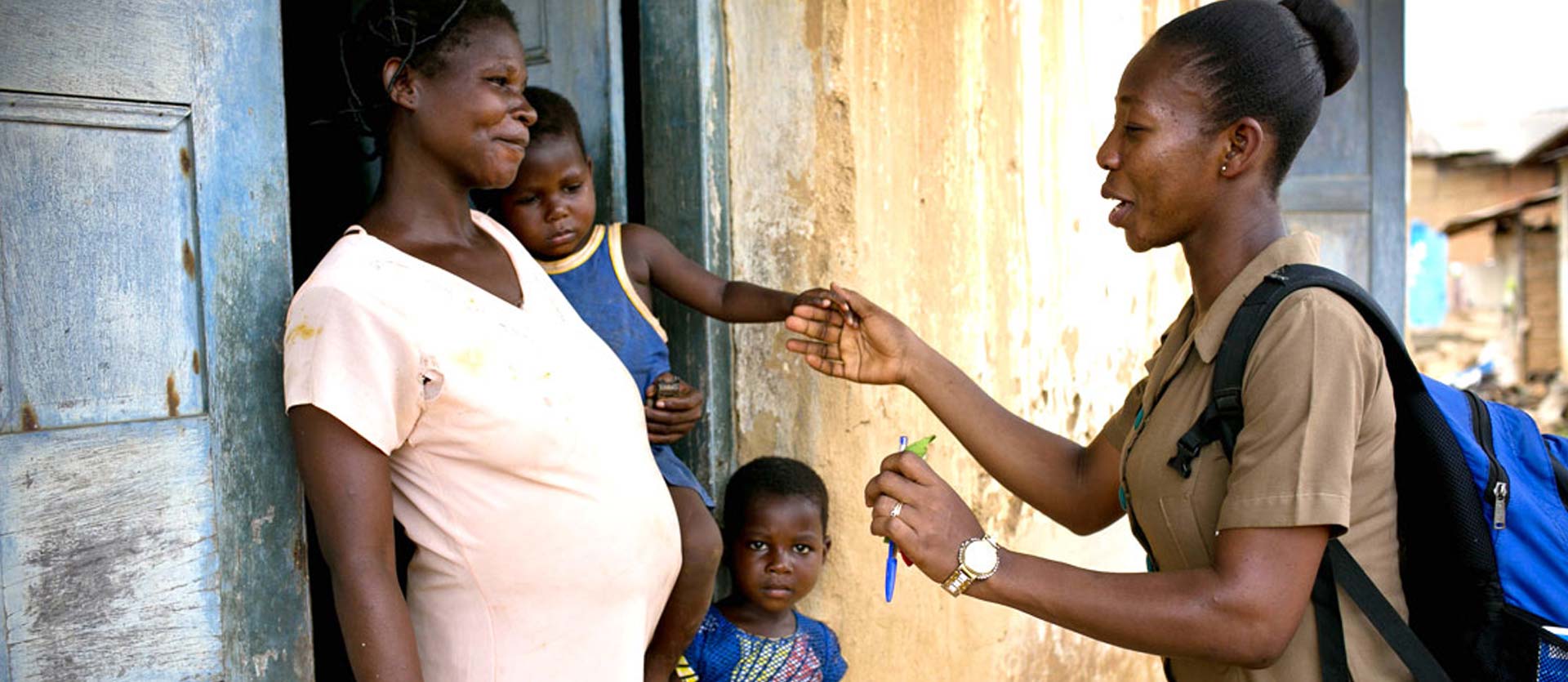
The paper concludes with a section on the particular relevance of the literature to issues in immunisation. For instance, a range of behaviour change interventions have been tested to improve immunisation coverage in neglected areas, such as various forms of reminders (stickers, immunisation cards, text messaging (SMS), voice calls), house-to-house visitations from health workers, and education sessions at facilities and in communities. The ERG finds that evidence demonstrates that "the most effective tool in changing behaviour towards improved immunisation coverage is community-led information sessions and discussion. It is critical that the sessions allow for vigorous information exchange with caregivers..." This reflects the HRBA emphasis on strategically engaging and mobilising communities in improving health-seeking behaviours.
ERG website, April 23 2019. Image credit: Kate Holt/Jhpiego
- Log in to post comments